

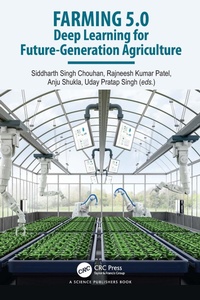
Farming 5.0
Deep Learning for Future-Generation Agriculture
Will be published approx. on 14. July 2026
452 pages
978-1-040-98413-0 (ISBN)
Description

Agriculture is going through a technology renaissance with deep learning leading the way. This volume addresses how advanced AI methods are transforming the future of farming, food systems, and environmental sustainability. It is forward-looking guide to integrating smart systems in agriculture across all scales - from soil to satellite. The volume comprises contributions from international leaders in AI, agronomy, genomics, remote sensing, and robotics. It addresses a broad array of emerging topics, such as autonomous farming systems, UAVs, and deep reinforcement learning for field operations; computer vision and hybrid models for crop, weed, and livestock detection; and advanced edge and federated learning approaches to real-time, privacy-conscious decision-making. It also discusses explainable AI for transparent agricultural models, deep learning in crop genomics and trait prediction, biodiversity monitoring, and time-series forecasting of pests and climate stress. Generative AI for generating synthetic agricultural data and simulating digital farms with AR/VR and digital twins are also covered. With a focus on climate-smart agriculture, the book addresses the role that deep learning can play in promoting resilient, adaptive, and sustainable food systems under climate change and food insecurity globally. It concludes with an examination of the ethical, regulatory, and policy issues, presenting a vision for inclusive, human-centric AI in agriculture.
Key Features:
Integrates autonomous agriculture, explainable artificial intelligence, edge/federated learning, genomics of crops, and biodiversity monitoring.
Highlights climate-resilient agriculture and future-proof simulations.
Incorporates real-world applications, case studies, and multidisciplinary viewpoints.
Connects AI research, policy, and ethics with agricultural adoption.
Key Features:
Integrates autonomous agriculture, explainable artificial intelligence, edge/federated learning, genomics of crops, and biodiversity monitoring.
Highlights climate-resilient agriculture and future-proof simulations.
Incorporates real-world applications, case studies, and multidisciplinary viewpoints.
Connects AI research, policy, and ethics with agricultural adoption.
More details
Language
English
Place of publication
London
United Kingdom
Publishing group
Taylor & Francis Ltd
Target group
College/higher education
Professional and scholarly
Product notice
Reflowable
Illustrations
54 Tables, black and white; 10 Line drawings, color; 23 Line drawings, black and white; 15 Halftones, color; 6 Halftones, black and white; 25 Illustrations, color; 29 Illustrations, black and white
File size
28,71 MB
ISBN-13
978-1-040-98413-0 (9781040984130)
Copyright in bibliographic data and cover images is held by Nielsen Book Services Limited or by the publishers or by their respective licensors: all rights reserved.
Schweitzer Classification
Other editions
Additional editions
Anju Shukla | Rajneesh Kumar Patel | Siddharth Singh Chouhan
Farming 5.0
Deep Learning for Future-Generation Agriculture
Book
approx. 07/2026
1st Edition
Taylor & Francis
€129.50
Not yet published
Persons
Dr. Siddharth Singh Chouhan is currently working as a Senior Assistant Professor Grade 2 in the School of Computing Science and Engineering, VIT Bhopal University, Sehore, India. He has a B.Tech. (with Honours) 2010, an MTech (with Honours), 2013 in Computer Science and Engineering from RGPV University, Bhopal, India, and a PhD in Computer Science and Engineering from Shri Mata Vaishno Devi University Katra, Jammu and Kashmir, India. He is a Post Doctorate from the University of Malta. His area of interest includes Artificial Intelligence, Computer Vision, Drone Technology, and Precision Agriculture. He had authored several research papers published in reputed journals and conferences.
Dr. Rajneesh Kumar Patel is an Assistant Professor in the School of Computing Science and Engineering, VIT Bhopal University, Sehore, India. He holds a B.E. and an M.Tech. in Electronics and Communication Engineering from RGPV University, Bhopal, India, and a PhD in Electronics and Communication Engineering from Maulana Azad National Institute of Technology, Bhopal, India. His areas of interest include developing image processing, Computer vision, Machine learning/Deep Learning, and Precision Agriculture. He has authored several research papers in many reputed journals and conferences.
Dr. Anju Shukla is an Assistant Professor in the School of Computing Science and Engineering at VIT Bhopal University, Sehore, India. She holds a Doctorate from Jaypee University of Engineering and Technology, Guna, and an MTech in Computer Engineering from Shobhit University, Meerut. Dr. Shukla has successfully guided many undergraduate (UG) students in Computer Science for their academic projects. She has presented and published research papers in international journals (including SCI- and Scopus-indexed journals) as well as in international conferences. She has also attended conferences, workshops, Faculty Development Programs (FDPs), and seminars. Dr. Shukla is an active researcher and has published articles in SCI-indexed journals. Her areas of interest include Cloud Computing, Distributed Computing, and Artificial Intelligence.
Dr. Uday Pratap Singh is a Professor in the Department of Mathematics, Central University of Jammu, Jammu, India. He completed his BSc and MSc (Mathematics and Statistics) from Dr. R.M.L. (Avadh) University, Ayodhya, India, and another MSc (Mathematics and Computing) from Indian Institute of Technology, Guwahati, India, and a PhD in Computer Science from Barkatullah University, Bhopal. His areas of interest include Soft Computing, Nonlinear Systems, and Image Processing. He had authored several research papers in the many reputed journals and conferences. He is a life member of Soft Computing Research Society (SCRC), Barata Ganita Parishad, Computer Society of India and Member of IEEE and AMS.
Dr. Rajneesh Kumar Patel is an Assistant Professor in the School of Computing Science and Engineering, VIT Bhopal University, Sehore, India. He holds a B.E. and an M.Tech. in Electronics and Communication Engineering from RGPV University, Bhopal, India, and a PhD in Electronics and Communication Engineering from Maulana Azad National Institute of Technology, Bhopal, India. His areas of interest include developing image processing, Computer vision, Machine learning/Deep Learning, and Precision Agriculture. He has authored several research papers in many reputed journals and conferences.
Dr. Anju Shukla is an Assistant Professor in the School of Computing Science and Engineering at VIT Bhopal University, Sehore, India. She holds a Doctorate from Jaypee University of Engineering and Technology, Guna, and an MTech in Computer Engineering from Shobhit University, Meerut. Dr. Shukla has successfully guided many undergraduate (UG) students in Computer Science for their academic projects. She has presented and published research papers in international journals (including SCI- and Scopus-indexed journals) as well as in international conferences. She has also attended conferences, workshops, Faculty Development Programs (FDPs), and seminars. Dr. Shukla is an active researcher and has published articles in SCI-indexed journals. Her areas of interest include Cloud Computing, Distributed Computing, and Artificial Intelligence.
Dr. Uday Pratap Singh is a Professor in the Department of Mathematics, Central University of Jammu, Jammu, India. He completed his BSc and MSc (Mathematics and Statistics) from Dr. R.M.L. (Avadh) University, Ayodhya, India, and another MSc (Mathematics and Computing) from Indian Institute of Technology, Guwahati, India, and a PhD in Computer Science from Barkatullah University, Bhopal. His areas of interest include Soft Computing, Nonlinear Systems, and Image Processing. He had authored several research papers in the many reputed journals and conferences. He is a life member of Soft Computing Research Society (SCRC), Barata Ganita Parishad, Computer Society of India and Member of IEEE and AMS.
Content
Preface. 1. Seeding the Future: Unveiling the AgriTech Revolution. 2. Introduction to Deep Learning in Agriculture. 3. Enhancing Soil Productivity and Health and Crop Yield with Artificial Intelligence. 4. Deep Learning for Satellite, UAV, and Hyperspectral Crop Monitoring. 5. Edge AI and On-Device Deep Learning Models for In-Field Diagnostics. 6. Interpretable Crop Yield Forecasting Under Climate Change Using Temporal Fusion Transformers. 7. AI4Farms: A Federated Deep Learning Framework for Climate-Resilient Agriculture in Coastal and Marginal Communities. 8. Deep Learning in Agriculture: Applications, Challenges, and Future Directions. 9. Computer Vision for Livestock and Agroforestry Monitoring. 10. Real-Time Recognition of Fruits, Pests, and Weeds Using Integrated Deep Learning Methods. 11. Deep Learning Applications for Agriculture: An Introduction. 12. A Comparative Analysis of 4G and 5G IoT Sensor Networks for Smart Agriculture: Performance, Efficiency, and Future Prospects. 13. Dynamic Detection of Fruit, Pest, and Weed Using Hybrid DL Models. 14. Integrating Deep Learning with loT, Blockchain, and Robotics in Agri-systems. 15. The Unseen Harvest: Ethical and Policy Perspectives in AI-Driven Agriculture. 16. Deep Learning for Satellite, UAV, and Hyperspectral Imaging-Based Crop Monitoring. 17. Pest and Disease Forecasting with Time-Series Deep Models. 18. Deep Reinforcement Learning for Farm Automation. 19. Tomato Plant Disease Classification using Deep Learning Techniques. Index.
