

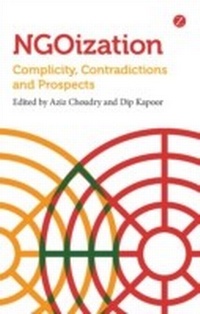
NGOization
Complicity, Contradictions and Prospects
1st Edition
Published on 11. July 2013
250 pages
978-1-78032-259-9 (ISBN)
Description

The growth and spread of non-governmental organizations (NGOs) at local and international levels has attracted considerable interest and attention from policy-makers, development practitioners, academics and activists around the world. But how has this phenomenon impacted on struggles for social and environmental justice? How has it challenged - or reinforced - the forces of capitalism and colonialism? And what political, economic, social and cultural interests does this serve?
NGOization - the professionalization and institutionalization of social action - has long been a hotly contested issue in grassroots social movements and communities of resistance. This book pulls together for the first time unique perspectives of social struggles and critically engaged scholars from a wide range of geographical and political contexts to offer insights into the tensions and challenges of the NGO model, while considering the feasibility of alternatives.
NGOization - the professionalization and institutionalization of social action - has long been a hotly contested issue in grassroots social movements and communities of resistance. This book pulls together for the first time unique perspectives of social struggles and critically engaged scholars from a wide range of geographical and political contexts to offer insights into the tensions and challenges of the NGO model, while considering the feasibility of alternatives.
Reviews / Votes
NGOization brings together voices not often heard in academia. This is a must read for anyone who is concerned about the future of democracy and wants to learn about the struggles of communities around the world to reclaim it. * Radha D'Souza, University of Westminster * Often conflated with social movements and other formations constituted by and representing the interests of the disempowered, NGOs require critical examination. Choudry and Kapoor have assembled an urgently timely and significant contribution in this regard and is a must-read for students and activists alike, especially in this moment of accelerating and deepening inequalities within and between countries. * Robyn Rodriguez, associate professor, Asian American Studies, University of California Davis * While deploying context-specific approaches to theorizing NGOs, social movements, and their complex inter-relations, this insightful and provocative collection demonstrates that it is imperative to analyze NGOs' complicity with capital and coloniality, especially in the current global crisis of neoliberalism. Perhaps most innovative is the argument - advanced by the editors and taken on squarely by richly detailed case studies from an impressive range of world regions - that NGOs are not external to state, market or society. Rather, in the early twenty-first century, they have come to constitute "one more institutional form through which class relations are being contested and reworked." A most welcome addition to the critical literature on NGOization. * Sonia E. Alvarez, Leonard J. Horwitz professor of Latin American politics and society, University of Massachusetts Amherst *More details
Edition
1. Auflage
Language
English
Place of publication
London
United Kingdom
Publishing group
Bloomsbury Publishing PLC
Target group
College/higher education
ISBN-13
978-1-78032-259-9 (9781780322599)
Copyright in bibliographic data and cover images is held by Nielsen Book Services Limited or by the publishers or by their respective licensors: all rights reserved.
Schweitzer Classification
Other editions
Additional editions
Book
07/2013
Zed Books Ltd
€36.50
Shipment within 3-4 weeks
Book
07/2013
Zed Books Ltd
€119.04
Article exhausted; check different version
Persons
Aziz Choudry is assistant professor in the Department of Integrated Studies in Education at McGill University, Canada. He is co-author of Fight Back: Workplace Justice for Immigrants (Fernwood, 2009), and co-editor of Learning from the Ground Up: Global Perspectives on Social Movements and Knowledge Production (Palgrave Macmillan, 2010) and Organize! Building from the Local for Global Justice (PM Press/Between the Lines, 2012). With over 25 years of experience as a social, environmental and political activist, educator and researcher, he currently sits on the boards of the Immigrant Workers Centre, Montreal and the Global Justice Ecology Project. He is also a co-initiator and part of the editorial team of www.bilaterals.org, a website supporting resistance against bilateral free trade and investment agreements.
Dip Kapoor is professor of international education in the Department of Educational Policy Studies at the University of Alberta, Canada. He is Research Associate and Founding Member of the Centre for Research and Development Solidarity CRDS), an Adivasi (original dweller)-Dalit rural peoples' organization in Orissa, India. His relationship with the Adivasi-Dalit Ekta Abhijan (ADEA) land and forest movement in Orissa goes back to the early 1990s. Recent co-edited collections nclude: Education, PAR, and Social Change; Education, Decolonization and Development; Indigenous Knowledge and Learning in Asia/Pacific and Africa; Learning from the Ground Up: Global Perspectives on Social Movements and Knowledge Production and Globalization, Culture and Education in South Asia: Critical Excursions.
Dip Kapoor is professor of international education in the Department of Educational Policy Studies at the University of Alberta, Canada. He is Research Associate and Founding Member of the Centre for Research and Development Solidarity CRDS), an Adivasi (original dweller)-Dalit rural peoples' organization in Orissa, India. His relationship with the Adivasi-Dalit Ekta Abhijan (ADEA) land and forest movement in Orissa goes back to the early 1990s. Recent co-edited collections nclude: Education, PAR, and Social Change; Education, Decolonization and Development; Indigenous Knowledge and Learning in Asia/Pacific and Africa; Learning from the Ground Up: Global Perspectives on Social Movements and Knowledge Production and Globalization, Culture and Education in South Asia: Critical Excursions.
Content
Preface by Sangeeta Kamat
Introduction - NGOization: Complicity, Contradictions and Prospects - Aziz Choudry and Dip Kapoor
1. Saving Biodiversity, for Whom and for What? Conservation NGOs, Complicity, Colonialism and Conquest in an Era of Capitalist Globalization - Aziz Choudry
2. Social Action and NGOization in Contexts of Development Dispossession in Rural India: Explorations into the Un-civility of Civil Society - Dip Kapoor
3. NGOs, Indigenous Peoples and the United Nations - Sharon H. Venne
4. From Radical Movement to Conservative NGO and Back Again? A Case Study of the Democratic Left Front in South Africa - Luke Sinwell
5. Philippine NGOs: Defusing Dissent, Spurring Change - Sonny Africa
6. Disaster Relief, NGO-led Humanitarianism and the Reconfiguration of Spatial Relations in Tamil Nadu - Raja Swamy
7. Seven Theses on Neobalkanism and NGOization in Transitional Serbia - Tamara Vukov
8. Peace-building and Violence against Women: Tracking the Ruling Relations of Aid in a Women's Development NGO in Kyrgyzstan - Elena Kim and Marie Campbell
9. Alignment and Autonomy: Food Systems in Canada - Brewster Kneen
Introduction - NGOization: Complicity, Contradictions and Prospects - Aziz Choudry and Dip Kapoor
1. Saving Biodiversity, for Whom and for What? Conservation NGOs, Complicity, Colonialism and Conquest in an Era of Capitalist Globalization - Aziz Choudry
2. Social Action and NGOization in Contexts of Development Dispossession in Rural India: Explorations into the Un-civility of Civil Society - Dip Kapoor
3. NGOs, Indigenous Peoples and the United Nations - Sharon H. Venne
4. From Radical Movement to Conservative NGO and Back Again? A Case Study of the Democratic Left Front in South Africa - Luke Sinwell
5. Philippine NGOs: Defusing Dissent, Spurring Change - Sonny Africa
6. Disaster Relief, NGO-led Humanitarianism and the Reconfiguration of Spatial Relations in Tamil Nadu - Raja Swamy
7. Seven Theses on Neobalkanism and NGOization in Transitional Serbia - Tamara Vukov
8. Peace-building and Violence against Women: Tracking the Ruling Relations of Aid in a Women's Development NGO in Kyrgyzstan - Elena Kim and Marie Campbell
9. Alignment and Autonomy: Food Systems in Canada - Brewster Kneen
