

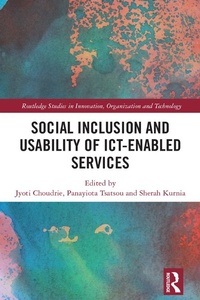
Social Inclusion and Usability of ICT-enabled Services.
Published on 31. October 2017
400 pages
978-1-317-38779-4 (ISBN)
Description

Social Inclusion and Usability of Innovative ICT-enabled Services is a cutting-edge research book written for researchers, students, academics, technology experts, activists and policy makers. The book explores a wide range of issues concerning innovative ICT-enabled digital services, their usability and their consequent role in social inclusion, It includes the impacts of the use of ICT-enabled digital services on individuals, organisations, governments and society, and offers a theoretically informed and empirically rich account of the socio-technical, management and policy aspects of social inclusion and innovative ICT-enabled digital services.
This publication offers insights from the perspectives of Information Systems, Media and Communications, Management and Social Policy, drawing on research from these disciplines to inform readers on diverse aspects of social inclusion and usability of innovative ICT-enabled digital services. The originality of this book lies in the combination of socio-technical, management and policy perspectives offered by the contributors, and integrated by the editors, as well as in the interdisciplinary and both theoretically framed and empirically rich features of the various chapters of the book. While providing a timely account of existing evidence and debates in the field of social inclusion and technology usability, this book will also offer some original insights into what practitioners, experts and researchers are to expect in the near future to be the emerging issues and agendas concerning the role of technology usability in social inclusion and the emerging forms and attributes of the latter.
Through a collection of high quality, peer reviewed papers; Social Inclusion and Usability of Innovative ICT-enabled Services will enhance knowledge of social inclusion and usability of innovative ICT-enabled digital services and applications at a diverse level.
This publication offers insights from the perspectives of Information Systems, Media and Communications, Management and Social Policy, drawing on research from these disciplines to inform readers on diverse aspects of social inclusion and usability of innovative ICT-enabled digital services. The originality of this book lies in the combination of socio-technical, management and policy perspectives offered by the contributors, and integrated by the editors, as well as in the interdisciplinary and both theoretically framed and empirically rich features of the various chapters of the book. While providing a timely account of existing evidence and debates in the field of social inclusion and technology usability, this book will also offer some original insights into what practitioners, experts and researchers are to expect in the near future to be the emerging issues and agendas concerning the role of technology usability in social inclusion and the emerging forms and attributes of the latter.
Through a collection of high quality, peer reviewed papers; Social Inclusion and Usability of Innovative ICT-enabled Services will enhance knowledge of social inclusion and usability of innovative ICT-enabled digital services and applications at a diverse level.
More details
Series
Language
English
Place of publication
London
United Kingdom
Publishing group
Taylor & Francis Ltd
Target group
College/higher education
Product notice
Reflowable
Illustrations
32 Tables, black and white
File size
4,64 MB
ISBN-13
978-1-317-38779-4 (9781317387794)
Copyright in bibliographic data and cover images is held by Nielsen Book Services Limited or by the publishers or by their respective licensors: all rights reserved.
Schweitzer Classification
Other editions
Additional editions
Jyoti Choudrie | Sherah Kurnia | Panayiota Tsatsou
Social Inclusion and Usability of ICT-enabled Services.
Book
12/2019
1st Edition
Routledge
€66.40
Shipment within 15-20 days
Jyoti Choudrie | Sherah Kurnia | Panayiota Tsatsou
Social Inclusion and Usability of ICT-enabled Services.
Book
11/2017
1st Edition
Routledge
€232.80
Shipment within 10-20 days
Persons
Jyoti Choudrie holds the position of Professor of Information Systems at University of Hertfordshire, UK.
Panayiota Tsatsou is an Associate Professor at the University of Leicester, UK.
Sherah Kurnia is a Senior Lecturer at the School of Computing and Information Systems, the University of Melbourne, Australia.
Panayiota Tsatsou is an Associate Professor at the University of Leicester, UK.
Sherah Kurnia is a Senior Lecturer at the School of Computing and Information Systems, the University of Melbourne, Australia.
Content
Part 1: Examining the Theoretical Foundations of Social Inclusion and ICT-Enabled Services
1. Social Inclusion and ICTs: a Literature Review Through the Lens of the Capability Approach
Efpraxia D. Zamani
2. Connectivity: A Socio-technical Construct to Examine ICT-enabled Service
Christoph F. Breidbach
3. Re-conceptualizing Social Inclusion in the Context of 21st Century Smart Cities
H. Patricia McKenna
4. Enhancing Social Inclusion Through Optimal Community Participation Levels in ICT4D Projects
Arthur Glenn Maail, Sherah Kurnia , and Shanton Chang
Part 2: ICT-Enabled Services of Value to Society and Organisations
5. Understanding the Impact of Political Structure, Governance and Public Policy on e-Government
David J. Yates, Girish J. "Jeff" Gulati, and Christine B. Williams
6. ICT-enabled E-entertainment Services in United States Counties: Socio-Economic Determinants and Geographic Patterns
Avijit Sarkar, James Pick, and Jessica Rosales
7. E-health as an Enabler of Social Inclusion
Ken Clarke, Adam Lodders, Robyn Garnett, Anne Holland, Rodrigo Marino, and Zaher Joukhadar
8. Challenging the Cost of Higher Education with the Assistance of Digital Tools: Case Studies of Protest Activity in Canada and the United States
Victoria Carty
9. Telework Impact on Productivity and Wellbeing: An Australian Study
Rachelle Bosua, Sherah Kurnia, Marianne Gloet, and Antonette Mendoza
10. Supporting Regional Food Supply Chains with an E-Commerce Application
Sherah Kurnia, Md Mahbubur Rahim, Serenity Hill, Kirsten Larsen, Patrice Braun, Danny Samson, and Prakash Singh
Part 3: Adoption, Usage and Management Aspects Surrounding Social Inclusion and Usability of ICT-Enabled Services
11. Digital Divides, Usability and Social Inclusion: Evidence from the Field of E-Services in the UK
Bianca C. Reisdorf and Darja Groselj
12. Mobility of Work: Usability of Digital Infrastructures and Technological Divide
Mohammad Hossein Jarrahi and Luke Williamson
13. Overcoming Obstacles to Activism with ICTs: An Analysis of MoveOn.Org and the Florida Tea Party Movement
Deana A. Rohlinger and Shawn Gaulden
14. Social Inclusion, Farmer Resignation and the Challenges of Information Technology Implementation
Ranjan Vaidya
15. Smartphones Adoption and Usage of 50+ Adults in the United Kingdom
Jyoti Choudrie, Sutee Pheeraphuttharangkoon, and Uchenna Ojiako
16. Literacy and Identity Links Forging Digital Inclusion? Critical Reflections and Signposts from a Qualitative Study
Panayiota Tsatsou, Gillian Youngs, and Carolyn Watt
Conclusion
Panayiota Tsatsou, Sherah Kurnia, and Jyoti Choudrie
1. Social Inclusion and ICTs: a Literature Review Through the Lens of the Capability Approach
Efpraxia D. Zamani
2. Connectivity: A Socio-technical Construct to Examine ICT-enabled Service
Christoph F. Breidbach
3. Re-conceptualizing Social Inclusion in the Context of 21st Century Smart Cities
H. Patricia McKenna
4. Enhancing Social Inclusion Through Optimal Community Participation Levels in ICT4D Projects
Arthur Glenn Maail, Sherah Kurnia , and Shanton Chang
Part 2: ICT-Enabled Services of Value to Society and Organisations
5. Understanding the Impact of Political Structure, Governance and Public Policy on e-Government
David J. Yates, Girish J. "Jeff" Gulati, and Christine B. Williams
6. ICT-enabled E-entertainment Services in United States Counties: Socio-Economic Determinants and Geographic Patterns
Avijit Sarkar, James Pick, and Jessica Rosales
7. E-health as an Enabler of Social Inclusion
Ken Clarke, Adam Lodders, Robyn Garnett, Anne Holland, Rodrigo Marino, and Zaher Joukhadar
8. Challenging the Cost of Higher Education with the Assistance of Digital Tools: Case Studies of Protest Activity in Canada and the United States
Victoria Carty
9. Telework Impact on Productivity and Wellbeing: An Australian Study
Rachelle Bosua, Sherah Kurnia, Marianne Gloet, and Antonette Mendoza
10. Supporting Regional Food Supply Chains with an E-Commerce Application
Sherah Kurnia, Md Mahbubur Rahim, Serenity Hill, Kirsten Larsen, Patrice Braun, Danny Samson, and Prakash Singh
Part 3: Adoption, Usage and Management Aspects Surrounding Social Inclusion and Usability of ICT-Enabled Services
11. Digital Divides, Usability and Social Inclusion: Evidence from the Field of E-Services in the UK
Bianca C. Reisdorf and Darja Groselj
12. Mobility of Work: Usability of Digital Infrastructures and Technological Divide
Mohammad Hossein Jarrahi and Luke Williamson
13. Overcoming Obstacles to Activism with ICTs: An Analysis of MoveOn.Org and the Florida Tea Party Movement
Deana A. Rohlinger and Shawn Gaulden
14. Social Inclusion, Farmer Resignation and the Challenges of Information Technology Implementation
Ranjan Vaidya
15. Smartphones Adoption and Usage of 50+ Adults in the United Kingdom
Jyoti Choudrie, Sutee Pheeraphuttharangkoon, and Uchenna Ojiako
16. Literacy and Identity Links Forging Digital Inclusion? Critical Reflections and Signposts from a Qualitative Study
Panayiota Tsatsou, Gillian Youngs, and Carolyn Watt
Conclusion
Panayiota Tsatsou, Sherah Kurnia, and Jyoti Choudrie
