

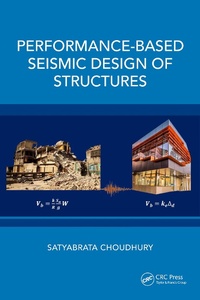
Performance-Based Seismic Design of Structures
1st Edition
Published on 1. July 2024
426 pages
978-1-040-03772-0 (ISBN)
Description

Seismic design of structures is fast turning to performance-based design (PBD) from old codal force-based design (FBD) method. The aim of the book is to expose readers to the meaning and need of PBD, the evolution of PBD to date, its various forms and applications. Various design philosophies and procedures have been described including modelling aspects and hazard considerations backed by examples. Direct displacement-based design (DDBD) and Unified PBD (UPBD) of reinforced concrete (RC) frame buildings, RC dual systems, steel frame buildings and bridge piers have also been explained.
The main features of this book are as follows:
* Illustrates performance-based seismic design to achieve the design target by performance objective-oriented design procedure.
* Covers modern design philosophies, modelling aspects, concepts in nonlinearities and use of supplemental damping devices.
* Contains a chapter on seismic safety of nonstructural components.
* Describes UPBD design procedure and examples of different structural systems.
* Includes application and examples with reference to SAP2000 software.
This book is aimed at graduate students, researchers and professionals in civil engineering, earthquake engineering and structural design.
The main features of this book are as follows:
* Illustrates performance-based seismic design to achieve the design target by performance objective-oriented design procedure.
* Covers modern design philosophies, modelling aspects, concepts in nonlinearities and use of supplemental damping devices.
* Contains a chapter on seismic safety of nonstructural components.
* Describes UPBD design procedure and examples of different structural systems.
* Includes application and examples with reference to SAP2000 software.
This book is aimed at graduate students, researchers and professionals in civil engineering, earthquake engineering and structural design.
More details
Edition
1. Auflage
Language
English
Place of publication
London
United Kingdom
Publishing group
Taylor & Francis Ltd
Target group
College/higher education
Professional and scholarly
Illustrations
89 Tables, black and white; 222 Line drawings, black and white; 2 Halftones, black and white; 224 Illustrations, black and white
ISBN-13
978-1-040-03772-0 (9781040037720)
Copyright in bibliographic data and cover images is held by Nielsen Book Services Limited or by the publishers or by their respective licensors: all rights reserved.
Schweitzer Classification
Other editions
Additional editions
Satyabrata Choudhury
Performance-Based Seismic Design of Structures
Book
approx. 07/2026
1st Edition
CRC Press
€66.00
Not yet published
Satyabrata Choudhury
Performance-Based Seismic Design of Structures
Book
07/2024
1st Edition
CRC Press
€187.40
Shipment within 10-20 days
Person
Satyabrata Choudhury is retired Professor of the Department of Civil Engineering, NIT Silchar, India. He had been a faculty of this institute since 1983, first as Lecturer and then as Assistant Professor, and finally as Professor and completed 40 years of service at retirement in January 2023. Prof. Choudhury obtained his Bachelor's degree in Civil Engineering from REC Silchar (now NIT Silchar), India. He obtained his master's degree in Structural Engineering from IIT Kharagpur, and Ph.D. in Earthquake Engineering from IIT Roorkee. He has served in various administrative positions in the institute including Head of the Department, Dean (P&D), Coordinator of various activities. He has received various awards including President of India's prize, Dr. Jai Krishna Gold medal (two times), Institution prize (IEI), etc. He has taught subjects like Performance-Based Seismic Design, Structural Dynamics, Concrete and Steel design at PG and UG level. His area of research is Performance-based seismic design. Prof. Choudhury is a guest editor of Practice Periodical on Structural Design and Construction, ASCE.
He has 45 papers in peer-reviewed journals, and a number of papers in international and national conferences. He has supervised about 60 M.Tech. dissertations, produced 7 Ph.D. and working with another 4 Ph.D. scholars. He was Chairperson of two international conferences and one national conference. He has evolved a new design methodology named Unified performance-based design (UPBD) which accommodates both drift and performance level as target design objectives. This method also provides member sizes.
He has 45 papers in peer-reviewed journals, and a number of papers in international and national conferences. He has supervised about 60 M.Tech. dissertations, produced 7 Ph.D. and working with another 4 Ph.D. scholars. He was Chairperson of two international conferences and one national conference. He has evolved a new design methodology named Unified performance-based design (UPBD) which accommodates both drift and performance level as target design objectives. This method also provides member sizes.
Content
1. Force-Based Design and its Limitations. 2. Introduction To Performance-Based Design. 3. Hazard Considerations. 4. Modelling Aspects. 5. Performance Criteria and Performance Levels. 6. Analysis for the Evaluation of Structures. 7. Direct Displacement-Based Design of RC Frame Buildings. 8. DDBD For Dual System. 9. Unified Performance-Based Design of RC Frame Buildings. 10. Unified Performance-Based Design of RC Dual System. 11. UPBD for Steel Frame Buildings. 12. Effect of Infill. 13. DDBD of RC Frame Buildings with Viscous Dampers. 14. Displacement-Based Design for Bridge Piers. 15. UPBD for Bridge Piers. 16. Energy Dissipating Devices. 17. Tuned Liquid Damper. 18. Tuned Mass Dampers. 19. Seismic Safety of OFCs. 20. Miscellaneous Topics.
