

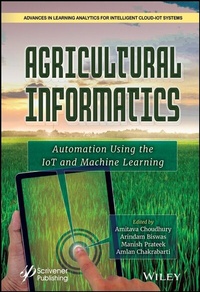
Agricultural Informatics
Description

Agricultural Informatics: Automation Using the IoT and Machine Learning focuses on all these topics, including a few case studies, and they give a clear indication as to why these techniques should now be widely adopted by the agriculture and farming industries.
More details
Other editions
Additional editions
Persons
Amitava Choudhury PhD is an assistant professor in the school of Computer Science, University of Petroleum & Energy Studies, Dehradun, India.
Arindam Biswas PhD is an assistant professor in School of Mines and Metallurgy at Kazi Nazrul University, Asansol, West Bengal, India.
Manish Prateek PhD is Professor and Dean, School of Computer Science, at the University of Petroleum and Energy Studies, Dehradun, India.
Amlan Chakrabarti PhD is a Full Professor in the A.K. Choudhury School of Information Technology at the University of Calcutta.
Content
Preface xiii
1 A Study on Various Machine Learning Algorithms and Their Role in Agriculture 1
Kalpana Rangra and Amitava Choudhury
1.1 Introduction 1
1.2 Conclusions 9
2 Smart Farming Using Machine Learning and IoT 13
Alo Sen, Rahul Roy and Satya Ranjan Dash
2.1 Introduction 14
2.2 Related Work 15
2.3 Problem Identification 22
2.4 Objective Behind the Integrated Agro-IoT System 23
2.5 Proposed Prototype of the Integrated Agro-IoT System 23
2.6 Hardware Component Requirement for the Integrated Agro-IoT System 26
2.7 Comparative Study Between Raspberry Pi vs Beaglebone Black 30
2.8 Conclusions 31
2.9 Future Work 32
3 Agricultural Informatics vis-à-vis Internet of Things (IoT): The Scenario, Applications and Academic Aspects--International Trend & Indian Possibilities 35
P.K. Paul
3.1 Introduction 36
3.2 Objectives 36
3.3 Methods 37
3.4 Agricultural Informatics: An Account 37
3.5 Agricultural Informatics & Technological Components: Basics & Emergence 40
3.6 IoT: Basics and Characteristics 41
3.7 IoT: The Applications & Agriculture Areas 43
3.8 Agricultural Informatics & IoT: The Scenario 45
3.9 IoT in Agriculture: Requirement, Issues & Challenges 49
3.10 Development, Economy and Growth: Agricultural Informatics Context 50
3.11 Academic Availability and Potentiality of IoT in Agricultural Informatics: International Scenario & Indian Possibilities 51
3.12 Suggestions 60
3.13 Conclusion 60
4 Application of Agricultural Drones and IoT to Understand Food Supply Chain During Post COVID-19 67
Pushan Kumar Dutta and Susanta Mitra
4.1 Introduction 68
4.2 Related Work 69
4.3 Smart Production With the Introduction of Drones and IoT 72
4.4 Agricultural Drones 75
4.5 IoT Acts as a Backbone in Addressing COVID-19 Problems in Agriculture 77
4.6 Conclusion 81
5 IoT and Machine Learning-Based Approaches for Real Time Environment Parameters Monitoring in Agriculture: An Empirical Review 89
Parijata Majumdar and Sanjoy Mitra
5.1 Introduction 90
5.2 Machine Learning (ML)-Based IoT Solution 90
5.3 Motivation of the Work 91
5.4 Literature Review of IoT-Based Weather and Irrigation Monitoring for Precision Agriculture 91
5.5 Literature Review of Machine Learning-Based Weather and Irrigation Monitoring for Precision Agriculture 92
5.6 Challenges 112
5.7 Conclusion and Future Work 113
6 Deep Neural Network-Based Multi-Class Image Classification for Plant Diseases 117
Alok Negi, Krishan Kumar and Prachi Chauhan
6.1 Introduction 117
6.2 Related Work 119
6.3 Proposed Work 121
6.4 Results and Evaluation 124
6.5 Conclusion 127
7 Deep Residual Neural Network for Plant Seedling Image Classification 131
Prachi Chauhan, Hardwari Lal Mandoria and Alok Negi
7.1 Introduction 131
7.2 Related Work 136
7.3 Proposed Work 139
7.4 Result and Evaluation 142
7.5 Conclusion 144
8 Development of IoT-Based Smart Security and Monitoring Devices for Agriculture 147
Himadri Nath Saha, Reek Roy, Monojit Chakraborty and Chiranmay Sarkar
8.1 Introduction 148
8.2 Background & Related Works 150
8.3 Proposed Model 155
8.4 Methodology 160
8.5 Performance Analysis 165
8.6 Future Research Direction 166
8.7 Conclusion 167
9 An Integrated Application of IoT-Based WSN in the Field of Indian Agriculture System Using Hybrid Optimization Technique and Machine Learning 171
Avishek Banerjee, Arnab Mitra and Arindam Biswas
9.1 Introduction 172
9.2 Literature Review 175
9.3 Proposed Hybrid Algorithms (GA-MWPSO) 177
9.4 Reliability Optimization and Coverage Optimization Model 179
9.5 Problem Description 181
9.6 Numerical Examples, Results and Discussion 182
9.7 Conclusion 183
10 Decryption and Design of a Multicopter Unmanned Aerial Vehicle (UAV) for Heavy Lift Agricultural Operations 189
Raghuvirsinh Pravinsinh Parmar
10.1 Introduction 190
10.2 History of Multicopter UAVs 192
10.3 Basic Components of Multicopter UAV 193
10.4 Working and Control Mechanism of Multicopter UAV 207
10.5 Design Calculations and Selection of Components 210
10.6 Conclusion 218
11 IoT-Enabled Agricultural System Application, Challenges and Security Issues 223
Himadri Nath Saha, Reek Roy, Monojit Chakraborty and Chiranmay Sarkar
11.1 Introduction 224
11.2 Background & Related Works 226
11.3 Challenges to Implement IoT-Enabled Systems 232
11.4 Security Issues and Measures 240
11.5 Future Research Direction 243
11.6 Conclusion 244
12 Plane Region Step Farming, Animal and Pest Attack Control Using Internet of Things 249
Sahadev Roy, Kaushal Mukherjee and Arindam Biswas
12.1 Introduction 250
12.2 Proposed Work 254
12.3 Irrigation Methodology 257
12.4 Sensor Connection Using Internet of Things 259
12.5 Placement of Sensor in the Field 263
12.6 Conclusion 267
References 268
Index 271
Preface
The emergence of automation in agriculture has become an important issue for every country. The world population is increasing at a very fast rate, and along with this increase in population the need for food is also increasing at a brisk pace. Traditional methods used by farmers are no longer sufficient to serve this increasing demand, resulting in the intensified use of harmful pesticides. This in turn has had a profound effect on agricultural practices, which in the end can render the land barren. This book discusses the different automation practices, including the internet of things (IoT), wireless communications, machine learning, artificial intelligence, and deep learning, currently being employed to address this problem. There are some areas of concern in the field of agriculture, such as crop disease, lack of storage, weed and water management, pesticide control, and lack of irrigation, all of which can be solved using the different techniques mentioned above.
From the earliest civilizations up till now, clothing, shelter and food have been the three primary needs of human beings that have remained constant. And even though we have become quite advanced in addressing issues related to housing and clothing, despite the increasing population (as per the Food and Agriculture Organization of the United Nations, 70% more food will need to be produced in 2050 than was produced in 2006), issues related to food production have yet to be completely addressed. In recent years, the IoT began to be used to address different industrial and technical challenges to meet this growing need. Therefore, now is the time to meet the future demands of farming which can only be accomplished by smart Agro-IoT tools. This will in turn boost productivity and minimize the pitfalls of traditional farming, which is the backbone of the world's economy. Aided by the IoT, continuous monitoring of fields will provide useful information to farmers, ushering in a new era in farming. The IoT can be used as a tool to combat climate change; monitor and manage water, land, soil and crops; increase productivity; control insecticides/pesticides; detect plant diseases; increase the rate of crop sales; etc. This book will focus on some case studies that involve monitoring of climate conditions, greenhouse automation, crop management, cattle monitoring and management for smart farming with IoT devices, which will give a clear indication as to why these techniques should be used in agriculture rather than some of the previously developed agricultural tools currently in use.
Organization of the Book
We are delighted to present this book, which was made possible with the support and contributions from academicians from various highly reputable institutions. It is a manifestation of various interesting and important aspects of theoretical and applied research covering complementary facets of innovative algorithms and applications in the fields of agriculture and cultivation processes, including:
- Machine learning algorithm and its role in agriculture
- Smart farming using machine learning and the IoT
- Agricultural informatics vis-à-vis the IoT
- Application of agricultural drones
- Real-time monitoring of environmental parameters in agriculture
- Deep neural network-based multiclass image classification of plant diseases
- Decryption and design of a multicopter unmanned aerial vehicle (UAV) for heavy lift agricultural operations
The 12 chapters of the book are briefly summarized below.
Chapter 1 discusses various state-of-the-art machine learning algorithms and their role in agriculture. The domain of crop production is very important for organizations, firms, and products related to agriculture. Data is collected from different sources for crop forecasting, and may vary in shape, size and type depending upon the source of collection. Agricultural data may be collected from metrological instruments, soil-sensors that are remotely installed, agricultural statistics, etc. Marketing, storage, transportation and decisions pertaining to crops have a high requirement for accurate data produced in a timely manner that can be used for predictions.
Chapter 2 describes how IoT tools are effective in smart farming. This chapter focuses on case studies like climate conditions monitoring, greenhouse automation, crop management, cattle monitoring, and smart farming management with IoT devices, which will provide a clear idea as to why this technique is preferable in agriculture rather than some previously developed agricultural tools.
Global aspects of agriculture automation through the IoT are discussed in Chapter 3. In this chapter, a case study on the IoT is highlighted which briefly discusses its basic and current applications. Also highlighted are aspects of IoT application in agriculture and related fields, and its importance in promoting agricultural informatics practice. The chapter focuses on the academic programs available in the field of agricultural informatics and related areas. Agricultural informatics programs are also proposed in concert with IoT and related fields in an international context and the potential fields in agricultural informatics are discussed as well.
In Chapter 4, the role that gathering information plays in productive crop management in smart farming is discussed. Current advances in data management for smart farming enabled by using sensor-based data-driven architecture have been found to increase efficiency in generating both qualitative and quantitative approaches in a range of challenges that will shake up existing agriculture methodologies. The chapter highlights the potential of wireless sensors and the IoT in agriculture and similar techniques which are feasible for surveillance and monitoring from sowing to harvesting and similar packaging operations. In this chapter, the authors focus on IoT technologies by highlighting the design of a novel drone concept with 3D mapping and address post COVID-19 issues in agriculture and proposed monitoring in comparative analysis. This chapter reviews an artificial intelligence-based decision-making system that will create supplementary benefits as a result of precision agriculture. Machine learning also plays a critical role in farming in terms of nutrients management. It is further found that automation in agriculture via the IoT is a proven technology that can work even for small farms such as those in India.
The study in Chapter 5 discusses real-time monitoring of environmental parameters in agriculture. The main objective of this chapter is realtime visualization and on-demand access of weather parameters even from remote locations and intelligent processing using IoT-based solutions like machine learning (ML). Ever-augmenting technologies like ML pave the way for identifying and adapting changes in crop design and irrigation patterns by taking into account a large variety of multidimensional weather data to accurately predict climate conditions suitable for crop irrigation. Hence, this chapter offers a detailed review of IoT-based ML solutions for precision agriculture depending on weather and irrigation schedules. It also highlights security solutions based on ML, which are capable of handling illegal data access by intruders during cloud data storage.
The immensely difficult challenge of recognizing plant disease in an agriculture farming field is discussed in Chapter 6. An effective management strategy will enable faster and more accurate prediction of leaf diseases in plants, which will help to improve crop production and market value and also dramatically reduce environmental damage. Since recognizing diseases in plants requires a lot of knowledge about all plant diseases, it can be a time-consuming and labor-intensive process. Hence, plant disease recognition is the most promising approach in agriculture, which is attracting significant attention in both the farming and computer communities. In order to help grow healthy plants, a deep convolutional neural network (CNN) model described in this chapter aids farming by identifying leaf disease. The CNN techniques are applied to a large agricultural plant dataset for accurate detection of plant leaf diseases.
In Chapter 7, deep residual neural network for plant seedling image classification is discussed. Weed conservation within the first six to eight weeks after planting is critical because during this time weeds compete aggressively with crops for nutrients and water. In general, yield losses will range from 10 to 100 percent depending on the degree of weed control practiced. Since yield losses are caused by weeds interfering with the growth and production of crops, successful weed control is imperative. The first vital prerequisite to enact successful control is accurate identification and classification of weeds. In this research, a detailed experimental study has been conducted on a residual neural network (ResNet) to tackle the problem of yield losses. The authors used the Plant Seedlings Dataset to train and test the system. The use of ResNet to classify images with a high accuracy rate can ultimately change how weeds affect the current state of agriculture.
Smart farming technologies continue to empower farmers, which helps them address the significant problems they face through much better remedies. The growth pattern and environmental parameters of crop growth provide scientific guidance and optimum countermeasures for agricultural production. A proposed system is presented in Chapter 8 that uses a Raspberry Pi board and an array of sensors, i.e., PIR sensor, pH sensor, and capacitance dielectric soil moisture...
