

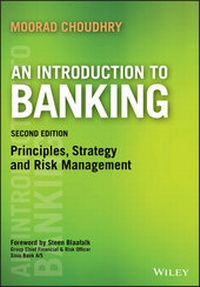
An Introduction to Banking
Description

Introduction to Banking, Second Edition is a comprehensive and jargon-free guide to the banking operation. Written at the foundational level, this book provides a broad overview of banking to give you an all-around understanding that allows you to put your specialty work into context within the larger picture of your organization. With a specific focus on risk components, this second edition covers all key elements with new chapters on reputational risk, credit risk, stress testing and customer service, including an updated chapter on sustainability. Practical material includes important topics such as the yield curve, trading and hedging, asset liability management, loan origination, product marketing, reputational risk and regulatory capital.
This book gives you the context you need to understand how modern banks are run, and the key points operation at all levels.
* Learn the critical elements of a well-structured banking operation
* Examine the risk components inherent in banking
* Understand operational topics including sustainability and stress testing
* Explore service-end areas including product marketing and customer service
Banks continue to be the heart of the modern economy, despite the global financial crisis --they have however become more complex. Multiple layers and a myriad of functions contribute to the running of today's banks, and it's critical for new and aspiring bankers to understand the full breadth of the operation and where their work fits in. Introduction to Banking, Second Edition provides an accessible yet complete primer, with emphasis on the areas that have become central to sustainable banking operation.
More details
Other editions
Additional editions
Person
Content
Foreword ix
Preface xi
Preface to the First Edition xv
Acknowledgements xvii
About the Author xix
Part I Bank Business and the Markets 1
1 Bank Business and Capital 3
2 Customer Services and Marketing for Bank Products 29
3 Credit Assessment and Managing Credit Risk 49
4 the Money Markets 95
5 the Yield Curve 131
6 Introduction to Money Market Dealing and Hedging 167
Part II Asset-liability Management and Liquidity Risk 205
7 Bank Asset and Liability Management I 207
8 Asset and Liability Management II: the Alco 247
9 Bank Liquidity Risk Management I 265
10 Liquidity Risk Management II: Basel III Liquidity, Liabilities Strategy, Stress Testing, Collateral Management and the HQLA 287
11 Business Best-practice Bank Internal Funds Transfer Pricing Policy 329
12 Net Interest Income (NII), Net Interest Margin (NIM) and the Management of Interest-rate Risk in the Banking Book 343
13 Securitisation Mechanics for Balance Sheet Management 375
Part III Strategy, Regulatory Capital and Case Studies 391
14 Strategy Setting 393
15 Bank Regulatory Capital, Basel Rules and ICAAP 419
16 Managing Operational Risk 493
17 Advice and Problem Solving: Case Studies 505
Appendix A Financial Markets Arithmetic 531
Appendix B Abbreviations and Acronyms 549
Index 553
