

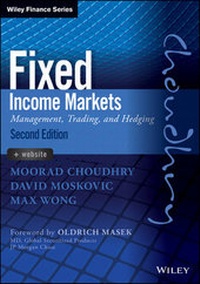
Fixed Income Markets
Description

More details
Other editions
Additional editions
Persons
Content
Foreword
I have been writing book chapters and forewords covering the fixed income markets anecdotally for over a decade. And like the markets that underlie the various themes I have commented on, the focus of my musings has evolved over this period as well. A consistent theme throughout my annotations, however, has been a basic assertion that the “science” of fixed income investing has been uniquely influenced by mathematics and computing technology. By most accounts, fixed income analytics as a formal study only began to take shape as a proper science during the 1970–1980s; and as with most developing sciences, analytical models rooted in mathematics became the means by which practitioners looked to enumerate the developing fixed income concepts. Interestingly, this was also the period that most would suggest when financial globalisation started. Whilst one can debate whether finance’s coming of age was coincidental with globalisation or perhaps its key driver, it would be hard to argue that the electronic connectivity between borrower and saver has been anything short of revolutionary. Irrespective of the cause or effect, though, the world’s escalating financial interconnectivity certainly warranted, if not necessitated, new thinking around fixed income valuation and risk management.
Consequently, analytical frameworks ranging from portfolio theory (i.e., optimal portfolio construction) to option theory (i.e., human choice) had their origins during this period. While each concept was unique in its own right, the collective insights helped practitioners appreciate that investment framing and decisioning are multivariate problems; financial markets are complex and dynamic by nature. In other words, fixed income value is not static by definition. Thus, rather than continuing to limit investors to simple “point in time” measures of value, valuation theory evolved to capture the effects that second, third, . . . , and Nth order factors have on investment performance over time. In fact, many of the concepts in this book (i.e., duration, convexity, correlation, . . . , optionality) had their genesis during those early days of fixed income science. Although the new theories were helpful in better framing value sensitivity, it was the advent of computing technology that provided for its practical application and mass acceptance. Risk managers could for the first time capture large quantums of diverse information and feed them through the developing mathematical tools in a scalable way. In other words, scenario analysis for fixed income performance became feasible; risk managers had the practical ability to vary inputs (or “conditions”) to build a probabilistic picture of all the potential returns one could possibly expect. The ability to understand the upside and downside sensitivity of an investment to a series of variables (i.e., credit spreads, interest rates, . . . default rates) categorically redefined the fundamental nature of fixed income analysis. Because they could be put into practice, these new theories and capabilities gained broad acceptance, and the creation of a professional industry ensued.
As a statement of fact, there is nothing particularly enlightening or controversial about the above observations. Undoubtedly, it is hard to dispute that the introduction of new valuation theories further empowered through computing would not be accretive to the knowledge base of any subject matter. Surely, research, scientific method, and technology are at the core of any industry’s advancement? If so, why then is it that the advances in the field of finance have, by contrast, been so uniquely targeted and discredited since the financial crisis? Keeping in mind, we are already a half a decade on from its commencement and yet still no reprieve from the sceptics. The often accepted notion that finance’s technological advancements were the sole catalyst for the crisis should be duly troubling to any impartial observer. Furthermore, the critics openly blame the complexity of derivatives, securitisation, and hybrid capital (collectively “financial engineering”) specifically. While these types of oversimplifications make for popular journalism, I would suggest that these criticisms are misdirected and have never been well reasoned in logic or supported in fact.
Certainly, the targeting of the advances in finance seems misplaced when, ironically, many of these instruments have been at the cornerstone of the crisis’s prescribed remedies. Governments, for example, have been fulfilling their quantitative easing programs through the purchasing of securitised assets; while troubled banks have been recapitalising themselves through the issuance of new forms of hybrid capital instruments, to name another.
With that irony in mind, it seems odd that the world is yet to move on from the fruitless task of looking to assign culpability for the challenges faced by the global financial system. In my opinion, efforts by critics would be better spent trying to understand the scope of knowledge afforded by the industry’s work; the faculty of its tools are powerful and should be embraced. It is easier to identify and take lessons from the crisis when the observations are spanned and compared against the currently accepted analytic frameworks. One should never forget that analytical frameworks are theories that need to evolve; they are not absolute truths. Knowledge and technology are symbiotic creatures that feed off of one another; and like the financial markets mentioned above, share a dynamic relationship.
As such, this is why books like this make for worthwhile reading; these types of broad references help contextualise the aggregate body of knowledge that has accumulated around fixed income. A solid understanding of the current thinking is the necessary foundation from which current practitioners and future students can then hope to build better tools. Hence, I challenge the next generation of thought leaders in the field to identify what the key lessons learned from the crisis are; and consequently, help set the direction of where the study of finance should go (i.e., what are the next generation tools needed?).
As the story is still playing out, I don’t think it is a cop-out to leave those questions to the next generation; realistically, both those questions are books in themselves and beyond the limits of a foreword. Equally, the debate would be long and fraught with controversy; and for the many that have tried, they invariably take a biased side and create drama out of what should be more of a philosophical message. I have, though, in different forums openly suggested that “financial engineering” in itself was not the root cause of the financial crisis; instead, it was the simple means by which these new tools and technology were employed and understood. Securitisation technology, for example, was not some inherently destructive technology that created the U.S. subprime crisis; it was bad judgement underpinning poorly underwritten mortgages. Securitisation technology was simply the practical delivery mechanism by which investors could take exposure to the mortgage asset class; the technology in itself didn’t change the behaviour of the underlying asset class. So, I would argue that the technology was not flawed; but rather the choice of the investable asset class (or “inputs”) were flawed. Practitioners simply lost perspective on the natural limitation of tools; again, their outputs are not absolutes. Perhaps this is where one key message from the crisis lies; or at least the key philosophical one.
So, despite all the advancements in financial thinking; their utility and usefulness are still dependent on human judgment. Judgment in terms of the inputs used as well as judgment as to how the outputs are interpreted. As we look forward, I think it is particularly important that we heed those cautions on the power of financial tools; we are in a period of unprecedented financial experimentation (i.e., global quantitative easing, structural bank reform, automated trading/exchanges). I appreciate that this all sounds like common sense; but, overreliance and underappreciation of the capabilities and consequences of developing technology are not a new challenge for society. In the extreme, atomic energy for instance, has had its moments of glory and shame in history. In spite of those moments, though, we as a society continue to utilise, research, and improve upon its application. Clearly, this is a dramatic comparison; albeit the messaging is the same. Discrediting efforts in science simply because we feel our current capabilities and knowledge are insufficient or incomplete is a societal failure—not one ascribable to the science itself. In that regard, I hope the sceptics will reflect on some of these observations and reorient some of their criticisms toward a more construct tone. Removing such distractions will allow the industry to more appropriately place all its efforts on developing the new tools needed rather than defending itself. It should not be lost on critics that the study of finance is an important science, which has yielded many notable achievements. In the end, advancing our understanding of the world’s financial system is in everyone’s interest; it is as vital to a healthy society as is energy above.
OLDRICH MASEK
Managing Director, Global Securitised Products
JPMorgan Chase
21 November 2013
The statements, views, and opinions expressed in this foreword are the writer’s own and do not necessarily reflect those of his employer, JPMorgan Chase & Co., its...
