

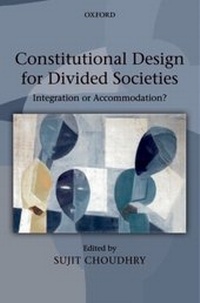
Constitutional Design for Divided Societies
Integration or Accommodation?
1st Edition
Published on 27. March 2008
491 pages
978-0-19-156023-1 (ISBN)
Description

How should constitutional design respond to the opportunities and challenges raised by ethnic, linguistic, religious, and cultural differences, and do so in ways that promote democracy, social justice, peace and stability? This is one of the most difficult questions facing societies in the world today. There are two schools of thought on how to answer this question. Under the heading of accommodation, some have argued for the need to recognize, institutionalize and empower differences. There are a range of constitutional instruments available to achieve this goal, such as multinational federalism and administrative decentralization, legal pluralism (e.g. religious personal law), other forms of non-territorial minority rights (e.g. minority language and religious education rights),consociationalism, affirmative action, legislative quotas, etc. But others have countered that such practices may entrench, perpetuate and exacerbate the very divisions they are designed to manage. They propose a range of alternative strategies that fall under the rubric of integration that will blur,transcend and cross-cut differences. Such strategies include bills of rights enshrining universal human rights enforced by judicial review, policies of disestablishment (religious and ethnocultural), federalism and electoral systems designed specifically to include members of different groups within the same political unit and to disperse members of the same group across different units, are some examples. In this volume, leading scholars of constitutional law, comparative politics and political theory address the debate at a conceptual level, as well as through numerous country case-studies, through an interdisciplinary lens, but with a legal and institutional focus.
More details
Other editions
Additional editions
Book
03/2008
Oxford University Press
€146.40
Shipment within 15-20 days
Content
- Intro
- Contents
- Acknowledgements
- Table of Cases
- PART I: INTRODUCTION AND OVERVIEW
- 1 Bridging comparative politics and comparative constitutional law: Constitutional design in divided societies
- 1. Introduction: Comparative constitutional law missing in action
- 2. The Lijphart-Horowitz debate
- 3. Integration versus accommodation
- 4. Lessons for the integration-accommodation debate
- 2 Integration or accommodation? The enduring debate in conflict regulation
- 1. Distinguishing integration and accommodation from assimilation
- 2. Integration
- 3. Accommodation
- 4. Engagements between integrationists and accommodationists
- 5. When is integration or accommodation appropriate?
- 6. Conclusion
- PART II: THEORETICAL PERSPECTIVES
- 3 Beyond the dichotomy of universalism and difference: Four responses to cultural diversity
- 1. Disestablishment
- 2. Nation building
- 3. Cultural preservation
- 4. Equality of status
- 5. Conclusion
- 4 The internationalization of minority rights
- 1. The basic international framework
- 2. Limitations of the international framework
- 3. Rethinking the approach
- 4. Conclusion
- 5 Does the world need more Canada? The politics of the Canadian model in constitutional politics and political theory
- 1. Introduction: Brian Barry versus Will Kymlicka
- 2. The Canadian model: Accommodation and integration
- 3. Will Kymlicka and the rise of the Canadian model in political theory
- 4. The politics of the Canadian model: Canada in constitutional crisis
- 5. Lessons from the Canadian model in crisis: A procedural and a substantive crisis
- 6. Conclusion: The lesson of the Canadian model for multinational polities
- 6 Ethnic identity and democratic institutions: A dynamic perspective
- 1. Ethnic identity
- 2. Democratic institutions
- 3. A dynamic perspective on institutional design
- PART III: CASE-STUDIES
- 7 Indonesia's quasi-federalist approach: Accommodation amid strong integrationist tendencies
- 1. Introduction
- 2. From integration to accommodation in Indonesia: Decentralization and "special" autonomy
- 3. Special autonomy: An ambiguous reconciliation for Papuans
- 4. The Law on Aceh: All but federacy
- 5. Conclusion
- 8 Integrationist and accommodationist measures in Nigeria's constitutional engineering: Successes and failures
- 1. The background
- 2. Constitutional engineering through the combination of integrationist and accommodationist devices
- 3. Accomplishments of the Nigerian design
- 4. Inadequacies of the Nigerian design
- 5. Political patronage, godfathers, and lawlessness
- 6. Constitutional rescue
- 7. Conclusion
- 9 The limits of constitutionalism in the Muslim world: History and identity in Islamic law
- 1. Introduction
- 2. Historicist jurisprudence: Manifesting the transcendent through law
- 3. Muslim state constitutions and protections for religious minorities
- 4. Illustrating the tension at work: Saudi Arabia and Egypt
- 5. Understanding historical Shari'a
- 6. Conclusion
- 10 A tale of three constitutions: Ethnicity and politics in Fiji
- 1. Background
- 2. The 1970 constitution
- 3. The 1990 constitution
- 4. The 1997 constitution
- 5. Coups and overthrow of the constitution
- 6. Conclusion
- 11 Rival nationalisms in a plurinational state: Spain, Catalonia, and the Basque Country
- 1. Accommodating national diversity
- 2. Political traditions in Spain
- 3. Catalonia
- 4. The Basque Country
- 5. Accommodating nationalism
- 6. Renegotiating autonomy
- 7. The issues at stake
- 8. Conclusion
- 12 Iraq's constitution of 2005: Liberal consociation as political prescription
- 1. Introduction
- 2. Iraq's constitution: Self-rule and shared rule
- 3. Iraq's constitution and federal shared rule
- 4. Conclusion
- 13 Consociation and its critics: Northern Ireland after the Belfast Agreement
- 1. Introduction
- 2. Consociational theory and Northern Ireland's Belfast Agreement
- 3. The debate between consociationalists and their integrationist and centripetalist critics
- 4. Conclusion
- 14 Recognition without empowerment: Minorities in a democratic South Africa
- 1. Mapping diversity in South Africa
- 2. Designs for a new South Africa
- 3. Constructing "The New South Africa"
- 4. Conclusion
- 15 Giving with one hand: Scottish devolution within a unitary state
- 1. Introduction
- 2. Plurinational constitutionalism: The conceptual challenge
- 3. Devolution for Scotland: Plurinational realignment without federalism?
- 4. Concluding remarks
- Index
- A
- B
- C
- D
- E
- F
- G
- H
- I
- K
- L
- M
- N
- P
- R
- S
- T
- U
- W
- Z
