

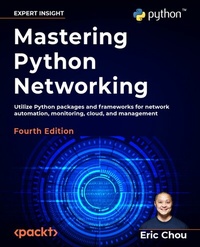
Mastering Python Networking
Utilize Python packages and frameworks for network automation, monitoring, cloud, and management
4th Edition
Published on 23. September 2024
594 pages
978-1-80324-232-3 (ISBN)
Description

Get to grips with the latest container examples, Python 3 features, GitLab DevOps, network data analysis, and cloud networking to get the most out of Python for network engineering with the latest edition of this bestselling guide Purchase of the print or Kindle book includes a free eBook in PDF format.
Key Features
Leverage Python's powerful libraries and frameworks to build production-ready network automation solutions efficiently and effectively
Implement network security, monitoring, and management solutions using modern DevOps tools and cloud-native approaches
Utilize AsyncIO and cloud capabilities in Python 3 for AWS and Azure network solutions
Book DescriptionNetworks in your infrastructure set the foundation for deploying, maintaining, and servicing applications. Python is the ideal language for network engineers to explore tools that were previously available to systems engineers and application developers. Mastering Python Networking, Fourth edition, guides you on a Python-driven journey from traditional network engineering to modern network development. This new edition incorporates the latest Python features and DevOps frameworks. In addition to new chapters on introducing Docker containers and Python 3 Async IO for network engineers, each chapter is updated with the latest libraries and working examples to ensure compatibility and clarity of the concepts. Starting with a basic overview of Python, the book teaches you how it can interact with both legacy and API-enabled network devices. You will learn to leverage high-level Python packages and frameworks to perform network automation tasks, monitoring, management, and enhanced network security, followed by AWS and Azure cloud networking. You will use Git for code management, GitLab for continuous integration, and Python-based testing tools to verify your network. By the end of this book, you'll be a confident network developer capable of automating modern infrastructure using Python, DevOps practices, and cloud technologies.What you will learn
Use Python to interact with network devices
Explore Docker for efficient network application development and deployment
Extract network insights using Python and monitoring tools like NetFlow and SNMP
Analyze network data with ELK for real-time visualization
Build high-level API with Flask for in-house applications
Discover the new AsyncIO feature and its concepts in Python 3
Explore test-driven development concepts and use PyTest to drive code test coverage
Understand how to implement DevOps best practices with GitLab in networking
Who this book is forMastering Python Networking, Fourth edition is for network engineers, developers, and SREs who want to learn Python for network automation, programmability, monitoring, cloud, and data analysis. Network engineers who want to transition from manual to automation-based networks using the latest DevOps tools will also get a lot of useful information from this book. Basic familiarity with Python programming and networking-related concepts such as Transmission Control Protocol/Internet Protocol (TCP/IP) will be helpful in getting the most out of this book.
Key Features
Leverage Python's powerful libraries and frameworks to build production-ready network automation solutions efficiently and effectively
Implement network security, monitoring, and management solutions using modern DevOps tools and cloud-native approaches
Utilize AsyncIO and cloud capabilities in Python 3 for AWS and Azure network solutions
Book DescriptionNetworks in your infrastructure set the foundation for deploying, maintaining, and servicing applications. Python is the ideal language for network engineers to explore tools that were previously available to systems engineers and application developers. Mastering Python Networking, Fourth edition, guides you on a Python-driven journey from traditional network engineering to modern network development. This new edition incorporates the latest Python features and DevOps frameworks. In addition to new chapters on introducing Docker containers and Python 3 Async IO for network engineers, each chapter is updated with the latest libraries and working examples to ensure compatibility and clarity of the concepts. Starting with a basic overview of Python, the book teaches you how it can interact with both legacy and API-enabled network devices. You will learn to leverage high-level Python packages and frameworks to perform network automation tasks, monitoring, management, and enhanced network security, followed by AWS and Azure cloud networking. You will use Git for code management, GitLab for continuous integration, and Python-based testing tools to verify your network. By the end of this book, you'll be a confident network developer capable of automating modern infrastructure using Python, DevOps practices, and cloud technologies.What you will learn
Use Python to interact with network devices
Explore Docker for efficient network application development and deployment
Extract network insights using Python and monitoring tools like NetFlow and SNMP
Analyze network data with ELK for real-time visualization
Build high-level API with Flask for in-house applications
Discover the new AsyncIO feature and its concepts in Python 3
Explore test-driven development concepts and use PyTest to drive code test coverage
Understand how to implement DevOps best practices with GitLab in networking
Who this book is forMastering Python Networking, Fourth edition is for network engineers, developers, and SREs who want to learn Python for network automation, programmability, monitoring, cloud, and data analysis. Network engineers who want to transition from manual to automation-based networks using the latest DevOps tools will also get a lot of useful information from this book. Basic familiarity with Python programming and networking-related concepts such as Transmission Control Protocol/Internet Protocol (TCP/IP) will be helpful in getting the most out of this book.
All prices
More details
Edition
4th Revised edition
Language
English
Place of publication
Birmingham
United Kingdom
Target group
Professional and scholarly
US School Grade: College Graduate Student
Edition type
Revised edition
Product notice
Reflowable
File size
24,58 MB
ISBN-13
978-1-80324-232-3 (9781803242323)
Copyright in bibliographic data and cover images is held by Nielsen Book Services Limited or by the publishers or by their respective licensors: all rights reserved.
Schweitzer Classification
Other editions
Additional editions
Eric Chou
Mastering Python Networking
Utilize Python packages and frameworks for network automation, monitoring, cloud, and management
Book
01/2023
4th Edition
Packt Publishing
€62.70
Shipment within 3-4 weeks
Previous edition
Eric Chou
Mastering Python Networking
Your one-stop solution to using Python for network automation, DevOps, and Test-Driven Development
E-Book
09/2024
2nd Edition
Packt Publishing
€38.99
Available for download
Person
Chou Eric :
Eric Chou is a seasoned technologist with over 20 years of experience. He has worked on some of the largest networks in the industry while working at Amazon, Azure, and other Fortune 500 companies. Eric is passionate about network automation, Python, DevOps, and helping companies build better security postures. In addition to being the author of Mastering Python Networking (Packt), he is the author or co-author of other top-selling books and highly-rated online classes. Eric is the primary inventor or co-inventor for three U.S. patents in IP telephony and networking. He shares his deep interest in technology through his books, classes, blog, and contributes to some of the popular Python open source projects.
Eric Chou is a seasoned technologist with over 20 years of experience. He has worked on some of the largest networks in the industry while working at Amazon, Azure, and other Fortune 500 companies. Eric is passionate about network automation, Python, DevOps, and helping companies build better security postures. In addition to being the author of Mastering Python Networking (Packt), he is the author or co-author of other top-selling books and highly-rated online classes. Eric is the primary inventor or co-inventor for three U.S. patents in IP telephony and networking. He shares his deep interest in technology through his books, classes, blog, and contributes to some of the popular Python open source projects.
Content
Table of Contents
Review of TCP/IP Protocol Suite and Python
Low-Level Network Device Interactions
APIs and Intent-Driven Networking
The Python Automation Framework - Ansible
Docker Containers for Network Engineers
Network Security with Python
Network Monitoring with Python - Part 1
Network Monitoring with Python - Part 2
Building Network Web Services with Python
Introduction to AsyncIO
AWS Cloud Networking
Azure Cloud Networking
Network Data Analysis with Elastic Stack
Working with Git
Continuous Integration with GitLab
Test-Driven Development for Networks
Review of TCP/IP Protocol Suite and Python
Low-Level Network Device Interactions
APIs and Intent-Driven Networking
The Python Automation Framework - Ansible
Docker Containers for Network Engineers
Network Security with Python
Network Monitoring with Python - Part 1
Network Monitoring with Python - Part 2
Building Network Web Services with Python
Introduction to AsyncIO
AWS Cloud Networking
Azure Cloud Networking
Network Data Analysis with Elastic Stack
Working with Git
Continuous Integration with GitLab
Test-Driven Development for Networks
Contents
- Preface
- Review of TCP/IP Protocol Suite and Python
- Low-Level Network Device Interactions
- APIs and Intent-Driven Networking
- The Python Automation Framework - Ansible
- Docker Containers for Network Engineers
- Network Security with Python
