

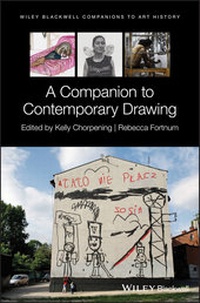
A Companion to Contemporary Drawing
Description

The first university-level textbook on the power, condition, and expanse of contemporary fine art drawing
A Companion to Contemporary Drawing explores how 20th and 21st century artists have used drawing to understand and comment on the world. Presenting contributions by both theorists and practitioners, this unique textbook considers the place, space, and history of drawing and explores shifts in attitudes towards its practice over the years. Twenty-seven essays discuss how drawing emerges from the mind of the artist to question and reflect upon what they see, feel, and experience.
This book discusses key themes in contemporary drawing practice, addresses the working conditions and context of artists, and considers a wide range of personal, social, and political considerations that influence artistic choices. Topics include the politics of eroticism in South American drawing, anti-capitalist drawing from Eastern Europe, drawing and conceptual art, feminist drawing, and exhibitions that have put drawing practices at the centre of contemporary art. This textbook:
- Demonstrates ways contemporary issues and concerns are addressed through drawing
- Reveals how drawing is used to make powerful social and political statements
- Situates works by contemporary practitioners within the context of their historical moment
- Explores how contemporary art practices utilize drawing as both process and finished artifact
- Shows how concepts of observation, representation, and audience have changed dramatically in the digital era
- Establishes drawing as a mode of thought
Part of the acclaimed Wiley Blackwell Companions to Art History series, A Companion to Contemporary Drawing is a valuable text for students of fine art, art history, and curating, and for practitioners working within contemporary fine art practice.
More details
Other editions
Additional editions
Persons
Kelly Chorpening is the Fine Art Programme Director at Camberwell College of Arts, University of the Arts, London. She has worked extensively in drawing as an artist, writer, curator and educator, within fine art and across disciplines, and in a number of national contexts.
Rebecca Fortnum is Professor of Fine Art at the Royal College of Art, UK. She is the author of Contemporary British Women Artists; In their own words and On Not Knowing; How Artists Think. She has exhibited widely including solo exhibitions at the Freud Museum and the The V&A Museum of Childhood in London.
Content
- Cover
- Title Page
- Copyright Page
- Contents
- List of Illustrations
- Notes on Contributors
- Acknowledgments
- Introduction
- Part 1 The Power of Drawing
- Chapter 1 The Black Index
- Kenyatta A.C. Hinkle: The Evanesced
- Titus Kaphar: Asphalt and Chalk
- Whitfield Lovell: Rounds
- Double Take
- Notes
- References
- Chapter 2 A State of Alert: The Politics of Eroticism in South American Drawing
- Defining South American Drawing
- The Politics of Drawing Maps
- Away with These Ancient Disabilities: Erotic Drawing in Brazil
- Outside the Boundaries of the Normal: Drawing and Pornography Toward Greater Freedom
- Epilogue
- Notes
- References
- Chapter 3 Graphic Witness
- Notes
- References
- Chapter 4 Drawn from Communism: Anti-Capitalist Drawing from Central-Eastern Europe
- Dialectics of Black and White
- (Not-So) White Cube
- Working as Drawing
- Baddrawing2
- Sistine Chapel of Egalitarian Art
- Interpretation as Practice
- Drawing as a Tool
- Drawing's Pedagogical Turn
- Drawing Surplus Population
- Drawing as the Brechtian Actor
- Notes
- References
- Chapter 5 Differencing Drawing: Feminist Perspectives on Line, Surface, and Space
- Encounter I: The Line of Christine Taylor Patten (USA, b.1940)
- Encounter II: Eva Hesse (b.1936) and Surface
- Encounter III: Claudette Johnson (b.1959) with Adrian Piper (b.1948)
- Encounter V Differencing: Some Theoretical Reflections
- References
- Chapter 6 A Dirty Double Mirror: Drawing, Autobiography and Feminism1
- Autobiography and Drawing
- Portraits and Self-Portraits
- Autobiographical Fictions
- Fool, of Thyself Speak Well: Fool, Do Not Flatter18
- Self-Made
- The Graphic Arts
- Through a Glass, Darkly
- Notes
- References
- Video
- Artworks cited
- Further Reading
- Chapter 7 Between the Sky and the Handle: Shilpa Gupta's Drawings in the Contemporary
- Drawing and Conceptual Art in Contemporary Indian art
- Acknowledgment
- Notes
- References
- Further Reading
- Chapter 8 Drawing as Contagion: Jade Montserrat
- Chapter 9 Curating Drawing: Exhibitions and the Centering of Drawing in Contemporary Art
- Introduction
- Drawing, Now and Then
- Drawing as Center7
- Notes
- References
- Part 2 The Condition of Drawing
- Chapter 10 Observation and Drawing: From Looking to Seeing
- A Line of Thought
- The Looking Encounter
- Notes
- References
- Chapter 11 "Drawing's Impropriety"
- The Subjectile
- The Ground
- Blank Silence
- Appendix
- Notes
- References
- Chapter 12 Drawing in Atopia: An Exploration of "Drift" as Method
- Notes
- References
- Chapter 13 Works on/in/with Paper: Approaching Drawing as Responsive Marking
- The First Drawings, or Appropriating the Surface
- Working with What Is in the Surface
- The First Drawings Revisited, or Being Beside the Surface
- Following the Mark, Following the Surface
- Notes
- References
- Chapter 14 Indexical Drawing: On Frottage
- Indexicality
- Max Ernst
- Rosalind Krauss on the Index
- Michelle Stuart
- Masao Okabe
- Do Ho Suh
- Anna Barriball
- Notes
- References
- Chapter 15 Ground as Critical Limit1
- Claiming the Surface
- Concealment
- Production of the Ground
- Terminology
- Note
- References
- Chapter 16 Drawing's Finish
- Acknowledgments
- Notes
- References
- Chapter 17 Radical Antinomies: Drawing and Conceptual Art
- Drawing as Thinking
- The Mediated Mark
- Paperwork
- Wall Drawings
- Withdrawing
- Academy of the Erased de Kooning
- References
- Chapter 18 Drawing Desires
- References
- Chapter 19 Drawing from Life and the Twenty-first Century Art School
- Introduction
- Changes in Art Education
- The Agency of Drawing
- Drawing, Photography and the Mass Sharing of Images
- Barbara Walker
- Robert Longo
- Spatial Drawing, William Kentridge and Tatiana Trouvé
- Acknowledgments
- Notes
- References
- Further Reading
- Part 3 The Expanse of Drawing
- Chapter 20 Marking Time, Moving Images: Drawing and Film
- Marking Time
- Cinematic Drawing
- Repetition, Silence, and Futility
- Film Stills and Transferred Photographs
- Rohfilm and Direct Animation
- Drawings for Projection
- Conclusion: Time Held Up
- Notes
- References
- Chapter 21 Digital Drawing
- Transmission in Analogue Drawing
- Early Analogue Computer Drawing
- Digital Drawing Begins
- Toward Transparency
- A Longer Continuity: The Appeal of Transparency
- Resisting Transparency
- Digitized Continuity
- Digitally Native Continuity
- Conclusion: Whatever Else We Miss
- Notes
- References
- Chapter 22 The Dot and the Line: Drawing Amongst Computers
- Medium Specificity, Drawing and the Digital
- The Beginning of Drawing with Computers
- Computer Drawings and Specific Objects
- Drawing Machines
- Autonomy and Algorithms
- Digital Drawing's esthetic
- Notes
- References
- Chapter 23 Installation/Drawing: Spaces of Drawing Between Art and Architecture
- The Space in Drawing
- Figures of Spaces
- Spaces of Representation
- Grounds for Drawing
- The Space of Drawing
- Notes
- References
- Chapter 24 Informational Drawing
- Notes
- References
- Chapter 25 Drawing Towards Sound - Notation, Diagram, Drawing
- Sound, Symbol, Notation
- Graphics, Chance, and Indeterminacy
- Performing Events
- Toward an Interdisciplinary Dialogue
- References
- Chapter 26 Chinese Calligraphy: A Drawing Ecology
- Speaking Forms
- Calligraphic Materials
- Fit to Use
- Alliances and Critical Vectors
- Recently
- Final Remarks
- References
- Further Readings
- Reproductions
- Chapter 27 The Enduring Power of Comic Strips
- Notes
- References
- Index
- EULA
