

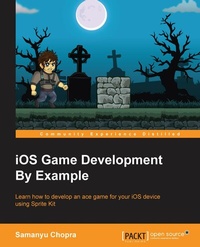
iOS Game Development By Example
Description

Key Features
Learn about the Sprite Kit engine and create games on the iOS platform from the ground up
Acquaint your Sprite Kit knowledge with Swift programming and turn your 2D game conceptualization into reality in no time
An abridged and focused guide to develop an exhaustive mobile game
Book DescriptionGame development has always been an exciting subject for game enthusiasts and players and iOS game development takes a big piece of this cake in terms of perpetuating growth and creativity. With the newest version of iOS and Sprite Kit, comes a series of breathtaking features such as Metal rendering support, camera nodes, and a new and improved Scene Editor. Conceptualizing a game is a dream for both young and old. Sprite Kit is an exciting framework supported by Apple within the iOS development environment. With Sprite Kit, creating stunning games has become an easy avenue. Starting with the basics of game development and swift language, this book will guide you to create your own fully functional game. Dive in and learn how to build and deploy a game on your iOS platform using Sprite Kit game engine. Go on a detailed journey of game development on the iOS platform using the Sprite Kit game engine. Learn about various features implemented in iOS 8 that further increase the essence of game development using Sprite Kit. Build an endless runner game and implement features like physics bodies, character animations, scoring and other essential elements in a game. You will successfully conceive a 2D game along with discovering the path to reach the pinnacle of iOS game development. By the end of the book, you will not only have created an endless runner game but also have in-depth knowledge of creating larger games on the iOS platform. Style and approach An easy-to-follow, comprehensive guide that makes your learning experience more intriguing by gradually developing a Sprite Kit game. This book discusses each topic in detail making sure you attain a clear vision of the subject.What you will learn
Learn about the Sprite Kit game engine and create indie games in no time
Set sail on the quest of game development career by successfully creating a runner game
Know more about the IDE provided by Apple for game development - Xcode
Get an overview of Apple's latest programming language, Swift
Discover the functionalities of scenes and nodes in a game
Explore how physics bodies work and how to add this feature into your game
Grasp knowledge of particle effect and shaders
Add a scoring system into your game to visualize high scores
Who this book is forThis book is for beginners who want to start their game development odyssey in the iOS platform. If you are an intermediate or proficient game developer hailing from a different development platform, this book will be a perfect gateway to the Sprite Kit engine. The reader does not need to have any knowledge of Sprite Kit and building games on the iOS platform.
All prices
More details
Other editions
Additional editions
Person
Samanyu Chopra is a developer, entrepreneur, and Blockchain supporter with wide experience of conceptualizing, developing, and producing computer and mobile software's. He has been programming since the age of 11. He is proficient in programming languages such as JavaScript, Scala, C#, C++, Swift, and so on. He has a wide range of experience in developing for computers and mobiles. He has been a supporter of Bitcoin and blockchain since its early days and has been part of wide-ranging decentralized projects since a long time. You can write a tweet to him at @samdonly1.
Content
Introduction to Sprite Kit
"Scenes"
"Sprite"
Nodes
"Physics"
"Animating Sprite Controls and Scene Kit"
"Particle Effect and Shaders"
Handling Multiple Scene and Level
using UI kit and some performance enhancement and extras
"Finalizing our game and integrating game center"
Adding a sprite without using textures
Mostly in a game, we add texture to our sprite, but we can also make a sprite without using textures. A texture property is an optional property in the SKSpriteNode class. If texture is nil, that means we have no texture to stretch, so the contract parameter is ignored. Let's open our GameScene.swift file and make a variable of SKSpriteNode, just below the backgroundNode declaration:
Now, with the preceding declaration, we have declared spriteWithoutTexture as optional. Since we have declared it optional, texture need not require a value. Now under didMoveToView, add following function:
After that, call this function inside didMoveToView(), below the addBackGround() function:
Now tap on play and see what happens. In our GameScene there is no change. Well that's not what we desire. Actually, we missed the z position of our texture. That's why it is rendering behind the background and not showing to us. Add this line in our addSpriteWithoutTexture() function, before addChild(spriteWithoutTexture!):
Run it. You will see a red square in the middle of the screen.
The code is self-explanatory. We made an instance of SKSpriteNode by instantiating it. We are passing nil as parameter for texture, meaning we don't want texture for this sprite. As we have made this sprite reference optional, we will have to unwrap it before using any SKSpriteNode properties, and we do so by using the ! mark after spriteWithoutTexture.
We can also initialize in another way. Delete the texture parameter from the initialization part:
Change the preceding initialization part as shown in the following:
spriteWithoutTexture = SKSpriteNode(color: UIColor.redColor(), size: CGSizeMake(100, 100))Run the code and it will produce the same result as the previous one. It automatically assigns nil to texture, and initializes a sprite with a color and the specified bounds. Let's do something interesting with it.
Changing the color property
We are going to use color property to change color when a user taps on this sprite. For this, first give a name to spriteWithoutTexture, so that we can recognize a tap on it:
Add the following function in the GameScene.swift file to change color, as shown in the following code:
Now, we use the touchesBegan function to detect touch by a user (as it was used previously in the MenuScene class):
Now, after running Xcode, click on the colorful area in GameScene. You will see that area changing its color.
In this code, when a user taps on the sprite, it will add a value to the current one and call the changeColor() function. In the changeColor() function, we have taken a switch case to determine the color property of spriteWithoutTexture. In Swift, switch case is used as in many other languages. We don't have to use the break statement. Every switch statement must be exhaustive. That means, we have to make every single case check for switch case. Hence, we have to write a default value for every switch case.
If our texture is not nil, we can use the colorBlendFactor property to colorize the texture. We can use it for a tinting effect, such as damage taken in the game; colorBlendFactor is ignored if texture is nil. Its default value is 0.0, which means that the texture should remain unmodified. When we increase the value, texture color is replaced with the blended color.
Changing colorBlendFactor in MenuScene
Let's add a tint to our play button. Open MenuScene and define a variable named tintChanger inside the MenuScene class as optional Float, so that we won't need to assign a value to it in the initializer:
Add the following function in the MenuScene class:
Call it from the update function:
Now run Xcode. You will see the Play button appearing and disappearing respectively.
In this code, we just make a Float type variable. In our tintPlayButton function, we check if the value of its colorBlendFactor property is between 1 to 0.
Now let's give it a color, inside the addChildToScene function:
Run it and you will see the Play button changing its color from the original one to reddish. Now, it's time to see the position property in action.
Changing the position of a sprite
Now, have a look at the position property of SKSpriteNode. Let's open GameScene again, as we are going to see the spriteWithoutTexture.position property and the ways we can set it. Add this function below changeColor:
And call it just below the changeColor() call.
Now if you will run it and tap inside your game scene, you will see spriteWithoutTexture changing its position and toggling between them.
The most part of the code is the same as in changecolor(), except the position. In case 0, we set its position to CGPointZero. Position is measured in the CGPoint unit. CGPointZero is equivalent to CGPointMake(0, 0). The position of a sprite depends on its anchorPoint as well as its parent anchorPoint.
As we define GameScene anchorPoint to (0.5 , 0.5), it means any other node which will be added to GameScene will have the starting position(0,0), from the middle of the screen. That's why the background and spriteWithoutTexture (0,0) co-ordinate will be in middle of the screen.
Now, as we specified the anchorPoint of spriteWithoutTexture, it will take its default value of (0.5,0.5). This means that its anchorPoint will be in the center of it. Hence, in case 0, it is rendering in the middle of the screen symmetrically. In case 1 and case 2, we just moved it to the right middle corner and left middle corner of the screen.
Let's try to change anchorPoint and see what happens. Add this line inside addSpriteWithoutTexture:
Now run it.
Before tap
After tap
You will see that all the positions are not as they were before. Can you guess the reason for this?
In the preceding code line, we assigned the new value (0,0) to spriteWithoutTexture, which will remove its default value (0.5,0.5). This means that its anchorPoint will not start from its middle. It will start from the bottom left of this. To visualize it, consider your sprite's top right corner as 1,1, and bottom left corner as 0,0. Now if you will set...

