

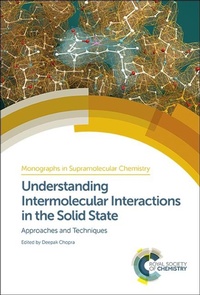
Understanding Intermolecular Interactions in the Solid State
Approaches and Techniques
1st Edition
Published on 4. September 2018
340 pages
978-1-78801-308-6 (ISBN)
Description

Technological and computational advances in the past decade have meant a vast increase in the study of crystalline matter in both organic, inorganic and organometallic molecules. These studies revealed information about the conformation of molecules and their coordination geometry as well as the role of intermolecular interactions in molecular packing especially in the presence of different intermolecular interactions in solids. This resulting knowledge plays a significant role in the design of improved medicinal, mechanical, and electronic properties of single and multi-component solids in their crystalline state.
Understanding Intermolecular Interactions in the Solid State explores the different techniques used to investigate the interactions, including hydrogen and halogen bonds, lone pair-pi, and pi-pi interactions, and their role in crystal formation.
From experimental to computational approaches, the book covers the latest techniques in crystallography, ranging from high pressure and in situ crystallization to crystal structure prediction and charge density analysis. Thus this book provides a strong introductory platform to those new to this field and an overview for those already working in the area. A useful resource for higher level undergraduates, postgraduates and researchers across crystal engineering, crystallography, physical chemistry, solid-state chemistry, supramolecular chemistry and materials science.
Understanding Intermolecular Interactions in the Solid State explores the different techniques used to investigate the interactions, including hydrogen and halogen bonds, lone pair-pi, and pi-pi interactions, and their role in crystal formation.
From experimental to computational approaches, the book covers the latest techniques in crystallography, ranging from high pressure and in situ crystallization to crystal structure prediction and charge density analysis. Thus this book provides a strong introductory platform to those new to this field and an overview for those already working in the area. A useful resource for higher level undergraduates, postgraduates and researchers across crystal engineering, crystallography, physical chemistry, solid-state chemistry, supramolecular chemistry and materials science.
More details
Series
Language
English
Place of publication
Cambridge
United Kingdom
Target group
Professional and scholarly
File size
33,02 MB
ISBN-13
978-1-78801-308-6 (9781788013086)
DOI
10.1039/9781788013086
Copyright in bibliographic data and cover images is held by Nielsen Book Services Limited or by the publishers or by their respective licensors: all rights reserved.
Schweitzer Classification
Other editions
Additional editions
Book
09/2018
Royal Society of Chemistry
€216.50
Shipment within 3-4 weeks
E-Book
09/2018
1st Edition
Royal Society of Chemistry
€233.99
Available for download
Person
Content
Integrating Computed Crystal Energy Landscapes in Crystal Form Discovery and Characterisation;
High Pressure Crystallography: Elucidating the Role of Intermolecular Interactions in Crystals of Organic and Coordination Compounds;
Intermolecular Interactions in In situ Cryocrystallized Compounds;
Experimental Electron Density Studies of Inorganic Solids;
Experimental Charge Density Analysis in Organic Solids;
Charge Density Studies and Topological Analysis of Hydrogen Bonds in Proteins;
Towards a Generalized Database of Atomic Polarizabilities;
Solid-state NMR in the Study of Intermolecular Interactions;
Quantitative Analysis of Weak Non-covalent ?-Hole and ?-Hole Interactions
High Pressure Crystallography: Elucidating the Role of Intermolecular Interactions in Crystals of Organic and Coordination Compounds;
Intermolecular Interactions in In situ Cryocrystallized Compounds;
Experimental Electron Density Studies of Inorganic Solids;
Experimental Charge Density Analysis in Organic Solids;
Charge Density Studies and Topological Analysis of Hydrogen Bonds in Proteins;
Towards a Generalized Database of Atomic Polarizabilities;
Solid-state NMR in the Study of Intermolecular Interactions;
Quantitative Analysis of Weak Non-covalent ?-Hole and ?-Hole Interactions
