

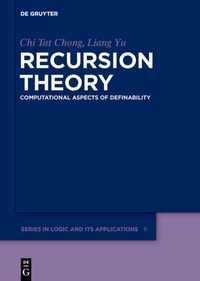
Recursion Theory
Description

This monograph presents recursion theory from a generalized point of view centered on the computational aspects of definability. A major theme is the study of the structures of degrees arising from two key notions of reducibility, the Turing degrees and the hyperdegrees, using techniques and ideas from recursion theory, hyperarithmetic theory, and descriptive set theory.
The emphasis is on the interplay between recursion theory and set theory, anchored on the notion of definability. The monograph covers a number of fundamental results in hyperarithmetic theory as well as some recent results on the structure theory of Turing and hyperdegrees. It also features a chapter on the applications of these investigations to higher randomness.
Reviews / Votes
"This book serves two purposes, and does so very well. In Part I, it provides an exposition of the now-classical theory of definability in first-order arithmetic, in the form of the arithmetic hierarchy, and in second-order arithmetic, in the form of effective descriptive set theory. This part would be a good source on which to base a graduate course on this material. In Parts II-IV, by giving a coherent and systematic treatment spanning many modern examples, it illustrates how these classical ideas have evolved into powerful mathematical tools, which is valuable both to newcomers and to experts." Mathematical Reviews
"This is a very well written book by researchers who contributed with significant results to the field, the treatment is mathematical rigourous, with important open problems, and an up-dated list of references. The book is suited for advanced courses and research." Zentralblatt für Mathematik
More details
Other editions
Additional editions
Persons
Content
1. ?11-uniformization and Applications to Turing Degrees
2. Rigidity of Hyperdegrees
3. Basis Theorems and ?11-Hyperarithmetic
4. The Jump Operator
5. Independence Results in the Turing Degrees
6. Higher Randomness
References
Index
