

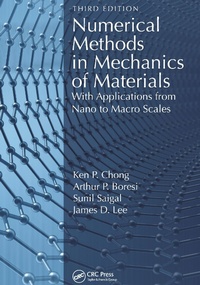
Numerical Methods in Mechanics of Materials
With Applications from Nano to Macro Scales
Published on 27. November 2017
332 pages
978-1-351-38099-7 (ISBN)
Description

In the dynamic digital age, the widespread use of computers has transformed engineering and science. A realistic and successful solution of an engineering problem usually begins with an accurate physical model of the problem and a proper understanding of the assumptions employed. With computers and appropriate software we can model and analyze complex physical systems and problems.
However, efficient and accurate use of numerical results obtained from computer programs requires considerable background and advanced working knowledge to avoid blunders and the blind acceptance of computer results. This book provides the background and knowledge necessary to avoid these pitfalls, especially the most commonly used numerical methods employed in the solution of physical problems. It offers an in-depth presentation of the numerical methods for scales from nano to macro in nine self-contained chapters with extensive problems and up-to-date references, covering:
Trends and new developments in simulation and computation
Weighted residuals methods
Finite difference methods
Finite element methods
Finite strip/layer/prism methods
Boundary element methods
Meshless methods
Molecular dynamics
Multiphysics problems
Multiscale methods
However, efficient and accurate use of numerical results obtained from computer programs requires considerable background and advanced working knowledge to avoid blunders and the blind acceptance of computer results. This book provides the background and knowledge necessary to avoid these pitfalls, especially the most commonly used numerical methods employed in the solution of physical problems. It offers an in-depth presentation of the numerical methods for scales from nano to macro in nine self-contained chapters with extensive problems and up-to-date references, covering:
Trends and new developments in simulation and computation
Weighted residuals methods
Finite difference methods
Finite element methods
Finite strip/layer/prism methods
Boundary element methods
Meshless methods
Molecular dynamics
Multiphysics problems
Multiscale methods
Reviews / Votes
"The book includes detailed descriptions of trending materials modeling methods such as concurrent multiscale methods and molecular dynamics methods. The authors explain well how these methods can be used to model materials at very fine scales and improve predictions compared to conventional approaches. The description contains enough numerical implementation details to allow students, engineers and researchers interested in high fidelity materials modeling to try the methods presented in the book."-- Wing Kam Liu, Northwestern University, USA
"This is a one-of-a-kind book and good for numerical methods to solve problems in mechanics of materials, from the nanoscale to the macroscale."
-- Shaofan Li, University of California, Berkeley, USA
"The book would be of greatest use for practicing engineers or graduate students in mechanical engineering, applied mechanics, applied physics, materials science, and related fields."
--J. Lambropoulos, University of Rochester in Choice Connect
More details
Language
English
Place of publication
London
United Kingdom
Publishing group
Taylor & Francis Ltd
Target group
College/higher education
Illustrations
10 s/w Tabellen, 78 s/w Zeichnungen
10 Tables, black and white; 78 Line drawings, black and white
File size
25,86 MB
ISBN-13
978-1-351-38099-7 (9781351380997)
Copyright in bibliographic data and cover images is held by Nielsen Book Services Limited or by the publishers or by their respective licensors: all rights reserved.
Schweitzer Classification
Other editions
Additional editions
Ken Chong | Arthur Boresi | Sunil Saigal
Numerical Methods in Mechanics of Materials
With Applications from Nano to Macro Scales
Book
09/2020
1st Edition
CRC Press
€65.60
Shipment within 15-20 days
Ken Chong | Arthur Boresi | Sunil Saigal
Numerical Methods in Mechanics of Materials
With Applications from Nano to Macro Scales
Book
12/2017
1st Edition
CRC Press
€178.27
Shipment within 10-20 days
Persons
Ken P. Chong was the former Interim Division Director, Engineering Advisor, and Program Director of Structural Systems, Mechanics and Materials at the National Science Foundation (NSF), 1989 - 2009. Currently he is a Research Professor at George Washington University. He earned a Ph.D. in Engineering Mechanics from Princeton University in 1969. He specializes in solid mechanics and materials, computational mechanics, nano-mechanics, smart structures and structural mechanics. He has been the principal investigator of over 20 federally funded research projects (from NSF, DOD, DOE, DOI, etc). He was a senior research engineer with the National Steel Corp. for 5 years after graduation from Princeton. After that he was a professor for 15 years at a state university. He has published 200 technical papers, authored 4 textbooks on engineering mechanics including Elasticity in Engineering Mechanics; Approximate Solution Methods in Engineering Mechanics, and edited 10 books including University Programs in Computer-Aided Engineering, Design, and Manufacturing; Materials for the New Millennium; Modeling and Simulation-based Life-cycle Engineering. He was the editor of the Elsevier Journal of Thin-Walled Structures, 1987-2013. He is co-editor of the UK Journal of Smart and Nano Materials, a CRC/Spon book series on structures as well as serving on several editorial boards. He has given over 50 keynote lectures at major conferences, the Mindlin, Sadowsky and Raouf Lectures, received awards including the fellow of ASME, American Academy of Mechanics, SEM, and United States Association for Computational Mechanics; Edmund Friedman Professional Recognition Award; Honorary Doctorate, Shanghai University; Honorary Professor, Harbin Institute of Technology; NCKU Distinguished Alumnus, Distinguished Member, ASCE; NSF highest Distinguished Service Award, AWU-DOE Outstanding Academic and Professional Achievement Award, and the ASME Belytschko Mechanics Award. He was the ASME Thurston Lecturer for 2014.
Arthur P. Boresi: Professor Emeritus in the Mechanical Science and Engineering Department at the University of Illinois at Urbana-Champaign, where he taught for more than 20 years, and later as the Head of the Department of Civil and Architectural Engineering at the University of Wyoming in Laramie. He is currently Professor Emeritus in the Civil and Architectural Engineering Department of the University of Wyoming. He has published over 200 refereed papers and several books including Elasticity in Engineering Mechanics, Advanced Mechanics of Materials, Engineering Statics and Engineering Dynamics. He had chaired and organized national conferences for ASCE and other societies. He is a fellow of AAM, ASME and ASCE.
Sunil Saigal: Ph.D.(Purdue), PE is a Distinguished Professor in the Department of Civil and Environmental Engineering and former Dean of Engineering at New Jersey Institute of Technology as well as a former NSF Program Director. His research in the area of computational mechanics has spanned numerous sub-disciplines and industrial applications. Much of his research has been focused on interactions with the industry and these contributions have included: development of boundary element shape optimization in collaboration with United Technologies; formulations for powder packing in collaboration with Alcoa and DuPont; development of computational models for nonlinear soil behavior in collaboration with ANSYS; cohesive element formulations for post crack behavior of glass-polymer composites in collaboration with DuPont; explicit algorithms for high velocity impact in collaboration with Naval Surface Warfare Center; computational simulations of acetabular hip component in collaboration with University of Pittsburgh Medical Center. These interdisciplinary efforts involved diverse ?elds ranging from anatomy to computer science to materials and solid mechanics. Recognition of his work has occurred through awards/honors including: Leighton and Margaret Orr Award for Best Paper, ASME, 2004; George Tallman Ladd Research Award, Carnegie Mellon University, 1990; Presidential Young Investigator Award, NSF, 1990; Ralph R. Teetor Award, Society of Automotive Engineers, 1988. He is the co-author of ?ve books on engineering mechanics and holds a patent for a method of manufacturing hot rolled I-beams. He is the author of over 100 peer-reviewed articles in archival journals. He has served on the editorial boards of several journals including International Journal for Numerical Methods in Engineering, Engineering with Computers, and International Journal for Computational Civil and Structural Engineering. He is a fellow of numerous societies including, ASCE, ASME and AAAS.
James D. Lee: Professor of Engineering and Applied Science in the Department of Mechanical and Aerospace Engineering, George Washington University, Washington, DC. He was an Associate Professor at West Virginia University and University of Minnesota. He worked at General Tire and Rubber Company for one year, National Institute of Standard and Technology for four years, NASA/Goddard Space Flight Center for one year. He earned a Ph.D. degree from Department of Mechanical and Aerospace Engineering, Princeton University in 1971. He has been doing research in many fields, including Nano Science, Multiscale Modeling, Mechanobiology, Microcontinuum Physics, Continuum Mechanics, Fracture Mechanics, Finite Element Method, Meshless Method, Optimal Control Theory, and Robotics, etc. He has been the principal investigator of federally funded research projects from NASA, NSF and DOT. He has published 120 journal papers, 20 book chapters, 2 textbooks "Meshless Methods in Solid Mechanics" and "Elasticity in Engineering Mechanics", and numerous conference papers and presentations. He has received the Distinguished Researcher Award from the School of Engineering and Applied Science, The George Washington University. He is the Fellow of ASME and Honorary Fellow of Australian Institute of High Energetic Materials.
Arthur P. Boresi: Professor Emeritus in the Mechanical Science and Engineering Department at the University of Illinois at Urbana-Champaign, where he taught for more than 20 years, and later as the Head of the Department of Civil and Architectural Engineering at the University of Wyoming in Laramie. He is currently Professor Emeritus in the Civil and Architectural Engineering Department of the University of Wyoming. He has published over 200 refereed papers and several books including Elasticity in Engineering Mechanics, Advanced Mechanics of Materials, Engineering Statics and Engineering Dynamics. He had chaired and organized national conferences for ASCE and other societies. He is a fellow of AAM, ASME and ASCE.
Sunil Saigal: Ph.D.(Purdue), PE is a Distinguished Professor in the Department of Civil and Environmental Engineering and former Dean of Engineering at New Jersey Institute of Technology as well as a former NSF Program Director. His research in the area of computational mechanics has spanned numerous sub-disciplines and industrial applications. Much of his research has been focused on interactions with the industry and these contributions have included: development of boundary element shape optimization in collaboration with United Technologies; formulations for powder packing in collaboration with Alcoa and DuPont; development of computational models for nonlinear soil behavior in collaboration with ANSYS; cohesive element formulations for post crack behavior of glass-polymer composites in collaboration with DuPont; explicit algorithms for high velocity impact in collaboration with Naval Surface Warfare Center; computational simulations of acetabular hip component in collaboration with University of Pittsburgh Medical Center. These interdisciplinary efforts involved diverse ?elds ranging from anatomy to computer science to materials and solid mechanics. Recognition of his work has occurred through awards/honors including: Leighton and Margaret Orr Award for Best Paper, ASME, 2004; George Tallman Ladd Research Award, Carnegie Mellon University, 1990; Presidential Young Investigator Award, NSF, 1990; Ralph R. Teetor Award, Society of Automotive Engineers, 1988. He is the co-author of ?ve books on engineering mechanics and holds a patent for a method of manufacturing hot rolled I-beams. He is the author of over 100 peer-reviewed articles in archival journals. He has served on the editorial boards of several journals including International Journal for Numerical Methods in Engineering, Engineering with Computers, and International Journal for Computational Civil and Structural Engineering. He is a fellow of numerous societies including, ASCE, ASME and AAAS.
James D. Lee: Professor of Engineering and Applied Science in the Department of Mechanical and Aerospace Engineering, George Washington University, Washington, DC. He was an Associate Professor at West Virginia University and University of Minnesota. He worked at General Tire and Rubber Company for one year, National Institute of Standard and Technology for four years, NASA/Goddard Space Flight Center for one year. He earned a Ph.D. degree from Department of Mechanical and Aerospace Engineering, Princeton University in 1971. He has been doing research in many fields, including Nano Science, Multiscale Modeling, Mechanobiology, Microcontinuum Physics, Continuum Mechanics, Fracture Mechanics, Finite Element Method, Meshless Method, Optimal Control Theory, and Robotics, etc. He has been the principal investigator of federally funded research projects from NASA, NSF and DOT. He has published 120 journal papers, 20 book chapters, 2 textbooks "Meshless Methods in Solid Mechanics" and "Elasticity in Engineering Mechanics", and numerous conference papers and presentations. He has received the Distinguished Researcher Award from the School of Engineering and Applied Science, The George Washington University. He is the Fellow of ASME and Honorary Fellow of Australian Institute of High Energetic Materials.
Content
The Role of Numerical Methods in Engineering. Numerical Analysis and Weighted Residuals. Finite Difference Methods. The Finite Element Method. Specialized Methods. The Boundary Element Method. Meshless Methods of Analysis. Multiphysics in Molecular Dynamics Simulation. Multiscale Modeling from Atoms to Genuine Continuum.
