

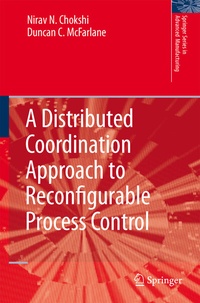
A Distributed Coordination Approach to Reconfigurable Process Control
Description

Success in the continuous process industries depends upon the ability to adapt to the demands of global supply chains in real-time. Thus, process plants must be designed to be easily reconfigured as and when necessary. "A Distributed Coordination Approach to Reconfigurable Process Control" presents research that addresses this issue, via developing a new distributed framework that will enable the building of a process control system that is capable of reconfigurability. This framework views the process as a set of readily-integrated, modular process elements, which operate relatively independently and are each supported by a degree of stand-alone decision-making capability. The rationale and benefits of moving towards the new approach is demonstrated by means of a worked example of a real process plant. The research will also help end-users to gain an understanding of the economic aspects of material flows across their plants, and the ways in which their processes can be integrated across the enterprise.
Reviews / Votes
From the reviews:
"The book is well organized and presents the most important classical and modern essentials of manufacturing control engineering. Suitable for senior under graduate and under graduate students as well as practical engineers and researchers interested in a distributed coordination approach to reconfigurable process control." (Seenith Sivasundaram, Zentrablatt MATH, Vol. 1153, 2009)
More details
Other editions
Additional editions
Persons
Nirav Chokshi is a Visiting Researcher with the Centre for Distributed Automation and Control at the University of Cambridge. He has worked in the chemical industry and the nuclear industry, where he was involved in a variety of small-to-medium scale projects on design and maintenance of process automation systems. His research interests include distributed automation, systems integration and process optimization and control.
Duncan McFarlane is a Professor of Service and Support Engineering at the Engineering Department of the University of Cambridge, and Head of the Distributed Information & Automation Laboratory within the Institute for Manufacturing. He is also Director of the Cambridge Auto-ID Lab and Research Director of two industrially supported activities: the Service and Support Engineering Programme and the Aero ID Programme. He has been involved in the design and operation of automation and information system for the manufacturing supply chain for twenty years. His research interests include manufacturing control & automation, modular manufacturing systems design, analysis and synthesis of co-operative control systems, information filtering, model tuning and adaptation, manufacturing systems integration, fault diagnostics, automated identification systems, quality control, and supply chain execution systems.
