

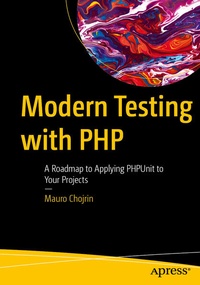
Modern Testing with PHP
Description

As a seasoned PHP developer, you've mastered classes, objects, and interfaces, yet bugs continue to surface after deployment, and often your clients are the ones discovering them. Frustrated by the tedious debugging and the stress of unexpected issues, you've decided it's time to elevate your skills. You've dabbled with PHPUnit, grasping the theory, but applying it effectively to real-world projects feels overwhelming. Questions like how to write meaningful tests, how many to create, and whether to test before or after coding keep you second-guessing your approach.
This book is your opportunity to leave behind the frustration of unreliable code and embrace a structured, confidence-building testing process. Modern Testing with PHP offers a practical roadmap, starting with foundational concepts and step-by-step guidance for installing tools, moving from manual testing to fully automated frameworks. Along the way, you'll gain a deeper understanding of what to test and why, learning strategies that provide proof your software works as intended. With this knowledge, you'll deploy with assurance and take pride in the quality of your work.
Packed with real-world examples, exercises, and actionable insights, this book equips you to transform your testing skills, regardless of your project's framework. You'll bridge the gap between theory and practice, building a robust testing foundation applicable to any PHP application. By the end, you'll not only deliver reliable software but also have a toolset that simplifies development and enhances your professional confidence.
You Will Learn:
- How to leverage TDD to improve your code
- How to implement ATDD
- How to make the most of PHPUnit
- How to write effective tests for your code
This Book for:
Intermediate/advanced PHP developers looking to deploy with increased confidence.
More details
Other editions
Additional editions
Person
Mauro Chojrin is a senior software developer with more than 20 years of experience ranging from small startups to multinational companies. Currently, he works as a technical coach, helping software development teams become more efficient by embracing XP practices.
Content
Chapter 1: About Automated Tests.- Chapter 2: Introduction to PHPUnit.- Chapter 3: Advanced uses of PHPUnit.- Chapter 4: Test Last.- Chapter 5: Test First.- Chapter 6: Testing from the outside in.- Chapter 7: Case study.
