

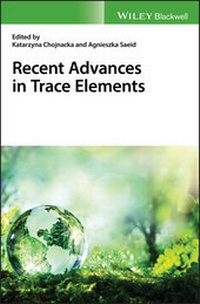
Recent Advances in Trace Elements
Description

This reference provides the latest research into the presence, characterization, and applications of trace elements and their role in humans, animals, and plants as well as their use in developing novel, functional feeds, foods, and fertilizers. It takes an interdisciplinary approach to the subject, describing the biological and industrial applications of trace elements. It covers various topics, such as the occurrence, role, and monitoring of trace elements and their characterization, as well as applications from the preliminary research to laboratory trials.
Recent Advances in Trace Elements focuses on the introduction and prospects of trace elements; tackles environmental aspects such as sources of emission, methods of monitoring, and treatment/remediation processes; goes over the biological role of trace elements in plants, animals, and human organisms; and discusses the relevance of biomedical applications and commercialization.
* A compendium of recent knowledge in interdisciplinary trace element research
* Uniquely covers production and characterization of trace elements, as well as the industrial and biomedical aspects of their use
* Paves the way for the development of innovative products in diverse fields, including pharmaceuticals, food, environment, and materials science
* Edited by well-known experts in the field of trace elements with contributions from international specialists from a wide range of areas
Unique in presenting comprehensive and multidisciplinary information of the key aspects of trace elements research in a digestible form, this book is essential reading for the novice and expert in the fields of environmental science, analytical chemistry, biochemistry, materials science, pharmaceutical science, nutraceutical, and pharmaceutical sciences. It is also valuable for companies that implement new products incorporating trace elements to the market.
More details
Other editions
Additional editions
Persons
About the Editors
Katarzyna Chojnacka, Faculty of Chemistry at Wroclaw University of Science and Technology, Poland.
Agnieszka Saeid, Faculty of Chemistry at Wroclaw University of Science and Technology, Poland.
Content
List of Contributors ix
1 Introduction 1
Katarzyna Chojnacka
2 Historical Aspects 11
Henryk Górecki and Katarzyna Chojnacka
3 Modern Analytical Methods of Speciation and Determination of Trace Elements in Inorganic, Organic, and Biological Samples 33
Boguslaw Buszewski, Wojciech Piekoszewski, Pawel Pomastowski, Katarzyna Rafinska, Mateusz Sugajski, and Tomasz Kowalkowski
4 Trace Elements in the Environment - Law, Regulations, Monitoring and Biomonitoring Methods 61
Elzbieta Mackiewicz, Aleksandra Pawlaczyk, and Malgorzata Iwona Szynkowska
5 Problems of Trace Elements in Water and Wastewater Treatment 105
Karol Pokomeda, Anna Dawiec-Lisniewska, Daria Podstawczyk, Macarena Rodriguez-Guerra Pedregal, Barbara Ortega Barcelo, and Anna Witek-Krowiak
6 Trace Elements in Agricultural and Industrial Wastes 121
Aneta Wisniewska, Agnieszka Saeid, and Katarzyna Chojnacka
7 Trace Elements in Aquatic Environments 143
Piotr Konieczka, Bartlomiej Cieslik, and Jacek Namiesnik
8 Trace Metals in Soils: A Review of Methods for Monitoring Trace Metals in Soils 161
Philiswa N. Nomngongo, Joseph M. Matong, and Tshimangandzo S. Munonde
9 The Role of Trace Elements in Living Organisms 177
Elzbieta Gumienna-Kontecka, Magdalena Rowinska-Zyrek, and Marek Luczkowski
10 Fluorine and Silicon as Essential and Toxic Trace Elements 207
Izabela Michalak and Katarzyna Chojnacka
11 Biological Functions of Cadmium, Nickel, Vanadium, and Tungsten 219
Agnieszka Dmytryk, Lukasz Tuhy, Mateusz Samoraj, and Katarzyna Chojnacka
12 Biosorption of Trace Elements 235
Inga Zinicovscaia
13 Bioaccumulation and Biomagnification of Trace Elements in the Environment 251
Malgorzata Iwona Szynkowska, Aleksandra Pawlaczyk, and Elzbieta Mackiewicz
14 Hydrometallurgy and Bio-crystallization of Metals by Microorganisms 277
Zygmunt Sadowski and Agnieszka Pawlowska
15 Trace Elements as Fertilizer Micronutrients 299
Izabela Michalak, Agnieszka Saeid, Katarzyna Chojnacka, and Mateusz Gramza
16 Trace Elements in Animal Nutrition 319
Lukasz Tuhy, Agnieszka Dmytryk, Mateusz Samoraj, and Katarzyna Chojnacka
17 Trace Elements in Human Nutrition 339
Klaudia Konikowska and Anna Mandecka
18 Trace Elements in Human Health 373
Renata Mozrzymas
19 Spirulina as a Raw Material for Products Containing Trace Elements 403
Liliana Cepoi, Tatiana Chiriac, Ludmila Rudi, Svetlana Djur, Liliana Zosim, Valentina Bulimaga, Ludmila Batir, Daniela Elenciuc, and Valery Rudic
20 Dietary Food and Feed Supplements with Trace Elements 421
Athanasios C. Pappas, Katarzyna Godlewska, and Peter F. Surai
21 Biofortification of Food with Trace Elements 443
Mateusz Samoraj, Lukasz Tuhy, Agnieszka Dmytryk, and Katarzyna Chojnacka
22 Biomarkers of Trace Element Status 457
Katarzyna Chojnacka and Marcin Mikulewicz
23 Human Exposure to Trace Elements from Dental Biomaterials 469
Marcin Mikulewicz and Katarzyna Chojnacka
24 Industrial Use of Trace Elements and their Impact on the Workplace and the Environment 481
Piotr Rusek and Marzena Mikos-Szymanska
25 Speciation of Trace Elements and its Importance in Environmental and Biomedical Sciences 501
Aleksandra Pawlaczyk, Elzbieta Mackiewicz, and Malgorzata Iwona Szynkowska
26 Trace Elements - A Threat or Benefit? 545
Katarzyna Chojnacka, Izabela Michalak, Agnieszka Saeid, Katarzyna Godlewska, Lukasz Tuhy, Mateusz Samoraj, Agnieszka Dmytryk, and Aneta Wisniewska
Index 569
1
Introduction
Katarzyna Chojnacka
Wroclaw University of Science and Technology, Faculty of Chemistry, Department of Advanced Material Technologies, Wroclaw, Poland
1.1 Introduction
Trace elements (TEs), although present in low quantities, can have significant effects in living organisms. Although the role of trace elements in the human body is not yet fully understood, it is known that their effect on human health can be essential, neutral, or detrimental [1]. Trace elements play a role in many chemical, biochemical, and enzymatic reactions; biological and physiological, catabolic and metabolic processes of living organisms [2]. Their role relies on the unique property of them forming complexes and binding with macromolecules (e.g., proteins) [1]. Frequently mentioned trace elements or micronutrients are: Cr, Co, Cu, F, I, Mn, Mo, Se, V, and Zn. The main sources of these elements for humans are drinking water, food and food supplements, and the general environment. There are trace elements that are essential, but there are also those that are non-essential or potentially toxic: Al, As, Cd, Hg, and Pb [2].
Humans are exposed to trace elements from atmospheric suspended particles in street and house dust to soil and are exposed through different routes such as inhalation, ingestion, or dermal adsorption. The establishment of emission standards for trace elements is important when considering the potential impact on society from urban areas, taking into account toxicity and the degree of human exposure [3].
1.2 Definition of Trace Elements (TEs)
Trace elements were first described at the beginning of the twentieth century as elements present at very low levels in different matrices. In actual fact, different branches of science (e.g., geochemistry, medicine, agriculture, and chemistry) have different understandings of TEs. The word "trace" is usually related to abundance, and includes elements with different chemical properties: elements and metalloids, including the micronutrients group, essential elements, and toxic elements. In geochemistry, TEs are chemical elements that occur in the earth's crust in amounts less than 0.1% and to biological sciences TEs are elements present in trace concentrations in living organisms [4]. The result of these differences is that, until now, no precise definition of TEs has been provided. Elements that are trace in biological materials are not necessarily trace in terrestrial environments (e.g., iron) [4]. Early research theorized that these elements do not play important functions due to their low abundance [1] but, more recently, it has been shown that this is not the case.
1.3 Sources of Trace Elements for Humans
There are beneficial effects of TEs in food. However, in some cases, impurities in the food chain and in the general environment has been observed to have detrimental effects [1]. The relation between bioavailability and speciation in food is an important factor here, especially concerning iron, selenium, or chromium [1].
Vincevica-Gaile et al. [2] reviewed the trace metal content in foods from plant (vegetables: carrots, onions, potatoes) and animal origin (cottage cheese, eggs, honey). Environmental factors (e.g., geographical location or seasonality), botanical origin, agricultural practices, product processing, and storage were all found to influence the content of TEs. The level of TEs in food depends on the environmental conditions of specific sites such as the composition of soil and water [2].
Tea plants contain high levels of TEs because they are grown in acidic soils where metal ions are more available for uptake by the root system. Some of the TEs (Al, Cu, Cd, Cr, Mn, and Ni) are beneficial; others are harmful for human health and are transferred through tea infusion. The content of tea has been assessed and found to show nutritional value, but also adverse health effects [5]. Tea contains 4-9% of inorganic matter, 30% of which is extracted. Polyphenolic compounds (flavonoids) bind metal ions, especially Fe and Cu [5]. The reported TE contents in fresh tea leaves are as follows (mg/kg): for example, Chinese tea [6]: Al 2034-3322, Cd 0.03-0.08, Cu 9.68-18.82, As 0.024-0.066, and Pb 0.31-3.42 [7] and Turkish tea: Mn 2617-3154 and Ni 6.60-11.7 [5, 8].
A good dietary source of TEs (Fe, Cu, Zn, and Mn) comes from seaweed. For instance, Porphyra vietnamensis can be added to foods to improve the content of essential minerals and trace elements. The strong flavor of seaweeds is related to the presence of TEs, the content of which is higher than in terrestrial vegetables. An example content of TEs in seaweed is: Fe 1260 mg/kg and Cu 7.46 mg/kg. The consumption of 8 g of green, brown, or red seaweed contains more than 25% of a daily Dietary Recommended Intake [9].
1.4 Analytical methods
Pollution of the environment with trace metals has generated the need for finding suitable analytical methods that are sensitive, rapid, effective, and reliable. Several analytical techniques; inductively coupled plasma-atomic emission spectrometry (ICP-AES), inductively coupled plasma-mass spectrometry (ICP-MS), atomic absorption spectrometry (AAS), x-ray fluorescence (XRF), total reflection x-ray fluorescence (TXRF) spectroscopy, and neutron activation analysis (NAA) have been developed to analyze and monitor trace elements in environmental and food samples, as well as in the human body [10]. The determination methods ICP-OES, NAA, and ICP-MS are techniques with high sensitivity and multi-element capability [11]. TXRF is a quantitative analysis technique for liquid samples which can be deposited as thin films on clean reflectors. The sensitivity and detection limits of TXRF are better than XRF [10].
The unique chemical properties and coherent behavior of TEs means that their environmental distribution reflects geographical location and aquatic factors (e.g., source input and water-rock interaction). Similarities between trace metals and their very low concentrations do, however, make determination difficult. Problems appear if a particular element is evaluated in a mixture with other elements as interferences and coincidences can occur [11]. The matrix and elements that are to be analyzed dictate the how difficult an analysis may be. For example, the direct determination of REEs (Rare Earth Elements) in high-salt groundwater, because the concentrations of REEs are close to the detection limit of ICP-MS and there are high concentrations of matrix ions (K, Na, Ca, and Mg) which defocus the extracted ion beam due to space charge effects, means that significant losses of analyte sensitivity are produced [11].
For this reason, pre-concentration techniques are used and separation from the matrix elements is required before ICP-MS analysis takes place. Solid phase extraction (SPE) or solvent extraction (SE) techniques are employed for the pre-treatment of high-salt samples (e.g., seawater). This removes the matrix components and enriches the samples with analytes. Of course, this can generate a new matrix and new interferences [11].
Speciation of TEs is important in the analysis of food, quality of products, health, and environment. Mobility, bioavailability, storage, retention, and toxicity of TEs depends on their chemical form. Biochemical and geochemical pathways depend on speciation [1]. Of particular importance is characterizing speciation of TEs in samples related to the chemistry of life. This requires the elaboration of separation techniques, sensitive enough to determine elements, as well as the identification of metallo-compounds [12]. The problem with speciation analysis is related to the low total concentration of TEs, for example, ng/L in serum. The level of given species can even be several times lower. Another problem lies within non-covalent bonds that are formed by TEs in different matrices such as tissue, blood, urine, sediment, water, and sludge, that are unstable especially after sampling [1].
1.5 Toxicity
The toxicity of TEs depends not only on their concentration (dose), but also on their speciation. Safe and adequate daily intake (SAI), and acceptable daily intake (ADI) have been defined as important toxicological measures. Table 1.1 summarizes the important toxicological issues related to TEs together with guidelines for drinking water and daily intake.
Table 1.1 Trace elements and their toxicity [5, 13].
WHO prescribed guideline value in drinking water, mg/L The estimated maximum intake, as FAO/WHO for provisional tolerable weekly intake (PTWI) µg/kg body weight (µg/person per week) ADI (Acceptable Daily Intake) (mg/d, safe and adequate daily intake) Toxic properties As 0.001 15 (900) - Mutagenic and carcinogenic, highly toxic to plants and animals. Cd 0.003 0.004 (420) - Human carcinogen. Origin in cropped soil: phosphate fertilizers - 50 % input. Phytotoxic, inhibits plant growth, affects assimilation of nitrates, disturbs plant balance of water and ions. Impairs photosynthesis. Cr 0.05 - - Essential, but also poses adverse effects. In...