

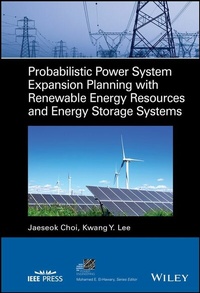
Probabilistic Power System Expansion Planning with Renewable Energy Resources and Energy Storage Systems
Description

Discover how modern techniques have shaped complex power system expansion planning with this one-stop resource from two experts in the field
Probabilistic Power System Expansion Planning with Renewable Energy Resources and Energy Storage Systems delivers a comprehensive collection of innovative approaches to the probabilistic planning of generation and transmission systems under uncertainties. The book includes renewables and energy storage calculations when using probabilistic and deterministic reliability techniques to assess system performance from a long-term expansion planning viewpoint.
Divided into two sections, the book first covers topics related to Generation Expansion Planning, with chapters on cost assessment, methodology and optimization, and more. The second and final section provides information on Transmission System Expansion Planning, with chapters on reliability constraints, probabilistic production cost simulation, and more.
Probabilistic Power System Expansion Planning compares the optimization and methodology across dynamic, linear, and integer programming and explores the branch and bound algorithm. Along with case studies to demonstrate how the techniques described within have been applied in complex power system expansion planning problems, readers will enjoy:
* A thorough discussion of generation expansion planning, including cost assessment, methodology and optimization, and probabilistic production cost
* An exploration of transmission system expansion planning, including the branch and bound algorithm, probabilistic production cost simulation for TEP, and TEP with reliability constraints
* An examination of fuzzy decision making applied to transmission system expansion planning
* A treatment of probabilistic reliability-based grid expansion planning of power systems including wind turbine generators
Perfect for power and energy systems designers, planners, operators, consultants, practicing engineers, software developers, and researchers, Probabilistic Power System Expansion Planning with Renewable Energy Resources and Energy Storage Systems will also earn a place in the libraries of practicing engineers who regularly deal with optimization problems.
More details
Other editions
Additional editions
Persons
JAESEOK CHOI, PHD, is Full Professor at Gyeongsang National University and is a Fellow of the Korean Institute of Electrical Engineers. He is a senior member of the IEEE Power Engineering Society and participates in the Reliability, Risk, and Probability Applications Subcommittee.
KWANG Y. LEE, PHD, is Professor and Chair of Electrical and Computer Engineering at Baylor University and a Life Fellow of IEEE. He is a member of the Intelligent Systems Subcommittee and Station Control Subcommittee of the IEEE Power and Energy Society.
Content
Author Biographies xvii
Preface xix
Acknowledgments xxv
Part I Generation Expansion Planning 1
1 Introduction 3
1.1 Electricity Outlook 3
1.2 Renewables 8
1.3 Power System Planning 12
2 Background on Generation Expansion Planning 15
2.1 Methodology and Issues 15
2.2 Formulation of the Least-Cost Generation Expansion Planning Problem 18
3 Cost Assessment and Methodologies in Generation Expansion Planning 21
3.1 Basic Cost Concepts 21
3.1.1 Annual Effective Discount Rate 22
3.1.2 Present Value 23
3.1.3 Relationship Between Salvage Value and Depreciation Cost 24
3.2 Methodologies 26
3.2.1 Dynamic Programming 26
3.2.2 Linear Programming 27
3.2.2.1 Investment Cost (Capital Cost) 27
3.2.2.2 Operating Cost 27
3.2.2.3 LP Formula 28
3.2.3 Integer Programming 28
3.2.4 Multi-objective Linear Programming 28
3.2.5 Genetic Algorithm 29
3.2.6 Game Theory 30
3.2.7 Reliability Worth 32
3.2.8 Maximum Principle 32
3.3 Conventional Approach for Load Modeling 34
3.3.1 Load Duration Curve 34
4 Load Model and Generation Expansion Planning 39
4.1 Introduction 39
4.2 Analytical Approach for Long-Term Generation Expansion Planning 40
4.2.1 Representation of Random Load Fluctuations 41
4.2.2 Available Generation Capacities 43
4.2.3 Expected Plant Outputs 44
4.2.4 Expected Annual Energy 47
4.2.5 Reliability Measures 47
4.2.5.1 Expected Annual Unserved Energy 47
4.2.5.2 Annual Loss-of-Load Probability 47
4.2.6 Expected Annual Cost 48
4.2.7 Expected Marginal Values 49
4.3 Optimal Utilization of Hydro Resources 50
4.3.1 Introduction 50
4.3.2 Conventional Peak-Shaving Operation and its Problems 51
4.3.3 Peak-Shaving Operation Based on Analytical Production Costing Model 52
4.3.3.1 Basic Concept 52
4.3.3.2 Peak-Shaving Operation Problem 53
4.3.4 Optimization Procedure for Peak-Shaving Operation 53
4.4 Long-Range Generation Expansion Planning 56
4.4.1 Statement of Long-Range Generation Expansion Planning Problem 56
4.4.1.1 Master Problem and Basic Subproblems 57
4.4.1.2 Hydro Subproblem 58
4.4.2 Optimization Procedures 59
4.5 Case Studies 60
4.5.1 Test for Accuracy of Formulas 60
4.5.2 Test for Solution Convergence and Computing Efficiency 62
4.6 Conclusion 65
5 Probabilistic Production Simulation Model 67
5.1 Introduction 67
5.2 Effective Load Distribution Curve 67
5.3 Case Studies 71
5.3.1 Case Study I: Sample System I With One 30MW Generator Only 71
5.3.2 Case Study II: Sample System II With One 10MW Generator Only 75
5.3.3 Case Study III: Sample System III With Two Generators - 30 and 10MW 78
5.4 Probabilistic Production Simulation Algorithm 82
5.4.1 Hartley Transform 82
5.5 Supply Reserve Rate 90
6 Decision Maker's Satisfaction Using Fuzzy Set Theory 95
6.1 Introduction 95
6.2 Fuzzy Dynamic Programming 96
6.3 Best Generation Mix 97
6.3.1 Problem Statement 97
6.3.2 Objective Functions 97
6.3.3 Constraints 99
6.3.4 Membership Functions 100
6.3.5 The Proposed Fuzzy Dynamic Programming-Based Solution Procedure 101
6.4 Case Study 102
6.4.1 Results and Discussion 104
6.5 Conclusion 108
7 Best Generation Mix Considering Air Pollution Constraints 111
7.1 Introduction 111
7.2 Concept of Flexible Planning 111
7.3 LP Formulation of the Best Generation Mix 112
7.3.1 Problem Statement 112
7.3.2 Objective Functions 113
7.4 Fuzzy LP Formulation of Flexible Generation Mix 116
7.4.1 The Optimal Decision Theory by Fuzzy Set Theory 116
7.4.2 The Function of Fuzzy Linear Programming 117
7.5 Case Studies 118
7.5.1 Results by Non-Fuzzy Model 120
7.5.2 Results by Fuzzy Model 122
7.6 Conclusion 124
8 Generation System Expansion Planning with Renewable Energy 127
8.1 Introduction 127
8.2 LP Formulation of the Best Generation Mix 128
8.2.1 Problem Statement 128
8.2.2 Objective Function and Constraints 129
8.3 Fuzzy LP Formulation of Flexible Generation Mix 132
8.3.1 The Optimal Decision Theory by Fuzzy Set Theory 132
8.3.2 The Function of Fuzzy Linear Programming 133
8.4 Case Studies 134
8.4.1 Test Results 134
8.4.2 Sensitivity Analysis 134
8.4.2.1 Capacity Factor of WTG and SCG 134
8.5 Conclusion 140
9 Reliability Evaluation for Power System Planning with Wind Generators and Multi-Energy Storage Systems 141
9.1 Introduction 141
9.2 Probabilistic Reliability Evaluation by Monte Carlo Simulation 143
9.2.1 Probabilistic Operation Model of Generator 1 143
9.2.2 Probabilistic Operation Model of Generator 2 144
9.3 Probabilistic Output Prediction Model of WTG 145
9.4 Multi-Energy Storage System Operational Model 147
9.4.1 Constraints of ESS control (EUi,k) 149
9.5 Multi-ESS Operation Rule 150
9.5.1 Discharging Mode 150
9.5.2 Charging Mode 151
9.6 Reliability Evaluation with Energy Storage System 151
9.7 Case Studies 152
9.7.1 Power System of Jeju Island 152
9.7.2 Reliability Evaluation of Single-ESS 156
9.7.3 Reliability Evaluation of Multi-ESS 159
9.7.4 Comparison of System A and System B 162
9.8 Conclusion 163
9.A Appendices 164
9.A.1 Single-ESS Model 164
9.A.2 Multi-ESS Model 167
9.A.3 Operation of Multi-ESS Models 168
Method 1: Energy Rate Dispatch Method (ERDM) 173
Method 2: Maximum First Priority Method (MFPM) 173
9.A.4 A Comparative Analysis of Single-ESS and Multi-ESS Models 175
10 Genetic Algorithm for Generation Expansion Planning and Reactive Power Planning 177
10.1 Introduction 177
10.2 Generation Expansion Planning 178
10.3 The Least-Cost GEP Problem 179
10.4 Simple Genetic Algorithm 180
10.4.1 String Representation 181
10.4.2 Genetic Operations 181
10.5 Improved GA for the Least-Cost GEP 182
10.5.1 String Structure 182
10.5.2 Fitness Function 182
10.5.3 Creation of an Artificial Initial Population 183
10.5.4 Stochastic Crossover, Elitism, and Mutation 185
10.6 Case Studies 186
10.6.1 Test Systems' Description 186
10.6.2 Parameters for GEP and IGA 187
10.6.3 Numerical Results 189
10.6.4 Summary 192
10.7 Reactive Power Planning 192
10.8 Decomposition of Reactive Power Planning Problem 194
10.8.1 Investment-Operation Problem 194
10.8.2 Benders Decomposition Formulation 195
10.9 Solution Algorithm for VAR Planning 196
10.10 Simulation Results 198
10.10.1 The 6-bus System 198
10.10.2 IEEE 30-bus System 199
10.10.3 Summary 200
10.11 Conclusion 201
References 203
Part II Transmission System Expansion Planning 213
11 Transmission Expansion Planning Problem 215
11.1 Introduction 215
11.2 Long-Term Transmission Expansion Planning 216
11.3 Yearly Transmission Expansion Planning 218
11.3.1 Power Flow Model 218
11.3.2 Optimal Operation Cost Model 220
11.3.3 Probability of Line Failures 222
11.3.4 Expected Operation Cost 223
11.3.5 Annual Expected Operation Cost 224
11.4 Long-Term Transmission Planning Problem 224
11.4.1 Long-Term Transmission Planning Model 225
11.4.2 Solution Technique for the Planning Problem 226
11.5 Case Study 227
11.6 Conclusion 232
12 Models and Methodologies 235
12.1 Introduction 235
12.2 Transmission System Expansion Planning Problem 235
12.3 Cost Evaluation for TEP Considering Electricity Market 236
12.4 Model Development History for TEP Problem 237
12.5 General DC Power Flow-Based Formulation of TEP Problem 238
12.5.1 Linear Programming 239
12.5.2 Dynamic Programming 240
12.5.3 Integer Programming (IP) 242
12.5.4 Genetic Algorithm by Mixed Integer Programming (MIP) 245
12.6 Branch and Bound Algorithm 246
12.6.1 Branch and Bound Algorithm and Flow Chart 246
12.6.2 Sample System Study by Branch and Bound 248
13 Probabilistic Production Cost Simulation for TEP 257
13.1 Introduction 257
13.2 Modeling of Extended Effective Load for Composite Power System 259
13.3 Probability Distribution Function of the Synthesized Fictitious Equivalent Generator 263
13.4 Reliability Evaluation and Probabilistic Production Cost Simulation at Load Points 265
13.5 Case Studies 266
13.5.1 Numerical Calculation of a Simple Example 266
13.5.2 Case Study: Modified Roy Billinton Test System 274
13.6 Conclusion 288
14 Reliability Constraints 291
14.1 Deterministic Reliability Constraint Using Contingency Constraints 291
14.1.1 Introduction 291
14.1.2 Transmission Expansion Planning Problem 292
14.1.3 Maximum Flow Under Contingency Analysis for Security Constraint 297
14.1.4 Alternative Types of Contingency Criteria 298
14.1.5 Solution Algorithm 299
14.1.6 Case Studies 300
14.1.7 Conclusion 316
Appendix 319
14.2 Deterministic Reliability Constraints 322
14.2.1 Introduction 322
14.2.2 Transmission System Expansion Planning Problem 323
14.2.3 Maximum Flow Under Contingency Analysis for Security Constraint 325
14.2.4 Solution Algorithm 325
14.2.5 Case Studies 326
14.2.6 Conclusion 331
14.3 Probabilistic Reliability Constraints 333
14.3.1 Introduction 333
14.3.2 Transmission System Expansion Planning Problem 338
14.3.3 Composite Power System Reliability Evaluation 340
14.3.4 Solution Algorithm 343
14.3.5 Case Study 344
14.3.6 Conclusion 357
14.4 Outage Cost Constraints 357
14.4.1 Introduction 357
14.4.2 The Objective Function 358
14.4.3 Constraints 359
14.4.4 Outage Cost Assessment of Transmission System 360
14.4.5 Reliability Evaluation of Transmission System 363
14.4.6 Outage Cost Assessment 363
14.4.7 Solution Algorithm 364
14.4.8 Case Study 365
14.4.9 Conclusion 369
14.5 Deterministic-Probabilistic (D-P) Criteria 373
15 Fuzzy Decision Making for TEP 375
15.1 Introduction 375
15.2 Fuzzy Transmission Expansion Planning Problem 377
15.3 Equivalent Crisp Integer Programming and Branch and Bound Method 379
15.4 Membership Functions 380
15.5 Solution Algorithm 381
15.6 Testing 382
15.6.1 Discussion of Results 384
15.6.2 Solution Sensitivity to Reliability Criterion 387
15.6.3 Sensitivity to Budget for Construction Cost 389
15.7 Case Study 390
15.8 Conclusion 396
15.A Appendix 396
15.A.1 Network Modeling of Power System 396
15.A.2 Definition 397
15.A.3 Fuzzy Integer Programming (FIP) 398
16 Optimal Reliability Criteria for TEP 401
16.1 Introduction 401
16.2 Probabilistic Optimal Reliability Criterion 401
16.2.1 Introduction 401
16.2.2 Optimal Reliability Criterion Determination 403
16.2.3 Optimal Composite Power System Expansion Planning 403
16.2.3.1 The Objective Function 403
16.2.3.2 Constraints 405
16.2.4 Composite Power System Reliability Evaluation and Outage Cost Assessment 406
16.2.4.1 Reliability Evaluation at HLI 406
16.2.4.2 Reliability Evaluation at HLII (Composite Power System) 407
16.2.4.3 Flow Chart of the Proposed Methodology for Optimal Reliability Criterion Determination in Transmission System Expansion Planning 409
16.2.5 Case Study 410
16.2.6 Conclusion 416
16.3 Deterministic Reliability Criterion for Composite Power System Expansion Planning 416
16.3.1 Introduction 416
16.3.2 Optimal Reliability Criterion Determination 419
16.3.3 Optimal Composite Power System Expansion Planning 419
16.3.3.1 Composite Power System Expansion Planning Formulation in CmExpP.For 419
16.3.3.2 Flow Chart 421
16.3.4 Composite Power System Reliability Evaluation 421
16.3.4.1 Reliability Indices at Load Points 422
16.3.4.2 Reliability Indices of the Bulk System 423
16.3.5 DMR Evaluation using Maximum Flow Method 424
16.3.6 Flow Chart of Optimal Reliability Criterion Determination 424
16.3.7 Case Study 425
16.3.7.1 Basic Input Data 425
16.3.7.2 Results of Construction Costs of Cases 428
16.3.7.3 Reliability Evaluation 428
16.3.8 Conclusion 431
17 Probabilistic Reliability-Based Expansion Planning with Wind Turbine Generators 433
17.1 Introduction 433
17.2 The Multistate Operation Model of WTG 434
17.2.1 WTG Power Output Model 434
17.2.2 Wind Speed Model 435
17.2.3 The Multistate Model of WTG using Normal ProbabilityDistribution Function 435
17.3 Reliability Evaluation of a Composite Power System with WTG 438
17.3.1 Reliability Indices at Load Buses 440
17.3.2 System Reliability Indices 440
17.4 Case Study 441
17.5 Conclusion 448
17.A Appendix 448
18 Probabilistic Reliability-Based HVDC Expansion Planning with Wind Turbine Generators 449
18.1 The Status of HVDC 449
18.2 HVDC Technology for Energy Efficiency and Grid Reliability 451
18.3 HVDC Impacts on Transmission System Reliabili ty 455
18.4 Case Study 455
References 465
Index 469
Preface
This book, Probabilistic Power System Expansion Planning with Renewable Energy Resources and Energy Storage Systems, is written for power system expansion planning concept under the new environment. The objective of this book is to review the state-of-the-art technologies in power system expansion planning and present case studies on how these techniques have been applied in complex power system expansion planning problems. Emphasis is given to applications rather than theory, and the organization of the book is on an application basis rather than tools.
The book can serve as a resource book for power system engineers in utilities, government, and industry, who are interested in electric power system generation and transmission expansion planning based on deterministic as well as probabilistic approaches. The book can also be used as a reference for graduate students in advanced standing in power and energy systems. Power systems expansion planning tools in the book are key subjects for continuing education for engineers and managers in many utilities.
The book is organized into two parts: Part I is on Generation Expansion Planning (GEP). In addition to the conventional thermal generating power plants, this part includes expansion planning with renewable energy sources in the viewpoint of Best Generation Mix (BGM) and energy storage systems (ESS). Part II is on Transmission Expansion Planning (TEP). In addition to the conventional AC transmission network expansion, this part also includes high-voltage DC (HVDC) transmission expansion planning.
In Part I, background, cost assessment, and model and optimization methodologies are first introduced for GEP. Specially, effective load models for probabilistic production cost simulation are developed and long-range generation planning problem is formulated as a dynamic optimization problem and the maximum principle is used as a solution technique. Furthermore, this book is discussing a fuzzy set theory application to power system planning and applied to the BGM problem considering environmental constraints. The GEP problem is expanded to include RES, and Reliability is evaluated considering Energy Storage Systems (ESSs). Finally, the GEP is improved with the Genetic Algorithm and augmented with the Reactive Power Planning (RPP) problem. Part I is organized in 10 chapters and their contents are highlighted in the following:
- Chapter 1 introduces the importance of electricity as energy in the modernization of the society and its expansion plans considering Sustainable Development Goal (SDG). The assumption of worldwide electricity production needed until 2040 is also briefly described with figures. The importance of renewables (solar, hydropower, or wind energy) as per environmental and economic issues concerned is also introduced. The basic and typical Generation Expansion Planning (GEP) criteria are derived in steps.
- GEP is one of the most important decision-making activities in electric utilities. Chapter 2 discusses the history of the methodologies and issues used in GEP and the least-cost generation expansion planning formulated which is to find a set of optimal decision vectors over a planning horizon that minimizes an objective function under several constraints.
- Chapter 3 defines and briefly discusses the types of costs associated with electric power-generating plants and systems in GEP and the methodologies used for solving the GEP problems. Therefore, while the terminology and conventions presented in this chapter are typical, they are not universal and are intended only to illustrate the basic concepts and categories of costs for power plants and electric generating systems.
- Chapter 4 presents a novel analytical approach to long-term GEP by representing random load fluctuations with Gaussian distribution functions, which probabilistically provides expected plant outputs, expected annual energy, expected reliability measures, expected annual cost including salvage cost, and expected marginal values. The optimal long-term GEP problem with a sufficiently accurate analytical cost formula is formulated as an investment optimization problem based on the discrete maximum principle that allows for the incorporation of any kind of constraints that are found necessary. The formulation enables to convert the multi-year high-dimensional optimization problem into a yearly low-dimensional Hamiltonian minimization problem with dynamic constraints. An advantage of the analytical approach is demonstrated when hydro resources are integrated for peak-shaving operation.
- Supply Reserve Rate (SRR) analysis becomes more important along with the huge expansion of power systems. The deterministic SRR and probabilistic Loss of Load Expectation (LOLE) relationship can be categorized by the exact method (Booth-Baleriaux method) and approximation methods (MONA). In Chapter 5, the probabilistic reliability evaluation and production cost simulation program, PRASim, was used to obtain these relationships.
- Chapter 6 proposes a fuzzy dynamic programming-based solution approach for the long-term generation mix with multi-stages (years) considering air pollution constraints on CO2 emissions under uncertain circumstances and demonstrated on a KEPCO-system. This proposed approach can accommodate pumped storage hydro and nuclear plants with strict load following considering SOx and NOx emissions.
- In Chapter 7, an alternative approach for the long-term generation mix with multi-criteria considering air pollution constraints is proposed using linear programming (LP), which not only considers SOx and NOx but also CO2 emission limitations. This flexible generation mix problem is proposed for the Korea Vision 2030. The approach provides a flexible solution to the generation mix plan.
- Chapter 8 has proposed a fuzzy LP-based approach for the long-term best generation mix with multi-criteria considering renewable energy generators such as wind turbine generators (WTGs) and solar cell generators (SCGs) and air pollution constraints. The proposed method can accommodate sensitivity analysis of capacity factor (CF) and apparent escalation rate (CER) of WTG and SCG including uncertainties. The effectiveness is demonstrated for the best generation mix in the Korea Vision 2030 which also includes other types of generation.
- Chapter 9 presents a new methodology for probabilistic power system reliability evaluation using a Monte Carlo simulation (MCS) when a multi-energy storage system (ESS) is integrated with wind farms in GEP. A large-scale WTG creates significant power fluctuations and affects the stability, frequency control, and reliability of the power system. A case study is demonstrated for the proposed model and methods in a power system in Jeju Island, Korea.
- Chapter 10 introduces an improved genetic algorithm (IGA) for a long-term least-cost generation expansion planning problem. It provides a better solution by incorporating improvements as compared to tunnel-constrained dynamic programming (TCDP) employed in the Wien Automatic System Planning (WASP) Package. A synthetic method of reactive power planning, modified simple genetic method (MSGA) approach, is introduced which uses not only objective function like SGA but also dual variable information.
In Part II, the TEP problem is decomposed into yearly and long-term transmission planning problems, and the Long-Term TEP is formulated as a dynamic optimization problem with the maximum principle as a solution technique. Different models of cost evaluation and methodologies for TEP are described with a special focus on Branch and Bound Method to solve the integer programming problem for the TEP. Probabilistic production cost models considering forced outage and capacity of transmission lines are extended and developed using the extended effective load and fictitious equivalent generator which is modeled as multi-states. Deterministic and probabilistic reliability constraints are presented for TEP. Deterministic reliability constraints are developed using the contingency analysis for security constraints and expanded to include bus marginal rate (BMR). As in GEP, the fuzzy set theory is also applied to TEP for decision making. The optimal deterministic and probabilistic reliability criteria are determined for composite power system expansion planning with an outage cost assessment. Finally, the TEP is considered for the composite power system expansion planning with wind turbine generators and HVDC. Part II is organized into eight chapters and their contents are highlighted in the following:
- Chapter 11 addresses the long-term transmission expansion planning (TEP) problem. The transmission planning algorithm is based on the linear power flow and failure probabilities for the operation cost model and the maximum principle for the long-term investment model. The optimization problem consists of the long-term problem to determine the annual investment and the yearly problem to determine the optimal operation. The high-dimensional long-term optimization problem is formulated as a low-dimensional yearly Hamiltonian minimization problem and the yearly problem is formulated as a linear programming problem.
- The premises in TEP are discussed in Chapter 12, which are demand forecasting and generation expansion schedule. The TEP problem formulation and cost evaluation are...
