

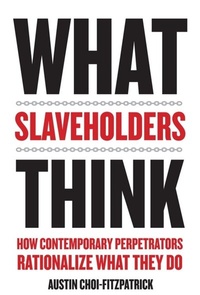
What Slaveholders Think
How Contemporary Perpetrators Rationalize What They Do
1st Edition
Published on 6. March 2017
248 pages
978-0-231-54382-8 (ISBN)
Description

Drawing on fifteen years of work in the antislavery movement, Austin Choi-Fitzpatrick examines the systematic oppression of men, women, and children in rural India and asks: How do contemporary slaveholders rationalize the subjugation of other human beings, and how do they respond when their power is threatened? More than a billion dollars have been spent on antislavery efforts, yet the practice persists. Why? Unpacking what slaveholders think about emancipation is critical for scholars and policy makers who want to understand the broader context, especially as seen by the powerful. Insight into those moments when the powerful either double down or back off provides a sobering counterbalance to scholarship on popular struggle.
Through frank and unprecedented conversations with slaveholders, Choi-Fitzpatrick reveals the condescending and paternalistic thought processes that blind them. While they understand they are exploiting workers' vulnerabilities, slaveholders also feel they are doing workers a favor, often taking pride in this relationship. And when the victims share this perspective, their emancipation is harder to secure, driving some in the antislavery movement to ask why slaves fear freedom. The answer, Choi-Fitzpatrick convincingly argues, lies in the power relationship. Whether slaveholders recoil at their past behavior or plot a return to power, Choi-Fitzpatrick zeroes in on the relational dynamics of their self-assessment, unpacking what happens next. Incorporating the experiences of such pivotal actors into antislavery research is an immensely important step toward crafting effective antislavery policies and intervention. It also contributes to scholarship on social change, social movements, and the realization of human rights.
Through frank and unprecedented conversations with slaveholders, Choi-Fitzpatrick reveals the condescending and paternalistic thought processes that blind them. While they understand they are exploiting workers' vulnerabilities, slaveholders also feel they are doing workers a favor, often taking pride in this relationship. And when the victims share this perspective, their emancipation is harder to secure, driving some in the antislavery movement to ask why slaves fear freedom. The answer, Choi-Fitzpatrick convincingly argues, lies in the power relationship. Whether slaveholders recoil at their past behavior or plot a return to power, Choi-Fitzpatrick zeroes in on the relational dynamics of their self-assessment, unpacking what happens next. Incorporating the experiences of such pivotal actors into antislavery research is an immensely important step toward crafting effective antislavery policies and intervention. It also contributes to scholarship on social change, social movements, and the realization of human rights.
All prices
More details
Other editions
Additional editions
Austin Choi-Fitzpatrick
What Slaveholders Think
How Contemporary Perpetrators Rationalize What They Do
Book
10/2019
Columbia University Press
€27.24
Shipment within 10-20 days
Austin Choi-Fitzpatrick
What Slaveholders Think
How Contemporary Perpetrators Rationalize What They Do
Book
03/2017
Columbia University Press
€37.14
Shipment within 10-20 days
Person
Austin Choi-Fitzpatrick is assistant professor of political sociology at the Joan B. Kroc School of Peace Studies at the University of San Diego. He is the coeditor of From Human Trafficking to Human Rights: Reframing Contemporary Slavery (2012), and his work has appeared in the Journal of Human Rights, Social Movement Studies, the Columbia Journal of International Affairs, Social Problems, and the Journal for the Theory of Social Behavior. All royalties from this book will be donated to Free the Slaves and Anti-Slavery International.
Content
Acknowledgments
1. In All Its Forms: Slavery and Abolition, Movements and Targets
2. Best-Laid Plans: A Partial Theory of Social-Movement Targets
3. Just Like Family: Slaveholders on Slavery
4. As If We Are Equal: Slaveholders on Emancipation
5. The Farmer in the Middle: Target Response to Threats
6. Private Wrongs: Slavery and Antislavery in Contemporary India
7. Long Goodbye: The Contemporary Antislavery Movement
8. Between Good and Evil: The Everyday Ethics of Resources and Reappraisal
Notes
References
Index
1. In All Its Forms: Slavery and Abolition, Movements and Targets
2. Best-Laid Plans: A Partial Theory of Social-Movement Targets
3. Just Like Family: Slaveholders on Slavery
4. As If We Are Equal: Slaveholders on Emancipation
5. The Farmer in the Middle: Target Response to Threats
6. Private Wrongs: Slavery and Antislavery in Contemporary India
7. Long Goodbye: The Contemporary Antislavery Movement
8. Between Good and Evil: The Everyday Ethics of Resources and Reappraisal
Notes
References
Index

