

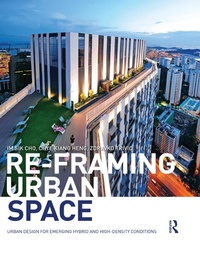
Re-Framing Urban Space
Urban Design for Emerging Hybrid and High-Density Conditions
Published on 23. October 2015
268 pages
978-1-317-53307-8 (ISBN)
Description

Re-framing Urban Space: Urban Design for Emerging Hybrid and High-Density Conditions rethinks the role and meaning of urban spaces through current trends and challenges in urban development. In emerging dense, hybrid, complex and dynamic urban conditions, public urban space is not only a precious and contested commodity, but also one of the key vehicles for achieving socially, environmentally and economically sustainable urban living. Past research has been predominantly focused on familiar models of urban space, such as squares, plazas, streets, parks and arcades, without consistent and clear rules on what constitutes good urban space, let alone what constitutes good urban space in 'high-density context'.
Through an innovative and integrative research framework, Re-Framing Urban Space guides the assessment, planning, design and re-design of urban spaces at various stages of the decision-making process, facilitating an understanding of how enduring qualities are expressed and negotiated through design measures in high-density urban environments. This book explores over 50 best practice case studies of recent urban design projects in high-density contexts, including Singapore, Beijing, Tokyo, New York, and Rotterdam.
Visually compelling and insightful, Re-Framing Urban Space provides a comprehensive and accessible means to understand the critical properties that shape new urban spaces, illustrating key design components and principles. An invaluable guide to the stages of urban design, planning, policy and decision making, this book is essential reading for urban design and planning professionals, academics and students interested in public spaces within high-density urban development.
Through an innovative and integrative research framework, Re-Framing Urban Space guides the assessment, planning, design and re-design of urban spaces at various stages of the decision-making process, facilitating an understanding of how enduring qualities are expressed and negotiated through design measures in high-density urban environments. This book explores over 50 best practice case studies of recent urban design projects in high-density contexts, including Singapore, Beijing, Tokyo, New York, and Rotterdam.
Visually compelling and insightful, Re-Framing Urban Space provides a comprehensive and accessible means to understand the critical properties that shape new urban spaces, illustrating key design components and principles. An invaluable guide to the stages of urban design, planning, policy and decision making, this book is essential reading for urban design and planning professionals, academics and students interested in public spaces within high-density urban development.
Reviews / Votes
"For a long time, conscientious professionals have expressed hostility towards dense environments and tall buildings, harboring, instead, the ideals of public spaces in the "human" scale and the city's rich visual communication in Medieval or 19th century urban design. Today, however, anybody can freely eat, profess their love, or read newspapers not only on ground level, but at heights 10m, 100m, 1,000m and 10,000m above ground. It is now time for classical knowledge to be reconstructed. This book provides stimulating material for architects, urban designers and landscape architects to revisit design philosophies on public spaces and reach brilliant new ideas fit to the realities of today." - Hidetoshi Ohno, Professor Emeritus, University of Tokyo"Focused on the dynamic, high density cities of East Asia, Reframing Urban Space argues that we need to move beyond traditional public-private space dualisms, to recognize the increasingly hybrid nature of contemporary cities. Provocative and richly illustrated, yet profoundly pragmatic, this foundational text should sit on every urban practitioner's desk." - Jennifer Wolch, William W. Wurster Dean, College of Environmental Design, University of California, Berkeley
More details
Language
English
Place of publication
London
United Kingdom
Publishing group
Taylor & Francis Ltd
Target group
College/higher education
Professional and scholarly
Illustrations
1 s/w Tabelle, 340 Farbfotos bzw. farbige Rasterbilder
1 Tables, black and white; 340 Halftones, color
File size
60,16 MB
ISBN-13
978-1-317-53307-8 (9781317533078)
Copyright in bibliographic data and cover images is held by Nielsen Book Services Limited or by the publishers or by their respective licensors: all rights reserved.
Schweitzer Classification
Other editions
Additional editions
Im Sik Cho | Chye-Kiang Heng | Zdravko Trivic
Re-Framing Urban Space
Urban Design for Emerging Hybrid and High-Density Conditions
Book
12/2015
1st Edition
Routledge
€258.50
Shipment within 10-20 days
Im Sik Cho | Chye-Kiang Heng | Zdravko Trivic
Re-Framing Urban Space
Urban Design for Emerging Hybrid and High-Density Conditions
Book
12/2015
1st Edition
Routledge
€82.00
Shipment within 10-20 days
Persons
Im Sik Cho is an assistant professor at the Department of Architecture, School of Design and Environment, National University of Singapore, where she serves as the leader for urban studies research and teaching and principal investigator for many research projects related to urban space design and participatory planning for sustainable high-density environment.
Chye Kiang Heng is a professor, urban designer and planner. Currently, he is the dean of the School of Design and Environment at the National University of Singapore. He has published four books and numerous articles and book chapters. He is visiting professor at several leading Asian universities and serves on the editorial board of a number of international journals.
Zdravko Trivic is an assistant professor at the Department of Architecture, School of Design and Environment (SDE), National University of Singapore (NUS). He also worked as a researcher at the Centre for Sustainable Cities (CSAC), SDE, NUS. His research and design work in the areas of urban design and health and space theories has been presented internationally. He has published several book chapters and conference and journal articles.
Chye Kiang Heng is a professor, urban designer and planner. Currently, he is the dean of the School of Design and Environment at the National University of Singapore. He has published four books and numerous articles and book chapters. He is visiting professor at several leading Asian universities and serves on the editorial board of a number of international journals.
Zdravko Trivic is an assistant professor at the Department of Architecture, School of Design and Environment (SDE), National University of Singapore (NUS). He also worked as a researcher at the Centre for Sustainable Cities (CSAC), SDE, NUS. His research and design work in the areas of urban design and health and space theories has been presented internationally. He has published several book chapters and conference and journal articles.
Content
1. Review - Urban Space & Current Tendencies in Urban Development 2. Understanding - Quality of Urban Space and Design Principles 3. Assessment & Analysis - Assessing the Quality of Urban Space 4. Application - Guide to Design Actions 5. Epilogue
