

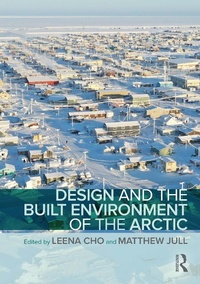
Design and the Built Environment of the Arctic
1st Edition
Published on 20. December 2023
268 pages
978-1-003-82873-0 (ISBN)
Description

Design and the Built Environment of the Arctic is a concise introductory guide to the design and planning of the built environments in the Arctic region.
As the global forces of change are becoming more pronounced in the Arctic, the future trajectories for living environments, city-making processes, and their adaptive capacities need to be addressed directly. This book presents 11 new and original contributions from both leading and emerging scholars and practitioners, positioning the Arctic as a dynamic, diverse, and lived place at the nexus of unprecedented socioenvironmental transformations. The volume offers key concepts for understanding and spatializing Arctic cities and landscapes; similarities and differences in the development of design and planning approaches responsive to specific climatic and cultural conditions; and historical and geographic case studies that provide unique perspectives for the management of the built environment, from the scales of a building and infrastructure to cities and territories. Altogether, the contributions expand regional Arctic design scholarship to understand how the variability of the Arctic context influences the designed urban, architecture, and landscape systems, and offer numerous lessons for design and other forms of spatial practice both within and beyond the Arctic.
This is a unique resource for researchers, creative practitioners, policymakers, and community decision-makers, as well as for advanced undergraduate and graduate students.
As the global forces of change are becoming more pronounced in the Arctic, the future trajectories for living environments, city-making processes, and their adaptive capacities need to be addressed directly. This book presents 11 new and original contributions from both leading and emerging scholars and practitioners, positioning the Arctic as a dynamic, diverse, and lived place at the nexus of unprecedented socioenvironmental transformations. The volume offers key concepts for understanding and spatializing Arctic cities and landscapes; similarities and differences in the development of design and planning approaches responsive to specific climatic and cultural conditions; and historical and geographic case studies that provide unique perspectives for the management of the built environment, from the scales of a building and infrastructure to cities and territories. Altogether, the contributions expand regional Arctic design scholarship to understand how the variability of the Arctic context influences the designed urban, architecture, and landscape systems, and offer numerous lessons for design and other forms of spatial practice both within and beyond the Arctic.
This is a unique resource for researchers, creative practitioners, policymakers, and community decision-makers, as well as for advanced undergraduate and graduate students.
Reviews / Votes
'A well-grounded compendium on the Arctic Region, Mathew Jull's and Leena Cho's handbook does much to render this relatively unknown part of our world whole with regard to constructed and future habitable environments. Drawing on scholarship from different parts of the world, a portrait emerges of a place being shaped under unique multi-cultural, socio-political and environmental conditions. A must-read volume for those interested in contemporary urbanism.' - Peter G. Rowe, Raymond Garbe Professor of Architecture and Urban Design, Harvard Distinguished Service Professor, Harvard University Graduate School of Design, USA'The Arctic's extreme climate, remoteness, and mixture of Indigenous and settler cultures present extraordinary design challenges to urban architects, planners, and managers. Often the built environment in the far north resembles southern models that are only poorly adapted. In contrast, the chapters in this book bring together a multidisciplinary team to further design thinking that will truly serve the interests of northern communities. The ideas assembled here help fulfill collective Arctic aspirations.' - Robert W. Orttung, Research Professor of International Affairs, George Washington University, USA
'Aptly described as "a region of spectacular negotiation between the natural and the built worlds," Cho and Jull have assembled a multidisciplinary and multiscalar reading of the inherent complexities and contradictions of architecture, landscape and urbanism in the Arctic. The ten chapters dismantle common assumptions about the singularity of the Arctic and immerse the reader in the land and ice to bear witness to "the physical, material and living environments of the Arctic." This comprehensive and global collection provides an urgent guide to contemporary design and planning scholarship in Arctic studies and will provide an essential resource to scholars and practitioners for years to come.' - Lola Sheppard, Professor, University of Waterloo, Canada, and Mason White, Professor, University of Toronto, Canada; Partners, Lateral Office 'A well-grounded compendium on the Arctic Region, Mathew Jull's and Leena Cho's handbook does much to render this relatively unknown part of our world whole with regard to constructed and future habitable environments. Drawing on scholarship from different parts of the world, a portrait emerges of a place being shaped under unique multi-cultural, socio-political and environmental conditions. A must-read volume for those interested in contemporary urbanism.' - Peter G. Rowe, Raymond Garbe Professor of Architecture and Urban Design, Harvard Distinguished Service Professor, Harvard University Graduate School of Design, USA
'The Arctic's extreme climate, remoteness, and mixture of Indigenous and settler cultures present extraordinary design challenges to urban architects, planners, and managers. Often the built environment in the far north resembles southern models that are only poorly adapted. In contrast, the chapters in this book bring together a multidisciplinary team to further design thinking that will truly serve the interests of northern communities. The ideas assembled here help fulfill collective Arctic aspirations.' - Robert W. Orttung, Research Professor of International Affairs, George Washington University, USA
'Aptly described as "a region of spectacular negotiation between the natural and the built worlds," Cho and Jull have assembled a multidisciplinary and multiscalar reading of the inherent complexities and contradictions of architecture, landscape and urbanism in the Arctic. The ten chapters dismantle common assumptions about the singularity of the Arctic and immerse the reader in the land and ice to bear witness to "the physical, material and living environments of the Arctic." This comprehensive and global collection provides an urgent guide to contemporary design and planning scholarship in Arctic studies and will provide an essential resource to scholars and practitioners for years to come.' - Lola Sheppard, Professor, University of Waterloo, Canada, and Mason White, Professor, University of Toronto, Canada; Partners, Lateral Office
More details
Edition
1. Auflage
Language
English
Place of publication
London
United Kingdom
Publishing group
Taylor & Francis Ebooks
Target group
College/higher education
Professional and scholarly
Illustrations
3 Tables, black and white; 13 Line drawings, black and white; 92 Halftones, black and white; 105 Illustrations, black and white
ISBN-13
978-1-003-82873-0 (9781003828730)
Copyright in bibliographic data and cover images is held by Nielsen Book Services Limited or by the publishers or by their respective licensors: all rights reserved.
Schweitzer Classification
Other editions
Additional editions
Leena Cho | Matthew Jull
Design and the Built Environment of the Arctic
Book
12/2023
1st Edition
Routledge
€52.50
Shipment within 10-20 days
Leena Cho | Matthew Jull
Design and the Built Environment of the Arctic
Book
12/2023
1st Edition
Routledge
€191.89
Shipment within 15-20 days
Persons
Leena Cho is an Associate Professor of Landscape Architecture at the University of Virginia School of Architecture, co-director of Arctic Design Group (ADG), and co-principal of the design practice Kutonotuk. Her research centers on material agencies, urban landscapes, and scientific sites in the Arctic environments.
Matthew Jull, Ph.D., is an Associate Professor of Architecture at the University of Virginia School of Architecture, co-director of Arctic Design Group (ADG), and co-principal of the design practice Kutonotuk. Merging backgrounds in both architecture and as a research scientist in geophysics, his work examines the design of cities and buildings in extreme environments.
Matthew Jull, Ph.D., is an Associate Professor of Architecture at the University of Virginia School of Architecture, co-director of Arctic Design Group (ADG), and co-principal of the design practice Kutonotuk. Merging backgrounds in both architecture and as a research scientist in geophysics, his work examines the design of cities and buildings in extreme environments.
Content
Introduction: Grounding Design in the Arctic 1. The Heterogeneity of Arctic Cities 2. Infrastructural Urbanization of the Arctic 3. Comfort and Discomfort: Conflicting Concerns in Arctic Urban Planning and Design 4. Reframing Urban Relocation in Kiruna, Sweden: An Integrative Ownership Model for Resident-Led Transformations 5. Airport Landscapes: The Case of Qaqortoq Airport, South Greenland 6. Green Spaces in the Context of Changing Human-Environment Relations in Siberian Cities 7. Principles of Northern Housing Design with Examples from Alaska 8. Doing Things Differently: Design Research in Partnership with Innu and Inuit Communities in Northern Quebec, Canada 9. Love and Care for Place in an Arctic Community: Place Development in Vardo, Norway 10. Land Inside
