

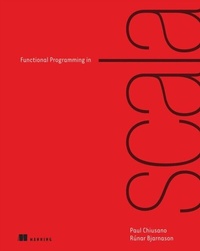
Functional Programming in Scala
1st Edition
Published on 1. September 2014
320 pages
978-1-63835-395-9 (ISBN)
Description

Summary
Functional Programming in Scala is a serious tutorial for programmers looking to learn FP and apply it to the everyday business of coding. The book guides readers from basic techniques to advanced topics in a logical, concise, and clear progression. In it, you'll find concrete examples and exercises that open up the world of functional programming.
Purchase of the print book includes a free eBook in PDF, Kindle, and ePub formats from Manning Publications.
About the Technology
Functional programming (FP) is a style of software development emphasizing functions that don't depend on program state. Functional code is easier to test and reuse, simpler to parallelize, and less prone to bugs than other code. Scala is an emerging JVM language that offers strong support for FP. Its familiar syntax and transparent interoperability with Java make Scala a great place to start learning FP.
About the Book
Functional Programming in Scala is a serious tutorial for programmers looking to learn FP and apply it to their everyday work. The book guides readers from basic techniques to advanced topics in a logical, concise, and clear progression. In it, you'll find concrete examples and exercises that open up the world of functional programming.
This book assumes no prior experience with functional programming. Some prior exposure to Scala or Java is helpful.
What's Inside
About the Authors
Paul Chiusano and Rúnar Bjarnason are recognized experts in functional programming with Scala and are core contributors to the Scalaz library.
Table of Contents
Functional Programming in Scala is a serious tutorial for programmers looking to learn FP and apply it to the everyday business of coding. The book guides readers from basic techniques to advanced topics in a logical, concise, and clear progression. In it, you'll find concrete examples and exercises that open up the world of functional programming.
Purchase of the print book includes a free eBook in PDF, Kindle, and ePub formats from Manning Publications.
About the Technology
Functional programming (FP) is a style of software development emphasizing functions that don't depend on program state. Functional code is easier to test and reuse, simpler to parallelize, and less prone to bugs than other code. Scala is an emerging JVM language that offers strong support for FP. Its familiar syntax and transparent interoperability with Java make Scala a great place to start learning FP.
About the Book
Functional Programming in Scala is a serious tutorial for programmers looking to learn FP and apply it to their everyday work. The book guides readers from basic techniques to advanced topics in a logical, concise, and clear progression. In it, you'll find concrete examples and exercises that open up the world of functional programming.
This book assumes no prior experience with functional programming. Some prior exposure to Scala or Java is helpful.
What's Inside
- Functional programming concepts
- The whys and hows of FP
- How to write multicore programs
- Exercises and checks for understanding
About the Authors
Paul Chiusano and Rúnar Bjarnason are recognized experts in functional programming with Scala and are core contributors to the Scalaz library.
Table of Contents
- What is functional programming?
- Getting started with functional programming in Scala
- Functional data structures
- Handling errors without exceptions
- Strictness and laziness
- Purely functional state
- Purely functional parallelism
- Property-based testing
- Parser combinators
- Monoids
- Monads
- Applicative and traversable functors
- External effects and I/O
- Local effects and mutable state
- Stream processing and incremental I/O
More details
Other editions
Additional editions
Paul Chiusano | Runar Bjarnason
Functional Programming in Scala
Book
10/2014
1st Edition
Manning Publications
€43.86
Shipment within 10-20 days
Persons
Paul Chiusano
Content
- Intro
- Copyright
- Brief Table of Contents
- Table of Contents
- Foreword
- Preface
- Acknowledgments
- About this Book
- Part 1. Introduction to functional programming
- Chapter 1. What is functional programming?
- Chapter 2. Getting started with functional programming in Scala
- Chapter 3. Functional data structures
- Chapter 4. Handling errors without exceptions
- Chapter 5. Strictness and laziness
- Chapter 6. Purely functional state
- Part 2. Functional design and combinator libraries
- Chapter 7. Purely functional parallelism
- Chapter 8. Property-based testing
- Chapter 9. Parser combinators
- Part 3. Common structures in functional design
- Chapter 10. Monoids
- Chapter 11. Monads
- Chapter 12. Applicative and traversable functors
- Part 4. Effects and I/O
- Chapter 13. External effects and I/O
- Chapter 14. Local effects and mutable state
- Chapter 15. Stream processing and incremental I/O
- Index
- List of Listings
