

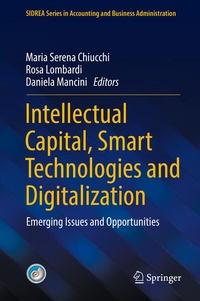
Intellectual Capital, Smart Technologies and Digitalization
Description

This book treats intellectual capital, smart technologies, and digitalization processes as levers of corporate competitiveness and global value creation. This book is based on theoretical and practical research output from the STEDIC SIDREA Group. It uses several methodologies to discover features and pillars on intellectual capital such as human capital, relational capital, and structural capital as well as smart technologies such as artificial intelligence, Internet of Things, big data, and digitalization.
More details
Other editions
Additional editions
Persons
Maria Serena Chiucchi is a full professor of business administration at Università Politecnica delle Marche, in Ancona, Italy, where she teaches management accounting and financial reporting. Her research interests include intellectual capital, management control, strategic control, non-financial information, and qualitative research with particular reference to the case study method and interventionist research.
Rosa Lombardi is associate professor of accounting at Sapienza University of Rome (Italy) and obtained the Italian National Qualification as full professor in May 2019. She is the editor-in-chief of the International Journal of Digital Culture and Electronic Tourism (Inderscience) as well as associate editor of the Palgrave Communications journal (Springer Nature) and editorial board member of the journals Meditari Accountancy Research, Management Decision, Business Strategy and the Environment, Corporate Social Responsibility and Environmental Management, International Journal of Applied Decision Sciences , and International Journal of Organizational Analysis (Emerald). She is also the academic coordinator for the Erasmus Programme and CIVIS Alliance in the Faculty of Economics Sapienza University. Her research interests and scientific publications cover financial and non-financial information, sustainability accounting, intellectual capital, ethics and corruption prevention models, and entrepreneurial universities, among others.
Daniela Mancini is Full Professor of Performance Measurement and Analytics at the University of Teramo. She received the Ph.D in Business Administration at University of Pisa. She is director of the Master Programme in "Chief Financial Officer" at the Parthenope University of Naples. She has been visiting professor at the IESEG School of Management, and the Catholic University of Lille. She collaborates as co-editor or member of the Editorial Board with the Management Control journal, the International Journal of Digital Culture and Electronic Tourism, The International Journal of Digital Accounting Research. She has authored or co-authored several books and papers on accounting information systems, digital transformation, management control and business networking.
