

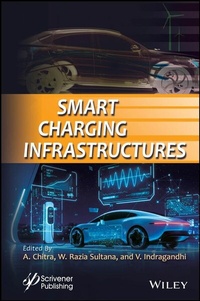
Smart Charging Infrastructures
Description

Drive the future of sustainable mobility with this essential book, which offers a comprehensive, multi-disciplinary guide to the challenges and AI-driven innovations for developing smart, efficient electric vehicle charging solutions.
The shift to electric vehicles supports the global commitment to reduce greenhouse gas emissions and decrease reliance on fossil fuels. However, crucial charging infrastructure is a key component for encouraging the adoption of electric vehicles. As a developing country, India is experiencing rapid urbanization, leading to higher vehicle ownership rates. With more vehicles on the road, the demand for charging infrastructure is growing, making smart chargers essential to efficiently manage and distribute electricity for electric vehicles. This book offers a comprehensive look at the challenges and innovations for electric vehicle charging solutions to expedite the transition to net-zero emissions. It focuses on the convergence of various technologies, including AI and deep and machine learning for smart charging systems. Through a multi-disciplinary approach and real-world case studies, this book will serve as an essential resource for innovators looking towards the future of green transportation.
More details
Other editions
Additional editions
Persons
A. Chitra, PhD is an Associate Professor in the School of Electrical Engineering at the Vellore Institute of Technology with more than 20 years of experience. She has published more than 63 papers in reputed journals and conferences, three patents, and three books. Her research areas include neural networks, induction motor drives, reliability analysis of multilevel inverters, and electric vehicles.
W. Razia Sultana, PhD is an Associate Professor in the School of Electrical Engineering at the Vellore Institute of Technology. She has published many papers in reputed journals. Her research interests include model predictive control of power converters, design and control of multilevel inverters, and control of power converters for electric vehicles.
V. Indragandhi, PhD is an Associate Professor in the School of Electrical Engineering at the Vellore Institute of Technology with more than 12 years of experience. She has authored one book, published more than 100 research articles in leading peer-reviewed international journals, and filed three patents. Her research focuses on renewable energy and power electronics.
Content
- Cover
- Series Page
- Title Page
- Copyright Page
- Contents
- Preface
- Chapter 1 Towards Sustainable Mobility: An Autonomous Electric Vehicle Charging Station Powered by Multifaceted Renewable Energy Sources
- 1.1 Introduction
- 1.2 Description of the Proposed Charging Station
- 1.3 Design and Analysis of the System
- 1.3.1 PV System
- 1.3.2 Wind
- 1.3.3 Fuel Cell
- 1.3.4 Boost Converter with MPPT
- 1.3.5 Buck Converter
- 1.3.6 EV Charge Controller
- 1.4 System Design Calculations
- 1.4.1 PV System
- 1.4.2 Wind Turbine
- 1.4.3 Fuel Cell
- 1.4.4 Battery Energy Storage System
- 1.5 Result Analysis
- 1.5.1 Case 1: PV BES Setup
- 1.5.2 Case 2: PV BES Wind Setup
- 1.5.3 Case 3: PV BES FC Setup
- 1.5.4 Case 4: BES Wind Setup
- 1.5.5 Case 5: BES FC Setup
- 1.5.6 Case 6: BES Wind FC Setup
- 1.5.7 Case 7: PV BES Wind FC Setup
- 1.6 Conclusion and Future Outlook
- References
- Chapter 2 Innovating EV Charging Infrastructure: A Hybrid Energy Storage System Approach for Solar Powered-Based DC Microgrid
- 2.1 Introduction
- 2.2 System Architecture
- 2.2.1 Modeling of PV System
- 2.2.2 Battery Storage System
- 2.2.3 Supercapacitor
- 2.3 Power Management System
- 2.4 Results and Discussion
- 2.5 Conclusion
- References
- Chapter 3 Design of Intermediate Charging Facilitated Port Configuration of Charging Station with Consideration of Reliability and Cost
- 3.1 Introduction
- 3.2 Methodology for Estimating the Reliability Probability of Charging Ports
- 3.3 Introduced Pattern Identical and Non-Identical Configuration
- 3.4 Results and Discussions
- 3.4.1 Identical Port Configuration
- 3.5 Conclusion
- References
- Chapter 4 AI-Based Smart Charging Infrastructures: Revolutionizing Electric Vehicle Integration
- 4.1 Introduction
- 4.2 Fundamentals of Smart Charging
- 4.2.1 Benefits of Smart-Charging Infrastructure
- 4.2.2 Deployment Factors for Smart Charging
- 4.3 Role of AI in Smart Charging
- 4.3.1 Understanding Artificial Intelligence in Charging Infrastructures
- 4.3.2 Machine Learning Algorithms for Predictive Charging
- 4.3.2.1 Benefits of ML-Powered Predictive Charging
- 4.3.3 Real-Time Data Analytics and Optimization Techniques
- 4.3.3.1 Real-Time Data Analytics
- 4.3.3.2 Optimization Techniques
- 4.3.4 AI-Based Demand Response Management
- 4.3.4.1 Understanding Demand Response Management
- 4.3.4.2 Benefits of AI-Based DRM for Charging Stations
- 4.4 Components of AI-Based Smart Charging Systems
- 4.4.1 Sensors and IoT Devices for Data Collection
- 4.4.2 Cloud Computing and Edge Computing Platforms
- 4.4.2.1 Cloud Computing Platforms
- 4.4.2.2 Edge Computing Platforms
- 4.4.3 Communication Protocols and Network Infrastructure
- 4.4.4 Control Algorithms for Dynamic Charging Control
- 4.5 Challenges and Future Directions
- 4.5.1 Security and Privacy Concerns in AI-Driven Infrastructures
- 4.5.2 Scalability and Interoperability Issues
- 4.5.3 Regulatory and Policy Implications
- 4.5.4 Emerging Technologies and Trends in Smart Charging
- Bibliography
- Chapter 5 EV Smart Charging Using RES.Challenges
- Acronyms
- 5.1 Introduction
- 5.2 System Description
- 5.2.1 Description of Photovoltaic (PV) Source
- 5.2.2 Description of Wind Energy
- 5.2.3 Description of EV
- 5.2.4 Objective Function
- 5.2.5 Constraint Conditions
- 5.2.5.1 Equality Constraint
- 5.2.5.2 Generator Constraint
- 5.2.6 Framework of Optimization Algorithm
- 5.3 Results and Discussion
- 5.4 Conclusion
- References
- Chapter 6 Green Energy-Based Active Grid Optimization Using Deep Learning for EV Charging Infrastructure
- 6.1 Introduction
- 6.2 Active Grid and Edge Computing
- 6.3 Modeling of Standalone Hybrid System
- 6.3.1 Solar PV Cell Model
- 6.3.2 Wind Turbine Model
- 6.3.3 EV Battery Model
- 6.4 Deep Learning and Its Implementation
- 6.4.1 Energy Demand Pattern
- 6.4.2 Wind Speed
- 6.4.3 Solar Irradiation
- 6.5 Micro-Grid and Control Mechanism
- 6.5.1 Microgrid Functioning in Different Modes
- 6.5.1.1 Islanded Mode
- 6.5.1.2 Multiple Microgrid Control with Centralized Energy Storage System
- 6.5.2 Energy Storage System Simulation
- 6.5.3 Wind Energy Storage System Simulation
- 6.5.4 EV Battery Control Mechanism
- 6.6 Results and Discussion
- 6.6.1 Deep Learning
- 6.6.2 Matlab/Simulink Model
- 6.7 Conclusion
- References
- Chapter 7 Bearing Fault Diagnosis in Permanent Magnet Synchronous Motor Using Deep Neural Network
- 7.1 Introduction
- 7.2 Methodology
- 7.2.1 Discrete Wavelet Transform
- 7.2.2 Kurtogram
- 7.2.3 Deep Neural Network-VGG
- 7.3 Results and Discussion
- 7.3.1 Case 1: Using DWT
- 7.3.2 Case 2: Using Kurtogram
- 7.4 Conclusion
- References
- Chapter 8 Enhancing Efficiency in Bidirectional CLLC ResonantConverters: A Hybrid Control Approach
- 8.1 Introduction
- 8.2 Bidirectional CLLC Resonant Converter
- 8.3 Working by Controlling Conversion of Frequency
- 8.4 How the Inductance Factor (k) Affects Voltage Gain (M)
- 8.5 How the Quality Factor (Q) Influences Voltage Gain (M)
- 8.6 Understanding Frequency-Conversion Control
- 8.7 Combining Frequency Conversion and Phase Shifting with a Hybrid Control Strategy
- 8.8 Simulation Results and Discussion
- 8.9 Conclusion
- References
- Chapter 9 IoT-Based Smart Charging Systems
- Abbreviation
- 9.1 Introduction
- 9.2 Remote Monitoring and Telematics
- 9.3 Infrastructure Connectivity for Charging
- 9.4 Autonomous Driving and Advanced Driver Assistance Systems (ADAS)
- 9.5 Logistics and Fleet Management
- 9.6 Sustainability and Energy Management
- 9.7 Services and User Experience
- 9.8 Algorithms for Shortest Path Finding
- 9.8.1 Dijkstra?fs Algorithm
- 9.8.2 Bellman.Ford Algorithm
- 9.8.3 A* Search Algorithm
- 9.8.4 Floyd.Warshall Algorithm
- 9.8.5 Bidirectional Search Algorithm
- 9.8.6 Rapidly Exploring Random Tree Algorithm
- 9.8.7 Probabilistic Roadmap Algorithm
- 9.8.8 Hybrid RRT-PRM Model
- 9.9 Advantages
- 9.10 Conclusion
- References
- Chapter 10 Embedded Control of Power Converters in E-Mobility
- 10.1 Introduction
- 10.1.1 Key Components of EV
- 10.2 Evolution of Digital Control in Power Converters
- 10.2.1 Key Functions of Embedded Control of Power Converters
- 10.2.2 Components of Embedded Control Systems
- 10.2.3 Control Strategies
- 10.2.4 Challenges and Innovations
- 10.3 Embedded Systems and Digital Control
- 10.4 Tools and Technologies for Digital Control Systems
- 10.5 Implementation of Embedded Digital Control Based on DSPs
- 10.6 Key Components in Embedded Digital Controllers
- 10.7 Signal Generation for Power Converter Devices
- 10.7.1 Operating Frequency and Resolution
- 10.7.2 Modes of Operation
- 10.8 Field Programmable Gate Arrays (FPGAs)
- 10.9 Code Composer Studio and JTAG
- 10.9.1 Functional Requirements of a Non-InvertingBuck-Boost Converter
- 10.10 Software Development Environment (SDE): Compiler, Linker, Assembler, and Downloader
- 10.11 STM-Based Embedded Controllers
- 10.12 Main Traction Inverter
- 10.13 On-Board Charger
- 10.14 Battery Management System (BMS)
- Acknowledgement
- Chapter 11 Solar Piezo Hybrid Power Charging System
- 11.1 Introduction
- 11.2 Methodology
- 11.2.1 Simulation Modelling in MATLAB/Simulink
- 11.2.2 Brief Description of Various Parts
- 11.2.3 Block Diagram and Working
- 11.3 Operating Modes
- 11.4 Result and Discussion
- 11.4.1 Simulation Results in MATLAB/Simulink
- 11.4.2 Hardware Implementation
- 11.4.3 IoT Integration
- 11.5 Conclusion
- Acknowledgments
- References
- Chapter 12 EV Power Train Performance with DC Motor
- 12.1 Introduction
- 12.2 Methodology
- 12.2.1 Architecture of Battery EV Power Train
- 12.2.2 Requirements of Electric Traction Motors
- 12.2.3 Machine Topologies
- 12.2.4 Vehicle Dynamics and Estimation of Output Parameters
- 12.3 Results and Discussion
- 12.3.1 Simulation Results
- 12.3.2 Cost.Benefit Analysis
- 12.4 Conclusion
- Acknowledgment
- References
- Chapter 13 RC Vehicle for Delivery
- 13.1 Introduction
- 13.1.1 Description of the RC Vehicle
- 13.1.1.1 Functioning of L298N Motor Driver
- 13.1.1.2 The Functioning of ESP32 Camera Module
- 13.2 Literature Review
- 13.2.1 Research Gap
- 13.3 Methodology
- 13.3.1 Radio-Controlled (RC) Vehicle
- 13.3.2 Camera System
- 13.3.3 Pan-Tilt Mechanism
- 13.3.4 Anti-Theft Locking System
- 13.3.5 Mobile-Application Interface
- 13.4 Result and Discussions
- 13.5 Conclusion
- References
- Chapter 14 Aerodynamic Drag Reduction in Heavy Vehicles
- 14.1 Introduction
- 14.2 Literature Survey
- 14.3 Methodology
- 14.3.1 Geometry and Meshing
- 14.3.2 Inlet, Outlet, and Boundary Conditions
- 14.3.3 Computational Procedure
- 14.4 Results and Discussion
- 14.4.1 Pressure Contour Comparison
- 14.4.2 Velocity Contour Comparison
- 14.4.3 Streamline Profile
- 14.4.4 VelocityVector Profile
- 14.5 Analysis Comparison
- 14.5.1 Streamline Comparison at Rear to Understand Flow Characteristics
- 14.5.2 Drag Force Comparison
- 14.6 Conclusion
- References
- Chapter 15 Review of Optimization-Based Sensor Fault Detection for Lithium-Ion Batteries in Electric Vehicles
- 15.1 Introduction
- 15.2 Gestalt of Battery Sensors
- 15.3 Utilization of Battery Sensors in Electric Vehicles
- 15.3.1 Significance of Sensor Fault Identification in Li-Ion Batteries
- 15.3.2 Sensor Fault Modeling
- 15.4 Optimization in Sensor Fault Detection
- 15.5 Advantages and Category of Metaheuristic Algorithm
- 15.5.1 Applications of Metaheuristic Approach for Sensor Fault Detection in Lithium-Ion Batteries
- 15.5.2 Challenges in Fault Detection
- 15.6 Result and Discussion
- 15.7 Conclusion
- References
- Chapter 16 Development of a Hybrid Foot.Stamping Bicycle with Dynamic Electric Support: A Sustainable Alternative to Traditional Pedal and Electric Bicycles
- 16.1 Introduction
- 16.2 Background and Motivation
- 16.2.1 Limitations of Traditional Pedal-Based Bicycles
- 16.2.2 The Rise of Electric Bicycles (E-Bikes)
- 16.2.3 The Need for a Hybrid Solution
- 16.2.4 Innovative Foot-Powered System
- 16.2.5 Electric Dynamic Support
- 16.2.6 Motivation for the Proposed Design
- 16.2.7 Design Concepts
- 16.3 Study Objectives
- 16.3.1 Design and Development of the Foot-Stamping Mechanism
- 16.3.2 Integration of Dynamic Electric Support
- 16.3.3 Performance Evaluation and Efficiency Analysis
- 16.3.4 Sustainability and Environmental Impact
- 16.3.5 User Experience and Accessibility
- 16.3.6 Prototype Development and Testing
- 16.4 Scope of Study
- 16.4.1 Design and Engineering Focus
- 16.4.2 Prototyping and System Testing
- 16.4.3 Energy Efficiency and Sustainability Assessment
- 16.4.4 User Experience and Practical Application
- 16.4.5 Technical and Financial Feasibility
- 16.4.6 Limitations and Constraints
- 16.5 Conclusion
- References
- Chapter 17 A Novel Multilevel Inverter with Reduced Switch for Electric Vehicle Applications
- 17.1 Introduction
- 17.2 Proposed MLI
- 17.2.1 Description and Analysis of Proposed MLI Circuit
- 17.3 Control Strategy and Simulation Outcomes
- 17.4 Conclusion
- References
- Index
- Also of Interest
- EULA
