

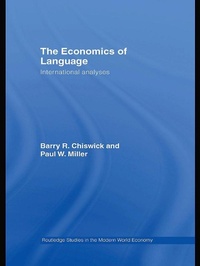
The Economics of Language
International Analyses
Published on 8. March 2007
26 pages
978-1-135-98205-8 (ISBN)
Description

Written by two internationally renowned experts in the field, this book explores the determinants of dominant language proficiency among immigrants and other linguistic minorities and the consequences of this proficiency for the labour market.Using empirical material from a range of countries, including the USA, Canada, Australia and Bolivia, the a
Reviews / Votes
'This book contains an impressive collection of essays on the Economics of Language. Barry Chiswick and Paul Miller have addressed a wide range of areas on both the determinants of language proficiency, and the consequences of language proficiency for labour market outcomes. They offer a broad and international perspective. The book provides careful and insightful analysis on issues relating to language and immigration and will be a great resource for researchers and graduate students working in this area.'Professor Christian Dustmann, Department of Economics and Centre for Research and Analysis of Migration (CReAM), University College London
'Barry Chiswick and Paul Miller have contributed greatly to an interdisciplinary understanding of the mechanisms, conditions, and consequences of language acquisition and the processes of migrant integration as a whole. Their work is a break-through in many respects.'
Professor Hartmut Esser, Department of Sociology, University of Mannheim
'In The Economics of Language: International Analyses', Barry Chiswick and Paul Miller have put together their finest articles on the topic. The book is nicely organized around important topics. The theoretical foundations for their empirical work come out strongly reminding us that it is exposure, efficiency and economic incentives that matter for determining language acquisition. The book will prove of great value to researchers on language issues, showcasing in a most useful way the contribution of economists."
Harry Anthony Patrinos, PhD, Lead Education Economist, The World Bank, Washington, D.C.
'Barry Chiswick is one of the most enlightened and insightful economics researchers alive today. Together with his co-author, Paul Miller, he has discovered the enormous importance LANGUAGE plays on the map of socio-economics in terms of jobs, immigration patterns and advancement in immigrant receiving countries.This book is obligatory reading for all concerned with immigrant and the socio-economic aspects of language.'
Professor Adam Makkai, Professor of English and Linguistics University of Illinois at Chicago Foundation Executive Director of LACUS, The Linguistic Association of Canada and the United States.
'Economics has too long omitted language, whether language in general or, as in the pathbreaking work of Chiswick and Miller, languages, plural:how a Greek migrant to Australia or a Polish migrant to America gets along by getting fluent. And linguistics too often omits the economics, provided here in lucid and cosmopolitan bulk. Chiswick and Miller ask how much language matters to immigrant lives. It matters a lot, though in surprising ways. The Economics of Language tells the story of the flight from Babel with theoretical depth and quantitative precision.'
Deirdre McCloskey, Distinguished Professor in the Departments of Economics, English and History at the University of Illinois at Chicago. "Economics has too long omitted language, whether language in general or, as in the pathbreaking work of Chiswick and Miller, languages, plural:how a Greek migrant to Australia or a Polish migrant to America gets along by getting fluent. And linguistics too often omits the economics, provided here in lucid and cosmopolitan bulk. Chiswick and Miller ask how much language matters to immigrant lives. It matters a lot, though in surprising ways. The Economics of Language tells the story of the flight from Babel with theoretical depth and quantitative precision."
Deirdre McCloskey, Distinguished Professor in the Departments of Economics, English and History at the University of Illinois at Chicago.
'This book contains an impressive collection of essays on the Economics of Language. Barry Chiswick and Paul Miller have addressed a wide range of areas on both the determinants of language proficiency, and the consequences of language proficiency for labour market outcomes. They offer a broad and international perspective. The book provides careful and insightful analysis on issues relating to language and immigration and will be a great resource for researchers and graduate students working in this area.'
Professor Christian Dustmann, Department of Economics and Centre for Research and Analysis of Migration (CReAM), University College London
'Barry Chiswick and Paul Miller have contributed greatly to an interdisciplinary understanding of the mechanisms, conditions, and consequences of language acquisition and the processes of migrant integration as a whole. Their work is a break-through in many respects.'
Professor Hartmut Esser, Department of Sociology, University of Mannheim
'In The Economics of Language: International Analyses', Barry Chiswick and Paul Miller have put together their finest articles on the topic. The book is nicely organized around important topics. The theoretical foundations for their empirical work come out strongly reminding us that it is exposure, efficiency and economic incentives that matter for determining language acquisition. The book will prove of great value to researchers on language issues, showcasing in a most useful way the contribution of economists."
Harry Anthony Patrinos, PhD, Lead Education Economist, The World Bank, Washington, D.C.
'Barry Chiswick is one of the most enlightened and insightful economics researchers alive today. Together with his co-author, Paul Miller, he has discovered the enormous importance LANGUAGE plays on the map of socio-economics in terms of jobs, immigration patterns and advancement in immigrant receiving countries.This book is obligatory reading for all concerned with immigrant and the socio-economic aspects of language.'
Professor Adam Makkai, Professor of English and Linguistics University of Illinois at Chicago Foundation Executive Director of LACUS, The Linguistic Association of Canada and the United States.
'Economics has too long omitted language, whether language in general or, as in the pathbreaking work of Chiswick and Miller, languages, plural:how a Greek migrant to Australia or a Polish migrant to America gets along by getting fluent. And linguistics too often omits the economics, provided here in lucid and cosmopolitan bulk. Chiswick and Miller ask how much language matters to immigrant lives. It matters a lot, though in surprising ways. The Economics of Language tells the story of the flight from Babel with theoretical depth and quantitative precision.'
Deirdre McCloskey, Distinguished Professor in the Departments of Economics, English and History at the University of Illinois at Chicago
'Chiswick and Miller's analyses of the economic importance of acquiring second languages are striking. In an increasingly interconnected world, such empirical studies as these reveal the significant impact of linguistic capital on economic advancement, and they underscore how important both education and literacy are in socioeconomic mobility.' - Marcia Farr, Professor of Education, College of Education and Human Ecology Adjunct Professor, Department of English The Ohio State University
More details
Series
Language
English
Place of publication
London
United Kingdom
Publishing group
Taylor & Francis Ltd
Target group
College/higher education
Illustrations
1 s/w Abbildung, 191 s/w Tabellen, 1 s/w Zeichnung
1 b/w image, 191 tables and 1 line drawing
File size
5,83 MB
ISBN-13
978-1-135-98205-8 (9781135982058)
Copyright in bibliographic data and cover images is held by Nielsen Book Services Limited or by the publishers or by their respective licensors: all rights reserved.
Schweitzer Classification
Other editions
Additional editions
Book
05/2014
1st Edition
Routledge
€84.36
Shipment within 10-20 days
Book
03/2007
Routledge
€282.26
Shipment within 15-20 days
Persons
Barry R. Chiswick, Paul W. Miller
Content
Introduction Part 1: The Determinants of Language Proficiency 1. A Model of Destination-language Acquisition: Application to Male Immigrants in Canada 2. Language Skill Definition: A Study of Legalized Aliens 3. Language Choice Among Immigrants in a Multi-lingual Destination 4. Language in the Immigrant Labor Market 5. Parents and Children Talk: English Language Proficiency within Immigrant Families Part 2: The Effects of Language Proficiency on Labor Market Outcomes 1. Immigrant Earnings: Language Skills, Linguistic Concentrations and the Business Cycle 2. Schooling, Literacy, Numeracy and Labor Market Success 3. Language Skills and Earnings Among Legalized Aliens 4. Language and Labor Supply: The Role of Gender Among Immigrants in Australia 5. Immigrant Adjustment in Israel: The Determinants of Literacy and Fluency in Hebrew and the Effects on Earnings Part 3: The Interaction of Language and Earnings among Immigrants 1. The Endogeneity between Language and Earnings: International Analyses 2. Speaking, Reading, and Earnings Among Low-skilled Immigrants 3. The Linguistic and Economic Adjustment of Soviet Jewish Immigrants in the United States, 1980-2000 Part 4: Language and Earnings among the Native Born 1. The Economic Cost to Native-born Americans of Limited English Language Proficiency, Report Prepared for the Center for Equal Opportunity, August 1998 2. Earnings in Canada: The Roles of Immigrant Generation, French Ethnicity, and Language 3. Indigenous Language Skills and the Labor Market in a Developing Economy: Bolivia Part 5: Language, Networks and Enclaves 1. Do Enclaves Matter in Immigrant Adjustment? 2. Ethnic Networks and Language Proficiency Among Immigrants Part 6: Linguistic Distance 1. The Effect of Linguistic Distance and Country of Origin on Immigrant Language Skills: Application to Israel 2. Linguistic Distance: A Quantitative Measure of the Distance between English and other Languages
