

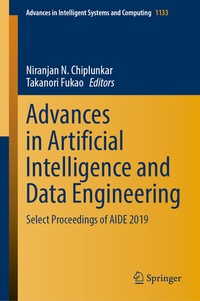
Advances in Artificial Intelligence and Data Engineering
Description

This book presents selected peer-reviewed papers from the International Conference on Artificial Intelligence and Data Engineering (AIDE 2019). The topics covered are broadly divided into four groups: artificial intelligence, machine vision and robotics, ambient intelligence, and data engineering. The book discusses recent technological advances in the emerging fields of artificial intelligence, machine learning, robotics, virtual reality, augmented reality, bioinformatics, intelligent systems, cognitive systems, computational intelligence, neural networks, evolutionary computation, speech processing, Internet of Things, big data challenges, data mining, information retrieval, and natural language processing. Given its scope, this book can be useful for students, researchers, and professionals interested in the growing applications of artificial intelligence and data engineering.
More details
Other editions
Additional editions
Persons
Dr. Niranjan N. Chiplunkar is currently a Professor at the Department of Computer Science & Engineering and Principal of NMAM Institute of Technology, Nitte, Udupi, India. With more than 32 years of teaching experience, he has written one textbook on "VLSI CAD" published by PHI Learning, in 2011 and has edited two international and one national-level conference proceedings volume. He was selected for the "Bharatiya Vidya Bhavan National Award for Best Engineering College Principal" for the year 2014 by the ISTE New Delhi and for the "Excellent Achievement Award" by the Centre for International Cooperation on Computerization, Government of Japan, in 2002. Prof. Chiplunkar's major interests include CAD for VLSI, wireless sensor networks, and multicore architecture and programming. He is a Fellow of the Institution of Engineers (India), Senior Member of the IEEE, and a member of several other professional bodies, e.g. the Computer Society of India, ISSS, and ISTE. He has successfully completed two funded research projects-one from the AICTE, New Delhi, and another from the DST, Government of India, on "Network on Chip Architecture Design" and "Multicore Software Framework Development," respectively.
Dr. Takanori Fukao is currently a Professor at the Department of Electrical and Electronics Engineering, College of Science and Engineering, Ritsumeikan University, Japan. His primary research interests include perceptual information processing, intelligent robotics, automated driving, platooning, parking of automobiles, flight control for blimp robots and drones, automated driving of agricultural vehicles, active control including active suspension systems, and 3D model generation using motion stereo or stereo cameras. He heads the research laboratory Intelligent Vehicle Systems. He has published 47 research papers in reputed international journals, and three books with leading publishers. He has received several awards for his research and teaching achievements. Currently, he is an editor of IEEE Transactions on Intelligent Vehicles.
Content
Fraud Detection in Online Transactions Using Machine Learning Approaches - A Review.- Artificial Intelligence Techniques for Predicting TYPE 2 DIABETES.- Braille cell Segmentation and Removal of Unwanted Dots using Canny Edge Detector.- IoT Based Data Storage for Cloud Computing Applications.- An Introduction To Sparse Sampling On Audio Signal By Exploring Different Basis Matrix.- A Home Security Camera System Based on Cloud and SNS.- Cyberbullying Detection Using Sentiment and Personality.- Sparse Reflectance Map Based Fabric Characterization.- Human Resource Working Prediction Based on Logistic Regression.- Study on Automatic Speech Therapy System for Patients.- An IoT based Congestion Control Framework for Intelligent Traffic Management System.- Multi Join Query Optimization using Modified ACO with GA.- Character Recognition of Tulu script using Convolutional Neural Network.
