
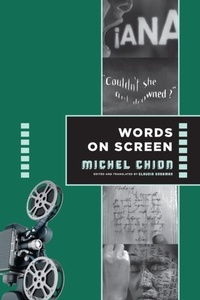
Words on Screen
Description
Alles über E-Books | Antworten auf Fragen rund um E-Books, Kopierschutz und Dateiformate finden Sie in unserem Info- & Hilfebereich.
Michel Chion is well known in contemporary film studies for his innovative investigations into aspects of cinema that scholars have traditionally overlooked. Following his work on sound in film in Audio-Vision and Film, a Sound Art, Words on Screen is Chion's survey of everything the seventh art gives us to read on screen. He analyzes titles, credits, and intertitles, but also less obvious forms of writing that appear on screen, from the tear-stained letter in a character's hand to reversed writing seen in mirrors. Through this examination, Chion delves into the multitude of roles that words on screen play: how they can generate narrative, be torn up or consumed but still remain in the viewer's consciousness, take on symbolic dimensions, and bear every possible relation to cinematic space.
With his characteristic originality, Chion performs a poetic inventory of the possibilities of written text in the film image. Taking examples from hundreds of films spanning years and genres, from the silents to the present, he probes the ways that words on screen are used and their implications for film analysis and theory. In the process, he opens up and unearths the specific poetry of visual text in film. Exhaustively researched and illustrated with hundreds of examples, Words on Screen is a stunning demonstration of a creative scholar's ability to achieve a radically new understanding of cinema.
All prices
More details
Other editions
Additional editions
Persons
Michel Chion is a composer of musique concrète, a filmmaker, an associate professor at the University of Paris III: Sorbonne Nouvelle, and a prolific writer on film, sound, and music. His previous books with Columbia University Press are The Voice in Cinema; Film, a Sound Art; and Audio-Vision: Sound on Screen.
Claudia Gorbman is emeritus professor of film studies at the University of Washington, Tacoma. She is the author of Unheard Melodies: Narrative Film Music, the editor of several books, and the author of many articles on film sound and film music. She has translated four other books by Michel Chion.
Content
List of Illustrations
Preface
Introduction
Part I: An Infinite Inventory
1. The Name on Screen
2. Nondiegetic Writing
3. Diegetic Writing as Athorybos
Part II: Writing, Reading
4. Fingers, Tablets, and Machines Writing
5. From Books Undone, Films
6. Half-Reading
7. Hearing One Language and Reading Another
Part III: Writing in Film Space
8. Writing in the Land of Three Dimensions
9. Anagrams and Clinamen
10. Excription
Glossary
Notes
Bibliography
Index

System requirements
File format: ePUB
Copy protection: Adobe-DRM (Digital Rights Management)
System requirements:
- Computer (Windows; MacOS X; Linux): Install the free reader Adobe Digital Editions prior to download (see eBook Help).
- Tablet/smartphone (Android; iOS): Install the free app Adobe Digital Editions or the app PocketBook before downloading (see eBook Help).
- E-reader: Bookeen, Kobo, Pocketbook, Sony, Tolino and many more (not Kindle).
The file format ePub works well for novels and non-fiction books – i.e., „flowing” text without complex layout. On an e-reader or smartphone, line and page breaks automatically adjust to fit the small displays.
This eBook uses Adobe-DRM, a „hard” copy protection. If the necessary requirements are not met, unfortunately you will not be able to open the eBook. You will therefore need to prepare your reading hardware before downloading.
Please note: We strongly recommend that you authorise using your personal Adobe ID after installation of any reading software.
For more information, see our ebook Help page.
File format: PDF
Copy-Protection: Adobe-DRM (Digital Rights Management)
System requirements:
- Computer (Windows; MacOS X; Linux): Install the free reader Adobe Digital Editions prior to download (see eBook Help).
- Tablet/smartphone (Android; iOS): Install the free app Adobe Digital Editions or the app PocketBook before downloading (see eBook Help).
- E-reader: Bookeen, Kobo, Pocketbook, Sony, Tolino and many more (only limited: Kindle).
The file format PDF always displays a book page identically on any hardware. This makes PDF suitable for complex layouts such as those used in textbooks and reference books (images, tables, columns, footnotes). Unfortunately, on the small screens of e-readers or smartphones, PDFs are rather annoying, requiring too much scrolling.
This eBook uses Adobe-DRM, a „hard” copy protection. If the necessary requirements are not met, unfortunately you will not be able to open the eBook. You will therefore need to prepare your reading hardware before downloading.
Please note: We strongly recommend that you authorise using your personal Adobe ID after installation of any reading software.
For more information, see our eBook Help page.
File format: ePUB
Copy protection: Watermark-DRM (Digital Rights Management)
System requirements:
- Computer (Windows; MacOS X; Linux): Use a reading software that can process the file format ePUB: e.g., Adobe Digital Editions or FBReader – both free (see eBook Help).
- Tablet/Smartphone (Android; iOS): Before downloading, install the free app Adobe Digital Editions (see eBook Help).
- E-reader: Bookeen, Kobo, Pocketbook, Sony, Tolino and many more (not Kindle).
The file format ePUB works well for novels and non-fiction books – i.e., „flowing” text without complex layout. On an e-reader or smartphone, line and page breaks automatically adjust to fit the small displays.
This eBook uses Watermark-DRM, a „soft” copy protection. This means that there are no technical restrictions to prevent illegal distribution. However, there is a personalised watermark embedded in the eBook that can be used to identify the purchaser of the eBook in the event of misuse and to provide evidence for legal purposes.
For more information, see our eBook Help page.
