
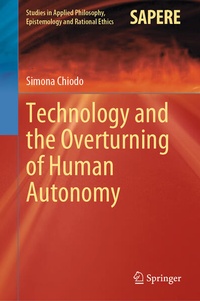
Technology and the Overturning of Human Autonomy
Description
Alles über E-Books | Antworten auf Fragen rund um E-Books, Kopierschutz und Dateiformate finden Sie in unserem Info- & Hilfebereich.
This book offers an extensive historical, philosophical and ethical discussion on the role of autonomous technologies, and their influence on human identity. By connecting those different perspectives, and analysing some practical case studies, it guides readers to dissect the relationship between machine and human autonomy, and machine and human identity. It analyses how the relationship between human and technology has been evolving in the last few centuries. Last, it aims at proposing an explanation on the reason/s why humans have been keen on developing their own autonomy's perfect avatar.
More details
Other editions
Additional editions
Person
Content
Introduction.- Technology's philosophical meanings.- Contemporary Prometheus.- First case in point: autonomous technologies.- Second case in point: self-tracking technologies and the quantified self.- Challenges of the future.- Epistemological challenges.- Human identity's challenges.- Ethical challenges.- Conclusion.

System requirements
File format: PDF
Copy protection: Watermark-DRM (Digital Rights Management)
System requirements:
- Computer (Windows; MacOS X; Linux): Use the free software Adobe Reader, Adobe Digital Editions, or any other PDF viewer of your choice (see eBook Help).
- Tablet/Smartphone (Android; iOS): Install the free app Adobe Digital Editions or another reading app for eBooks, e.g., PocketBook (see eBook Help).
- E-reader: Bookeen, Kobo, Pocketbook, Sony, Tolino and many more (only limited: Kindle).
The file format PDF always displays a book page identically on any hardware. This makes PDF suitable for complex layouts such as those used in textbooks and reference books (images, tables, columns, footnotes). Unfortunately, on the small screens of e-readers or smartphones, PDFs are rather annoying, requiring too much scrolling.
This eBook uses Watermark-DRM, a „soft” copy protection. This means that there are no technical restrictions to prevent illegal distribution. However, there is a personalised watermark embedded in the eBook that can be used to identify the purchaser of the eBook in the event of misuse and to provide evidence for legal purposes.
For more information, see our eBook Help page.