

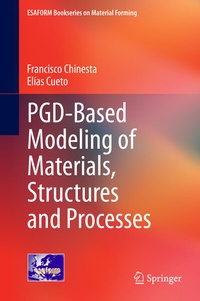
PGD-Based Modeling of Materials, Structures and Processes
Description

This book focuses on the development of a new simulation paradigm allowing for the solution of models that up to now have never been resolved and which result in spectacular CPU time savings (in the order of millions) that, combined with supercomputing, could revolutionize future ICT (information and communication technologies) at the heart of science and technology. The authors have recently proposed a new paradigm for simulation-based engineering sciences called Proper Generalized Decomposition, PGD, which has proved a tremendous potential in many aspects of forming process simulation. In this book a review of the basics of the technique is made, together with different examples of application.
More details
Other editions
Additional editions
Content
1 Introduction.- 1.1 Recurrent issues in numerical simulation.- 1.2 Model reduction: information versus relevant information.- 1.3 PGD at a glance.- 1.4 Revisiting the simulation challenges.- 1.5 A brief state of the art on PGD-based model order reduction.- 2 Multiscale modelling.- 2.1 From quantum mechanics to kinetic theory.- 2.2 Advanced solvers for multi-dimensional models.- 2.3 Numerical examples.- 2.4 Conclusions.- 3 Homogenization.- 3.1 Homogenization of linear heterogenous models.- 3.2 Non-concurrent nonlinear homogenization.- 3.3 Numerical examples.- 3.4 Conclusions.- 4 Coupled models.- 4.1 Efficient coupling of global and local models.- 4.2 Fully globalized local models.- 4.3 Heterogeneous time integration.- 4.4 Numerical example.- 4.5 Discussion.- 5 Parametric models in evolving domains.- 5.1 Evolving domains issues.- 5.2 PGD in evolving domains.- 5.3 Separated representation constructor.- 5.4 Numerical test.- 5.5 Towards parametric modeling in evolving domains.- 5.6 Numerical test involving parametric modeling.- 5.7 Conclusions.- 6 Space separation.- 6.1 In-plane/out-of-plane separated representation.- 6.2 Laminates.- 6.3 Conclusions.- 7 Process optimization.- 7.1 Parametric boundary conditions.- 7.2 Parametric modeling of pultrusion.- 7.3 Optimization strategy.- 7.4 Conclusion 8 Shape optimization.- 8.1 Introduction.- 8.2 Geometrical parameters as extra-coordinates.- 8.3 Numerical results.- 8.4 Conclusions.- 9 DDDAS.- 9.1 Introduction to DDDAS.- 9.2 PGD solution of a flowing process.- 9.3 Simulating a breakdown scenario.- 9.4 Post-processing in a smartphone.- 9.5 Conclusions.- 10 Inverse analysis.- 10.1 PGD based parameter identification.- 10.2 PGD based Cauchy's problem.- 10.3 Parameter identification examples.- 10.4 Cauchy's problem example.- 10.5 Conclusions.- 11 Tape placement.- 11.1 Parametric modeling.- 11.2 ATP thermal model.- 11.3 ATP mechanical modeling.- 11.4 Numerical results.- 11.5 Conclusions.- 12 Augmented learning.- 12.1 Towards augmented learning.- 12.2 Examples of augmented learning.- 12.3 Conclusions.- References.- Index.
