

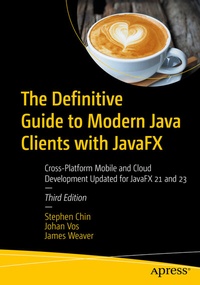
The Definitive Guide to Modern Java Clients with JavaFX
Description

Build enhanced visual experiences and design and deploy modern, easy-to-maintain, client applications across a variety of platforms. This book will show you how these applications can take advantage of JavaFX's latest user interface components, 3D technology, and cloud services to create immersive visualizations and allow high-value data manipulation. This book is a professional reference for building Java applications for desktop, mobile, and embedded in the Cloud age. It offers end-to-end coverage of the latest features in JavaFX 21 and 23.
This third edition has been updated to include new features introduced in JavaFX 21 and 23, including NEW APIs: Map, FlatMap, and OrElse fluent bindings for ObservableValue, along with the new Subscription API. Additionally, it's updated to account for new bug fixes and overall improvements to existing functionality in Java.
After reading this book, you will be equipped to upgrade legacy client applications, develop cross-platform applications in Java, and build enhanced desktop and mobile native clients.
What You Will Learn
- Create modern client applications in Java using the latest JavaFX 21 and 23
- Build enterprise clients that will enable integration with existing cloud services
- Use advanced visualization and 3D features
- Deploy on desktop, mobile, and embedded devices
Who This Book Is For
Professional Java developers who are interested in learning the latest client Java development techniques to fill out their skills set
More details
Other editions
Additional editions
Previous edition
Persons
Stephen Chin is VP of Developer Relations at Neo4j and author of additional titles, including Raspberry Pi with Java , Pro JavaFX Platform , and DevOps Tools for Java Developers . He has keynoted numerous conferences around the world, including AI DevSummit, Devoxx, DevNexus, JNation, JavaOne, Joker, swampUP, and Open Source India. Stephen is an avid motorcyclist who has done evangelism tours in Europe, Japan, and Brazil, interviewing hackers in their natural habitat. When he is not traveling, he enjoys teaching kids how to do AI, and embedded and robot programming, together with his daughters.
Johan Vos started to work with Java in 1995. He was part of the Blackdown team, porting Java to Linux. His main focus is on end-to-end Java, combining backend systems and mobile/embedded devices. He received a Duke Choice award in 2014 for his work on Javafx on mobile. In 2015, he co-founded Gluon, which allows enterprises to create (mobile) Java Client applications leveraging their existing backend infrastructure. Gluon received a Duke Choice award in 2015. Johan is a Java Champion and an Oracle Developer Champion, a member of the BeJUG steering group and the Devoxx steering group, and he is a JCP member. He has been a speaker at numerous conferences on Java.
James Weaver is a Java developer, author, and speaker with a passion for cloud-native applications, machine learning, and quantum computing. He is a Java Champion, and a JavaOne Rockstar. James has written books, including I nside Java , Beginning J2EE , the Pro JavaFX series, and Java with Raspberry Pi . As a Pivotal Developer Advocate, James speaks internationally at software technology conferences. He tweets as @JavaFXpert.
Content
1: Getting Started with Client Java.- 2: JavaFX Fundamentals.- 3: Properties and Bindings.- 4: JavaFX Controls Deep Dive.- 5: Mastering Visual and CSS Design.- 6: High Performance Graphics.- 7: Bridging Swing JavaFX Style.- 8: JavaFX 3D.- 9: JavaFX to Web and Cloud.- 10: Packaging Apps for the Desktop.- 11: Native Mobile Apps.- 12: JavaFX 11 on Raspberry Pi.- 13: Machine Learning and JavaFX.- 14: Java Science.
