

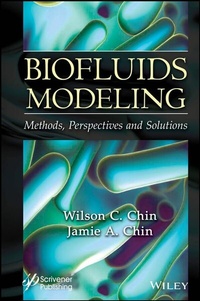
Biofluids Modeling
Methods, Perspectives, and Solutions
1st Edition
Published on 8. November 2023
512 pages
978-1-119-91057-2 (ISBN)
Description

BIOFLUIDS MODELING
The first book offering analytical and modern computational solutions to important biofluids problems, such as non-Newtonian flows in blood vessels, clogged arteries and veins, bifurcated arteries and veins, arbitrary stent geometries, tissue properties prediction, and porous media Darcy flow simulation in large-scale organ analysis, this is a must-have for any library.
This book introduces new methods for biofluids modeling and biological engineering. The foregoing subjects are treated rigorously, with all modeling assumptions stated and solutions clearly derived. But that's not all. Key supporting physics-based ideas, algorithmic details, and software design interfaces are equally emphasized, in order to support our overriding objective of getting the anatomical and clinical information that physicians need.
Importantly, this volume provides a self-contained exposition that includes all required biological concepts, plus the background preparation needed in fluid mechanics, basic differential equations, and modern numerical analysis. The presentation style will appeal to medical practitioners, researchers, biomedical engineers, and students interested in quantitative fluid flow modeling, as well as engineering students eager to learn about advances in a rapidly growing and changing biological science. As such, the book represents "must-reading" suitable at the advanced undergraduate level, and motivated readers should be able to embark on related research following guided study.
The first book offering analytical and modern computational solutions to important biofluids problems, such as non-Newtonian flows in blood vessels, clogged arteries and veins, bifurcated arteries and veins, arbitrary stent geometries, tissue properties prediction, and porous media Darcy flow simulation in large-scale organ analysis, this is a must-have for any library.
This book introduces new methods for biofluids modeling and biological engineering. The foregoing subjects are treated rigorously, with all modeling assumptions stated and solutions clearly derived. But that's not all. Key supporting physics-based ideas, algorithmic details, and software design interfaces are equally emphasized, in order to support our overriding objective of getting the anatomical and clinical information that physicians need.
Importantly, this volume provides a self-contained exposition that includes all required biological concepts, plus the background preparation needed in fluid mechanics, basic differential equations, and modern numerical analysis. The presentation style will appeal to medical practitioners, researchers, biomedical engineers, and students interested in quantitative fluid flow modeling, as well as engineering students eager to learn about advances in a rapidly growing and changing biological science. As such, the book represents "must-reading" suitable at the advanced undergraduate level, and motivated readers should be able to embark on related research following guided study.
More details
Other editions
Additional editions
Wilson C. Chin | Jamie A. Chin
Biofluids Modeling
Software
06/2024
Wiley
€280.87
Article exhausted; check different version
Book
11/2023
1st Edition
Wiley-Scrivener
€207.50
Shipment within 15-20 days
Persons
Wilson C. Chin, PhD, has published over twenty books with Wiley-Scrivener and other leading book publishers, more than one hundred papers for scientific and scholarly journals, and holds four dozen patents. He is the recipient of five awards from the United States Department of Energy in fluid and computational physics, and he has developed engineering flow simulation models for numerous Fortune 500 companies.
Jamie A. Chin, a biologist affiliated with the Beijing International School, is expanding her research interests, recently publishing innovative biofluids approaches that model complicated clotting effects in non-circular distorted blood vessels and complex multi-branched arterial systems.
Content
- Cover
- Title Page
- Copyright Page
- Contents
- Preface
- Acknowledgements
- Dedication
- Chapter 1 Fluid Physics in Circulatory Systems - Problems, Analogies and Methods
- Presentation philosophy
- 1.1 Basic Biological Notions and Fluid-Dynamical Ideas
- Conduit flow examples
- Basic continuous flow concepts
- Eulerian versus Lagrangian descriptions
- Steady versus transient models
- Newtonian versus non-Newtonian flows
- Porous media continuum flow models
- Darcy flows in human and animal tissue
- Objectives in conduit and Darcy flow modeling
- 1.2 Quantitative Modeling Perspectives
- 1.2.1 Rheology considerations in conduit flows
- Better arterial flow models needed
- 1.2.2 Darcy flow model in continuous media
- Temperature diffusion
- Darcy flow pressure diffusion
- Important porous media approach
- Relevance of Darcy flows to biofluids
- 1.3 Preview of Complicated but Simple Boundary Value Problem Solutions
- Closing remarks
- 1.4 References
- Chapter 2 Math Models, Differential Equations and Numerical Methods
- 2.1 Presentation Approach
- What we won't do
- Pursuing studies that uncover the physics
- Examples on presentation approach
- 2.2 Diffusion Processes, Partial Differential Equations and Formulation Development
- 2.2.1 Heat transfer applications
- 2.2.2 Heat equation derivation
- 2.2.3 Pressure diffusion in porous media
- 2.2.4 Dynamically coupled heat and pressure diffusion
- 2.3 Boundary-Conforming Curvilinear Grid Generation
- 2.3.1 Comments on classical coordinate transforms and conformal mapping
- 2.3.2 Curvilinear gridding method for irregular domains
- 2.3.2.1 Grid generation for eccentric annular flow
- Mapping formalism and key ideas
- Thompson's mapping
- Some reciprocity relations
- Relation to conformal mapping, finally
- Solutions to mesh generation equations
- Boundary conditions
- Fast iterative solutions
- On Laplacian transformations
- 2.3.2.2 Grid generation for singly-connected conduit flow
- 2.4 Finite Difference Solutions Made Easy - Iterative Methods, Programming and Source Code Details
- 2.4.1 Basic ideas in finite differences
- A simple differential equation
- Variable coefficients and grids
- 2.4.2 Formulating steady flow problems
- Direct versus iterative solutions
- Iterative methods
- Convergence acceleration
- Wells and internal boundaries
- Peaceman well corrections
- Derivative discontinuities
- Point relaxation methods
- Observations on relaxation methods
- Minimal computing resources
- Good numerical stability
- Fast convergence
- Why relaxation methods converge
- Over-relaxation
- Line and point relaxation
- Curvilinear grid generation and relaxation solutions
- Coupled equations on curvilinear meshes
- 2.5 References
- Chapter 3 Hagen-Poiseuille Extensions - Real Flow Effects and General Bifurcations
- 3.1 Blood Rheology and Overview
- 3.1.1 Hagen-Poiseuille - Misunderstandings and limitations
- 3.1.2 Ideal versus non-Newtonian rheology
- 3.1.3 Some conventional rheological models
- 3.1.4 Perfect concentric flow velocity, pressure and flow rate relations
- Newtonian flow solution
- Bingham Plastic pipe flow
- Power Law fluid pipe flow
- Herschel-Bulkley pipe flow
- Ellis fluid pipe flow
- 3.1.5 Example solutions for imperfect arteries with stenosis and book presentation outline
- Book presentation outline
- 3.2 Newtonian Flow in Simple Bifurcations
- 3.2.1 Theory - Two uneven bifurcated blood vessels with Q1 specified
- Case 1. Flow rate Q1 prescribed
- Case 2. Inlet pressure Pi prescribed
- Case 3. Identical outlet pressures Po,2 and Po,3 given
- 3.2.2 Software - Two uneven bifurcated arteries with Q1 specified (Reference, CODE-1)
- An example computation
- An additional validation
- 3.2.3 Theory - Two uneven bifurcated arteries with Pi specified
- 3.2.4 Software - Two uneven bifurcated arteries with Pi specified (Reference, CODE-2)
- A practical example
- 3.3 Theory - Complicated Arteries with Chained Bifurcations
- 3.4 Network with Arbitrary Number of Bifurcations
- 3.5 Bifurcated Newtonian Flow in Noncircular Clogged Blood Vessels
- 3.6 References
- Chapter 4 Non-Newtonian Flow in Circular Conduits and Networks
- Bifurcation model and analytical approach
- Different rheological applications
- Validation procedures
- 4.1 Power Law Fluids with Inlet Flow Rate Prescribed
- Iterative "half-step" solution for Pa and Pi
- Shear stress
- Typical parameters
- Example calculations
- 4.2 Herschel-Bulkley Fluids and Yield Stress
- 4.2.1 Analytical and numerical approach
- Yield stress modeling
- 4.2.2 BIFURC-6 runs assuming ôy = 0 psi (Power Law limit)
- 4.2.3 BIFURC-6 runs assuming ôy = 0.00001 psi
- 4.3 Newtonian and Herschel-Bulkley Examples
- Power Law limitations
- 4.4 References
- Chapter 5 Flows in Clogged Arteries and Veins
- 5.1 Hagen-Poiseuille Revisited - Rectangular Coordinates
- Newtonian pipe flow recapitulation
- A physical description
- Detailed assessments
- Recapitulation
- 5.2 Non-Newtonian Power Law Circular Pipe Flow in Rectangular Coordinates
- 5.3 Clinical Implications for Pressure Gradient and Viscous Shear Stress
- 5.4 Evolutionary Approaches for Complicated Geometries
- Static versus evolutionary approaches
- 5.5 A Detailed Clog Flow Computation
- Simulation 1 - Newtonian flow in perfect circle
- Simulation 2 - Power Law flow in perfect circle
- Simulation 3 - Power Law flow in a clogged blood vessel
- 5.6 References
- Chapter 6 Square Stents, Centrifugal Effects, Pulsatile Flow, Clogged Bifurcations and Axial Variations
- 6.1 Stent Geometry Effects on Volume Flow Rate
- 6.1.1 Conventional stents, analytical flow model
- Stent detailed function
- Analytical modeling
- Exact analytical Hagen-Poiseuille solution
- 6.1.2 Finite difference method
- 6.1.3 Square stent designs, analytical and numerical models
- Exact analytical solution for rectangular stents
- Finite difference solution
- Example calculation
- 6.2 General Formulations and Solutions for Complicated Geometries and Arbitrary Fluids
- Recapitulation
- 6.3 Centrifugal Force Influence on Volume Flow Rate
- Straight, closed ducts
- Hagen-Poiseuille flow between planes
- Flow between concentric plates
- Typical calculations
- Flows in closed curved ducts
- 6.4 Unsteady Pulsatile Flow Model for Complicated Duct Cross-Sections
- 6.5 Bifurcated Conduits with Newtonian Flow in Clogged Geometric Cross-sections
- 6.6 Modeling Axial Variations with Pseudo-Three- Dimensional Method
- 6.7 Modeling Transient Wall Effects
- 6.8 Steady Bifurcated Newtonian Flows With Arbitrary Clogs, A Numerical Example
- 6.8.1 Motivating questions and examples
- 6.8.2 Detailed single-element pipe flow solutions
- 6.8.3 Method for bifurcated systems with clogged piping elements
- 6.8.4. Effective radius flow properties
- 6.8.5 Discussion and conclusions
- 6.9 References
- Chapter 7 Tissue Properties from Steady and Transient Syringe Pressure Analysis
- 7.1 Importance of Compressibility, Permeability, Anisotropy, Pressure and Porosity in Medical Applications
- Compressibility
- Permeability
- Anisotropy
- Local pressures
- Porosity
- Additional highlights
- 7.2 Geoscience Perspectives and Background
- 7.3 Formation Testing in Petroleum Well Logging
- 7.4 Operational Guidelines to Biofluids Pressure Testing
- Intelligent syringe concepts
- Multiprobe syringe assemblies for anisotropy and heterogeneity mapping
- 7.5 Intelligent Syringe Fundamentals
- 7.5.1 Background and Motivation
- 7.5.2 Clinical and Diagnostic Objectives
- 7.5.3 Syringe Flow Basics and Porous Media Pressure Conventions
- 7.5.4 Single Intelligent Syringe Basic Layout
- Figure 3A description
- Figure 3B description
- Figure 3C description
- Figure 3D description
- Figure 3E description
- General Comments
- 7.5.5 Syringe Arrays for Heterogeneity Mapping and Biopsy Sampler
- Array syringe and biopsy sampler
- Array syringe general concept
- 7.6 Mathematical Models for Porous Media Flow
- 7.6.1 Transient Isotropic Darcy Flow - Forward Solutions
- 7.6.2 Transient Transversely Isotropic Darcy Flow - Forward Solutions
- 7.6.3 Transient Isotropic and Transversely Isotropic Flow - Inverse Solutions
- 7.6.4 Steady Transversely Isotropic Flow - Inverse Solutions
- 7.6.5 Modeling Notes and Physical Consequences
- Geometric factor
- Flowline compressibility
- Flowline pressure drops
- Pressure effects on tissue
- 7.6.6 Anisotropic Permeabilities from Oscillatory Pressure Fields
- 7.6.7 Formulation for Supercharged Damage Zones
- 7.6.8 General Properties, Calculated Results and Validations
- Example 1. Forward and Inverse Simulations in Isotropic Media Using Drawdown Method
- Example 2. Forward and Inverse Simulations in Transversely Isotropic Media Using Pure Drawdown (or Pure Buildup) Methods
- Example 3. Forward and Inverse Simulations in Transversely Isotropic Media Using Drawdown-Buildup Method
- Example 4. Forward and Inverse Simulations in Transversely Isotropic Media Using Drawdown and Phase Delay Method
- Example 5. Forward and Inverse Simulations in Transversely Isotropic Media for Flows with Nonzero Dip Angle
- 7.6.9 Application to Subcutaneous Injection Yorkshire Swine Laboratory Data
- Experimental Details
- Laboratory Setup and Raw Data Analysis
- Example 1. Needle Gauge Effect on Mobility Predictions
- Example 2. Transversely Isotropic (kh = 20 md, kv = 30 md) Prediction of kh and kv from Steady Pressure Drops
- Example 3. Transversely Isotropic (kh = 30 md, kv = 20 md) Prediction of kh and kv from Steady Pressure Drops
- Example 4. Anisotropic Transient Method for Effective Permeability
- Example 5. Effects of Compressibility
- 7.6.10 Application to Subcutaneous Injection Adult Human Laboratory Data
- Example 1. Pressure Analysis for Figure 7-1D
- Example 2. Pressure Analysis for Figures 7-1A,B,C
- 7.6.11 Laboratory Notes for Flowline Geometry and Frictional Effects
- 7.6.12 Closing Remarks
- 7.7 References
- Chapter 8 Artery, Capillary and Vein Interactions in Anisotropic Heterogeneous Porous Tissue Flows
- Intuitive physical ideas
- Concrete simulation examples
- 8.1 Qualitative Review of the Circulatory System
- 8.2 Porous Media Flows in the Geosciences and in Biofluids Applications
- Biofluids applications
- 8.3 Electrical and Biological Analogies
- Series and parallel electrical circuits
- Cardiovascular system model
- Validating examples
- Simulation 1. Baseline run with three active capillary bed groups (see Figure 8-18a)
- Simulation 2. Baseline run with two active capillary groups (middle group, with smaller permeability, is altered)
- Simulation 3. Calculating flow rate versus pressure drop
- Tissue masses connected in series
- 8.4 References
- Chapter 9 Geoscience Ideas in Biofluids Modeling
- Solution strategies and perspectives
- Blood vessel assumptions revisited
- 9.1 Multisim Background and Biofluids Applications
- Interesting possibilities
- Multisim limitations in our applications
- What Multisim does and how it works
- 9.2 Running Multisim
- 9.2.1 Simulation 1. Set-up and "Flatman" visual display
- Rendering "Flatman" in Multisim
- 9.2.2 Simulation 2 - Simple aneurysm model
- 9.2.3 Simulation 3 - Mimicking pressure drops in blood vessels
- 9.2.4 Simulation 4 - Pressure versus flow rate specifications
- Run 1. Pressure-pressure specification
- Run 2. Flow rate - flow rate specification
- Run 3. Pressure - flow rate specification
- 9.3 Closing Remarks
- 9.4 References
- Cumulative References
- About the Authors
- Index
- EULA
