

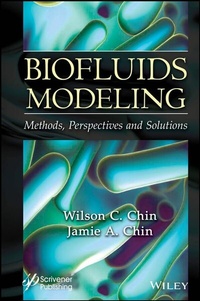
Biofluids Modeling
Description

The first book offering analytical and modern computational solutions to important biofluids problems, such as non-Newtonian flows in blood vessels, clogged arteries and veins, bifurcated arteries and veins, arbitrary stent geometries, tissue properties prediction, and porous media Darcy flow simulation in large-scale organ analysis, this is a must-have for any library.
This book introduces new methods for biofluids modeling and biological engineering. The foregoing subjects are treated rigorously, with all modeling assumptions stated and solutions clearly derived. But that's not all. Key supporting physics-based ideas, algorithmic details, and software design interfaces are equally emphasized, in order to support our overriding objective of getting the anatomical and clinical information that physicians need.
Importantly, this volume provides a self-contained exposition that includes all required biological concepts, plus the background preparation needed in fluid mechanics, basic differential equations, and modern numerical analysis. The presentation style will appeal to medical practitioners, researchers, biomedical engineers, and students interested in quantitative fluid flow modeling, as well as engineering students eager to learn about advances in a rapidly growing and changing biological science. As such, the book represents "must-reading" suitable at the advanced undergraduate level, and motivated readers should be able to embark on related research following guided study.
More details
Other editions
Additional editions
Persons
Wilson C. Chin, PhD, has published over twenty books with Wiley-Scrivener and other leading book publishers, more than one hundred papers for scientific and scholarly journals, and holds four dozen patents. He is the recipient of five awards from the United States Department of Energy in fluid and computational physics, and he has developed engineering flow simulation models for numerous Fortune 500 companies.
Jamie A. Chin, a biologist affiliated with the Beijing International School, is expanding her research interests, recently publishing innovative biofluids approaches that model complicated clotting effects in non-circular distorted blood vessels and complex multi-branched arterial systems.
Content
Preface xv
Acknowledgements xix
Dedication xxi
1 Fluid Physics in Circulatory Systems - Problems, Analogies and Methods 1
1.1 Basic Biological Notions and Fluid-Dynamical Ideas 3
1.2 Quantitative Modeling Perspectives 16
1.3 Preview of Complicated but Simple Boundary Value Problem Solutions 24
1.4 References 27
2 Math Models, Differential Equations and Numerical Methods 29
2.1 Presentation Approach 31
2.2 Diffusion Processes, Partial Differential Equations and Formulation Development 34
2.3 Boundary-Conforming Curvilinear Grid Generation 41
2.4 Finite Difference Solutions Made Easy - Iterative Methods, Programming and Source Code Details 63
2.5 References 98
3 Hagen-Poiseuille Extensions - Real Flow Effects and General Bifurcations 100
3.1 Blood Rheology and Overview 101
3.2 Newtonian Flow in Simple Bifurcations 112
3.3 Theory - Complicated Arteries with Chained Bifurcations 120
3.4 Network with Arbitrary Number of Bifurcations 122
3.5 Bifurcated Newtonian Flow in Noncircular Clogged Blood Vessels 123
3.6 References 125
4 Non-Newtonian Flow in Circular Conduits and Networks 127
4.1 Power Law Fluids with Inlet Flow Rate Prescribed 130
4.2 Herschel-Bulkley Fluids and Yield Stress 141
4.3 Newtonian and Herschel-Bulkley Examples 149
4.4 References 154
5 Flows in Clogged Arteries and Veins 155
5.1 Hagen-Poiseuille Revisited - Rectangular Coordinates 157
5.2 Non-Newtonian Power Law Circular Pipe Flow in Rectangular Coordinates 164
5.3 Clinical Implications for Pressure Gradient and Viscous Shear Stress 167
5.4 Evolutionary Approaches for Complicated Geometries 168
5.5 A Detailed Clog Flow Computation 175
5.6 References 182
6 Square Stents, Centrifugal Effects, Pulsatile Flow, Clogged Bifurcations and Axial Variations 183
6.1 Stent Geometry Effects on Volume Flow Rate 183
6.2 General Formulations and Solutions for Complicated Geometries and Arbitrary Fluids 200
6.3 Centrifugal Force Influence on Volume Flow Rate 204
6.4 Unsteady Pulsatile Flow Model for Complicated Duct Cross-Sections 214
6.5 Bifurcated Conduits with Newtonian Flow in Clogged Geometric Cross-sections 220
6.6 Modeling Axial Variations with Pseudo-Three- Dimensional Method 221
6.7 Modeling Transient Wall Effects 223
6.8 Steady Bifurcated Newtonian Flows With Arbitrary Clogs, A Numerical Example 225
6.9 References 233
7 Tissue Properties from Steady and Transient Syringe Pressure Analysis 234
7.1 Importance of Compressibility, Permeability, Anisotropy, Pressure and Porosity in Medical Applications 236
7.2 Geoscience Perspectives and Background 246
7.3 Formation Testing in Petroleum Well Logging 249
7.4 Operational Guidelines to Biofluids Pressure Testing 255
7.5 Intelligent Syringe Fundamentals 263
7.6 Mathematical Models for Porous Media Flow 286
7.7 References 374
8 Artery, Capillary and Vein Interactions in Anisotropic Heterogeneous Porous Tissue Flows 380
8.1 Qualitative Review of the Circulatory System 383
8.2 Porous Media Flows in the Geosciences and in Biofluids Applications 389
8.3 Electrical and Biological Analogies 393
8.4 References 407
9 Geoscience Ideas in Biofluids Modeling 408
9.1 Multisim Background and Biofluids Applications 414
9.2 Running Multisim 421
9.3 Closing Remarks 447
9.4 References 449
Cumulative References 450
About the Authors 460
Index 461
1
Fluid Physics in Circulatory Systems - Problems, Analogies and Methods
Writing a useful research-oriented book on biofluids modeling is extremely challenging. Some expertise in mathematics, at the differential equation level or higher, is often presumed. Software proficiency is presumed. At the same time, a background in fluid mechanics is taken for granted, as is a year's preparation in biology. Yet, if our potential audience strictly interpreted and followed these requirements, there would be limited numbers of qualified readers - the simple but powerful ideas we propose would remain unknown and unlikely to benefit practitioners. How then do we proceed?
Presentation philosophy.
To appeal to the broadest audience, from undergraduates, to clinicians, to medical researchers, and to engineers and scientists interested in learning about an expanding and evolving discipline - and to deliver our work assuming a basic academic preparation, between the covers of a four-hundred page book, within the constraints of a year's study time, at most - the authors have adopted a rapidly paced tutorial style that is rigorous yet understandable, focused yet encompassing, and academically oriented yet interesting. Portions of our work have been tested over time with diverse audiences, e.g., from Texas's Aldine Independent School Districts' "Education for the Energy Industry" (EEI) program in fluid mechanics, to China's Beijing No. 55 International School's biology students, and to the University of Houston's (Open Admissions) process engineering group department in pipe flow analysis. Finally, seminars at two recent Houston conferences and several engineering universities in China have proven very fruitful.
For example, we will start arterial flow discussions by citing the well known Hagen-Poiseuille equation (together with its assumptions, limitations and strengths) without the usual formalism drawing on continuum mechanics and tensor analysis. Modern science cannot evolve without strong mathematical foundations and that means partial differential equations - a broad subject area that easily consumes years of study. But for practical purposes, it is not possible to present even a watered-down course syllabus, e.g., equation types (elliptic, parabolic, hyperbolic), solution methods (separation of variables, Laplace transforms, Fourier series and integrals), numerical methods (implicit, explicit, relaxation, finite element methods, and so on) and similarly broad topics. And in biology, where major discoveries are made on a daily basis in microscopic exchange processes, advanced imaging methods, tissue engineering and blood rheology, it is difficult to review any particular paper let alone entire research disciplines.
But none of the above will limit the purpose of this volume - and that is to develop and understandably communicate new methods and tools that clinicians and medical researchers need in order to provide the information they want. In short, we will present specific math methods only when they are required in specific biological applications. For example, with the Hagen-Poiseuille law as a starting discussion point for conduit flows (assuming Newtonian flow in large diameter vessels), we develop bifurcation models that describe branching effects - first for double and multiple branched systems, then extensions to non-Newtonian fluids, and finally, generalizations for non-circular flow conduits with geometrically complicated cross-sectional clogs.
Or consider the use of Darcy flow modeling in porous flow tissue analysis. While published models are limited in breadth, we will explain why pressure transients that are measurable during syringe injections are affected by compressibility, permeability, anisotropy and porosity - and importantly give methods demonstrating how these parameters can be predicted during drug delivery. We also expand upon conventional Darcy flow analyses with comprehensive models showing how blood flows from arteries, through complex organs, and then to veins; how volume flow rates are calculated together with pressure drops; and finally, how damage or decreased functionality in any subsystem can affect the entire system. Finally, an interesting example uses an oilfield Darcy flow simulator to describe the effect of arterial flow through tissues in our "Flatman" prototype for whole-body pressure modeling.
1.1 Basic Biological Notions and Fluid-Dynamical Ideas.
In this chapter, we introduce basic fluid flow modeling concepts as they apply to principal parts of the circulatory system. As mentioned earlier, our aim is not an exhaustive (or even limited) literature review. By "circulatory system," we refer macroscopically to arteries, capillaries and veins" and surrounding tissues, and by necessity, do not focus on the very complicated microscopic biological, cellular and chemical processes that are ongoing throughout the body. Our literature search and cited figures are limited in this respect - our reviews focus only on what medical researchers and clinicians need and how we can provide better information using available knowledge and accessible data.
Similarly, our fluid-dynamics discussions and modeling methods support only those biological problems that we have introduced. However several math methods are new to the literature, for example, one developed to support general clogged flow analyses in straight and curved blood vessels in Chapters 5 and 6, and the second to support interpretation algorithms behind the "intelligent syringes" of Chapter 7. In these areas, not covered in the usual numerical analysis and engineering publications, we will present details. And so, our coverage is complete in the sense that standard topics, where external references are available, are not substantially reviewed here, while new approaches are explained to a high but understandable level for specialists.
Conduit flow examples.
Again, in this book we will focus on the "circulatory system," which refers macroscopically to arteries, capillaries and veins" and surrounding tissues, and out of necessity, do not consider the very complicated microscopic biological, cellular and chemical processes ongoing throughout the body. Within this framework, studies can be separated into two categories, "distinct conduit flows" and then "continuum descriptions." The former mainly refers to arteries and veins functioning independently of the tissue environment - we are mainly concerned with the effects of fluid rheology and geometric flow cross-section on pressure drop and volume flow rate, and note that the corresponding math models are largely algebraic in nature. By contrast, the latter refers to the surrounding tissue, that is, how fluids flow through permeable and porous media like sponges, sands and soils, how heterogeneities and anisotropy appear in continuum models, and how these (together with the former conduit models) affect heart pumping efficiency (that is, volume flow rate and pressure drop). These continuum models require the solution of partial differential equations.
Flows in arteries and veins are very complicated and extensively researched in the medical literature. For our purposes, they serve only as conduits whose flows require mathematical description that address blood heterogeneity and vessel geometry. Basically, blood flow emerges from the heart into arteries and ultimately returns through veins. An Internet image search leads to numerous excellent examples, as shown in Figures 1-1a and 1-1b, where typically "red" represents arteries and "blue" denotes veins.
Figure 1-1a. Arteries and veins.
Credit: rxlist.com.
Figure 1-1b. Arteries and veins.
Credit: focusedcollection.com.
A closer look at Figures 1-1a and 1-1b shows that single blood vessels will bifurcate, or branch, into two or more vessels, with the process repeating itself, as highlighted in Figures 1-2a, 1-2b and 1-2c. What geometric and rheological properties connect inlet and outlet flows? How are these calculated? These questions seem obvious, but the literature offers conflicting explanations and solutions at times.
Figure 1-2a. Bifurcation example.
Credit: indianaexpress.com.
Figure 1-2b. Bifurcation example.
Credit: medicalnewstoday.com.
Figure 1-2c. Bifurcation example.
Credit: anatomyqa.com.
For example, Chegg.com, a well known tutorial site, assumes conservation of total energy at flow junctions for simplicity, an idealistic modeling assumption that is unrealistic - fluid flow is inherently lossy. On the other hand, software used to design piping networks in process plants makes extensive use of "head loss" coefficients, e.g., empirical loss factors inferred from operations, and lab experiments for pipe roughness, inlet changes, fittings effects, pipe turns, contractions and expansions. And then, there are finite element methods, e.g., as shown in Figure 1-3, which suggest high degrees of accuracy through impressive color displays - graphics which de-emphasize grid effects related to shape and size on solution integrity. We instead present physically and mathematically rigorous methods...
