

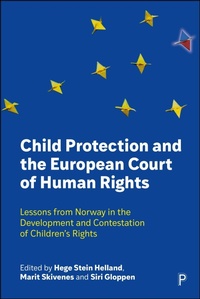
Child Protection and the European Court of Human Rights
Lessons from Norway in the Development and Contestation of Children's Rights
Policy Press
1st Edition
Published on 16. October 2025
292 pages
978-1-4473-7148-9 (ISBN)
Description

Article 1 of the European Convention of Human Rights gives children the same protection of their fundamental rights and freedoms as adults. However, there is a notable absence of specific provisions for their rights. What does this imply in practice?
This interdisciplinary volume brings together leading scholars in political science, law, social work and more to examine how the European Court of Human Rights (ECtHR) shapes - and is shaped by - child protection litigation and mobilisation.
Norway has had more child protection cases decided by the ECtHR than any other country, and so this book, a first of its kind, uses Norway as a specific focus and explores the evolving role of the Court in balancing parental rights, state authority and children's best interests, offering a fresh perspective on the intersection of international human rights law, children's rights and child protection policy.
This interdisciplinary volume brings together leading scholars in political science, law, social work and more to examine how the European Court of Human Rights (ECtHR) shapes - and is shaped by - child protection litigation and mobilisation.
Norway has had more child protection cases decided by the ECtHR than any other country, and so this book, a first of its kind, uses Norway as a specific focus and explores the evolving role of the Court in balancing parental rights, state authority and children's best interests, offering a fresh perspective on the intersection of international human rights law, children's rights and child protection policy.
Reviews / Votes
"An important book which considers the European Court of Human Rights jurisprudence in child protection matters. This is an area that has largely been overlooked." Samantha Davey, University of EssexMore details
Edition
First Edition
Language
English
Place of publication
Bristol
United Kingdom
Publishing group
Bristol University Press
Target group
College/higher education
Illustrations
Not illustrated
File size
0,95 MB
ISBN-13
978-1-4473-7148-9 (9781447371489)
Copyright in bibliographic data and cover images is held by Nielsen Book Services Limited or by the publishers or by their respective licensors: all rights reserved.
Schweitzer Classification
Other editions
Additional editions
Child Protection and the European Court of Human Rights
Lessons from Norway in the Development and Contestation of Children's Rights
Book
10/2025
1st Edition
Policy Press
€37.50
Shipment within 15-20 days
Persons
Hege Stein Helland is Postdoctoral Fellow at the Department of Government and the Centre for Research on Discretion and Paternalism at the University of Bergen.
Marit Skivenes is Professor of Political Science at the Department of Government and the Centre for Research on Discretion and Paternalism at the University of Bergen.
Siri Gloppen is Professor of Political Science at the Department of Government and the Centre for Law & Social Transformation at the University of Bergen.
Marit Skivenes is Professor of Political Science at the Department of Government and the Centre for Research on Discretion and Paternalism at the University of Bergen.
Siri Gloppen is Professor of Political Science at the Department of Government and the Centre for Law & Social Transformation at the University of Bergen.
Contributions
European Parliamentary Forum for Sexual & Reproductive Rights (EPF)
University or Bergen, Norway & Tampere University, Finland
Tampere University and Tampere University of Applied Sciences (TAMK)
Monash University
Emmanuel College in Boston USA; Centre for Research on Discretion and Paternalism at the University of Bergen
Zurich University of Applied Science
Oslo Metropolitan University
Content
1. Children's Rights Under Pressure: Norway, the European Court of Human Rights, and the Challenges to Welfare State Legitimacy - Hege Stein Helland, Marit Skivenes and Siri Gloppen
Part 1: The European Court of Human Rights from a national perspective
2. Are the child welfare cases against Norway in the European Court of Human Rights unique? - Marius Emberland
3. Child Protection and the European Court of Human Rights - the case of Finland and Article 8 - Raija Huhtanen and Tarja Poesoe
4. Children's rights and the ECtHR judgements' effects on Norwegian Courts and jurisprudence - Kirsten Sandberg
5. Implementing International Human Rights Case Law at the Domestic Street-Level: The Case of Norwegian Child Protection - Hege Stein Helland
6. Representations of children in ECtHR judgments - Katrin Kriz and Daniela Reimer
7. Exploring ethnicity constructs in ECtHR judgments - Daniela Reimer, Katrin Kriz, Mary Burns, Gabriela Serra, and Kerry Shea
Part 2: Transnational influence of the European Court of Human Rights
8. Prioritising the Child's Best Interests: Mixed Messages in the International Human Rights Arena - Elaine E. Sutherland
9. Think of the Children! Children's Rights as the New Frontier in Anti-gender Contestation - Neil Datta
10. When "Bad Friends" Lobby the Court against Human Rights - Asgeir Falch-Eriksen
11. Mobilised Interests, the ECtHR and Children's Rights - Rachel Cichowski and Elizabeth Chrun
Part 3: The European Court of Human Rights and its jurisprudence
12. Children and Rights to Identity at the European Court of Human Rights - Jill Marshall
13. Normative considerations about the guiding principles for the European Court of Human Rights allocating custody in child protection - David Archard and Marit Skivenes
14. The Relationship Between the UN Convention on the Rights of the Child and The European Court of Human Rights in Numbers - Claire Fenton-Glynn
15. The European Court of Human Rights - an untapped source for advancing child rights? - Hege Stein Helland, Marit Skivenes and Siri Gloppen
Part 1: The European Court of Human Rights from a national perspective
2. Are the child welfare cases against Norway in the European Court of Human Rights unique? - Marius Emberland
3. Child Protection and the European Court of Human Rights - the case of Finland and Article 8 - Raija Huhtanen and Tarja Poesoe
4. Children's rights and the ECtHR judgements' effects on Norwegian Courts and jurisprudence - Kirsten Sandberg
5. Implementing International Human Rights Case Law at the Domestic Street-Level: The Case of Norwegian Child Protection - Hege Stein Helland
6. Representations of children in ECtHR judgments - Katrin Kriz and Daniela Reimer
7. Exploring ethnicity constructs in ECtHR judgments - Daniela Reimer, Katrin Kriz, Mary Burns, Gabriela Serra, and Kerry Shea
Part 2: Transnational influence of the European Court of Human Rights
8. Prioritising the Child's Best Interests: Mixed Messages in the International Human Rights Arena - Elaine E. Sutherland
9. Think of the Children! Children's Rights as the New Frontier in Anti-gender Contestation - Neil Datta
10. When "Bad Friends" Lobby the Court against Human Rights - Asgeir Falch-Eriksen
11. Mobilised Interests, the ECtHR and Children's Rights - Rachel Cichowski and Elizabeth Chrun
Part 3: The European Court of Human Rights and its jurisprudence
12. Children and Rights to Identity at the European Court of Human Rights - Jill Marshall
13. Normative considerations about the guiding principles for the European Court of Human Rights allocating custody in child protection - David Archard and Marit Skivenes
14. The Relationship Between the UN Convention on the Rights of the Child and The European Court of Human Rights in Numbers - Claire Fenton-Glynn
15. The European Court of Human Rights - an untapped source for advancing child rights? - Hege Stein Helland, Marit Skivenes and Siri Gloppen
