

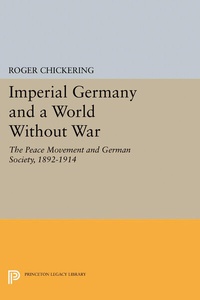
Imperial Germany and a World Without War
The Peace Movement and German Society, 1892-1914
1st Edition
Published on 19. May 2015
504 pages
978-1-4008-6773-8 (ISBN)
Description

This book provides the first thorough examination of the peace movement in pre-World War I Germany, concentrating on the factors in German politics and society that account for the movement's weakness. The author draws on a wide range of documents to survey the history, organization, and ideologies of the peace groups, placing them in their social and political context.
Working through schools, churches, the press, political parties, and other opinion-forming groups, the German peace movement attempted systematically to promote the idea that the world's nations composed a harmonious community in which law was the proper means for resolving disputes. Except for small pockets of support, however, the movement met only resistance-resistance greater, the author contends, than elsewhere in the West. Evaluating the reasons for hostility to the peace movement in Germany, he concludes that dominant features of German political culture emphasized the inevitability of international conflict, in the final analysis because Imperial Germany's ruling elites feared the domestic as well as the international implications of the movement's program.
Originally published in 1976.
The Princeton Legacy Library uses the latest print-on-demand technology to again make available previously out-of-print books from the distinguished backlist of Princeton University Press. These editions preserve the original texts of these important books while presenting them in durable paperback and hardcover editions. The goal of the Princeton Legacy Library is to vastly increase access to the rich scholarly heritage found in the thousands of books published by Princeton University Press since its founding in 1905.
Working through schools, churches, the press, political parties, and other opinion-forming groups, the German peace movement attempted systematically to promote the idea that the world's nations composed a harmonious community in which law was the proper means for resolving disputes. Except for small pockets of support, however, the movement met only resistance-resistance greater, the author contends, than elsewhere in the West. Evaluating the reasons for hostility to the peace movement in Germany, he concludes that dominant features of German political culture emphasized the inevitability of international conflict, in the final analysis because Imperial Germany's ruling elites feared the domestic as well as the international implications of the movement's program.
Originally published in 1976.
The Princeton Legacy Library uses the latest print-on-demand technology to again make available previously out-of-print books from the distinguished backlist of Princeton University Press. These editions preserve the original texts of these important books while presenting them in durable paperback and hardcover editions. The goal of the Princeton Legacy Library is to vastly increase access to the rich scholarly heritage found in the thousands of books published by Princeton University Press since its founding in 1905.
More details
Other editions
Additional editions
Roger Chickering
Imperial Germany and a World Without War
The Peace Movement and German Society, 1892-1914
Book
04/2016
Princeton University Press
€161.80
Article not available at the moment
Roger Chickering
Imperial Germany and a World Without War
The Peace Movement and German Society, 1892-1914
Book
03/2015
Princeton University Press
€61.50
Article not available at the moment

Roger Chickering
Imperial Germany and a World Without War
The Peace Movement and German Society, 1892-1914
Book
01/1976
Princeton University Press
€86.80
Article exhausted; check different version
Roger Chickering
Imperial Germany and a World Without War
The Peace Movement and German Society, 1892-1914
Book
01/1976
Princeton University Press
€27.28
Article exhausted; check different version
Person
Roger Chickering
Content
Frontmatter, pg. i
Contents, pg. vii
Preface, pg. xi
Abbreviations, pg. xiii
1. Introduction: The Peace Movement, Pacifism, and Political Culture, pg. 1
2. The German Peace Society, pg. 38
3. The Ideology of German Pacifism, pg. 89
4. The Expansion of the German Peace Movement, pg. 122
5. The Peace Movement and the Political Education of German Society, pg. 163
6. The Peace Movement and German Politics, pg. 218
7. The German Peace Movement and International Politics, pg. 286
8. Excursus: The Peace Movement in France, pg. 327
9. The Peace Movement in Imperial Germany: The Nature of the Opposition, pg. 384
Bibliography, pg. 421
Index, pg. 467
Contents, pg. vii
Preface, pg. xi
Abbreviations, pg. xiii
1. Introduction: The Peace Movement, Pacifism, and Political Culture, pg. 1
2. The German Peace Society, pg. 38
3. The Ideology of German Pacifism, pg. 89
4. The Expansion of the German Peace Movement, pg. 122
5. The Peace Movement and the Political Education of German Society, pg. 163
6. The Peace Movement and German Politics, pg. 218
7. The German Peace Movement and International Politics, pg. 286
8. Excursus: The Peace Movement in France, pg. 327
9. The Peace Movement in Imperial Germany: The Nature of the Opposition, pg. 384
Bibliography, pg. 421
Index, pg. 467
