

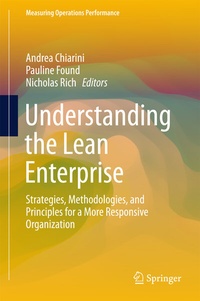
Understanding the Lean Enterprise
Description

This publication is in collaboration with the University of Buckingham and is the result of a combined research and review process carried out by the three Editors who belongs to the University of Ferrara, Italy, the University of Buckingham, UK and Swansea University, UK .
The book deepens the debate about the lean enterprise from both an academic and a professional management perspective. It thus provides the reader with a sound understanding of the modern lean enterprise and its current evolution. A range of innovative topics are covered, with individual chapters addressing the combinations of lean with hoshin kanri, green management, IT, organizational learning, flow accounting, system thinking, problem solving, internationalization aspects, luxury industry, and product innovation.
Since the term "lean" first entered contemporary operations management language in 1990 to describe a set of practices proven to deliver superior performance over mass production systems, the lean approach to waste reduction and value generation has moved from vehicle production to other manufacturing sectors. It has reshaped the support functions of manufacturing businesses and has evolved from private industry into the public sector. Lean thinking is now a dominant model of operations management and has brought with it a new language and toolbox.
More details
Other editions
Additional editions
Persons
Andrea Chiarini is managing director at Chiarini & Associates, a European consulting firm that specializes in Business Management, and Visiting Professor at the University of Ferrara, Italy. He earned a PhD and a Master of Arts from Sheffield Hallam University, UK, and he also gained a Master's Degree in Electronic Engineering and a Post-graduate Diploma in Business Administration from Bologna University, Italy. He is a Senior Member of the American Society for Quality.
Pauline Found is a Senior Lecturer in Lean Operations at the University of Buckingham and was formerly part of the Lean Enterprise Research Centre (LERC) at Cardiff University. She was educated at The Open University, Cardiff University and Bristol University. She is a Fellow of the Institute of Operations Management (FIOM) and a Member of the American Society of Quality (ASQ). She holds a PhD, MBA, BSc (Hons), BA and a Postgraduate Diploma in environmental management. She was President of the International POMS (Production and Operations Management Society) College of Behavior 2009-2011.
Nicholas Rich
is a renowned academic and expert in the fields of productivity management and the application of lean enterprise methods. He has written several books and numerous papers concerning lean manufacturing, policy deployment, total productive maintenance, value stream management and sustaining lean improvements. He holds a number of non-executive directorships and maintains an Honorary Fellowship at Cardiff University (in recognition of his years of service to the college), an Honorary Professorship at Warwick Medical School and a Visiting Scholarship at the University of Bath.
