

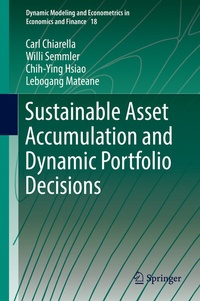
Sustainable Asset Accumulation and Dynamic Portfolio Decisions
Description

This book examines sustainable wealth formation and dynamic decision-making. The global economy experienced a veritable meltdown of asset markets in the years 2007-9, where many funds were overexposed to risky returns and suffered considerable losses. On the other hand, the long-term upswing in the stock market since 2010 has led to asset price booms and some new, but also uneven, wealth formation.
In this book a broader set of constraints and guidelines for asset management and wealth accumulation is developed. The authors investigate how wealth formation and the proper management of financial funds can help to adequately buffer income risk and obtain sufficient risk-free income at a later stage of life, while also being socially and environmentally sustainable.
The book explores behavioral and institutional rules for decision-making that reflect such constraints and guidelines, without necessarily being optimal in the narrow sense. The authors explain the need for such a dynamic decision-making and dynamic re-balancing of portfolios, by putting forward dynamic programming as an approach to dynamic decision-making that can allow sustainable wealth accumulation and dynamic asset allocation to be successfully integrated.
This book provides a clear and comprehensive treatment of asset accumulation and dynamic portfolio models with an emphasis on long term and sustainable wealth formation. An important concern in public debate is the sustainability of our economy and this book employs cutting edge quantitative techniques and models to highlight important facts that cannot be disputed under any reasonable assumptions. It has the potential to become a standard reference for both academic researchers and quantitatively trained practitioners.
Eckhard Platen, Professor of Quantitative Finance, University of Technology Sydney, Australia
This book should be read by both academics and practitioners alike. The former will find intellectually rigorous discussions and innovative solutions. The latter may find a few of the concepts a bit challenging. Yet, theory and technology are there to help simplify the work of those who worry about what time it is rather than how to make a watch--- but they do need a watch.
Jean Brunel, Founder of Brunel Associates and Editor of The Journal of Wealth Management
Reviews / Votes
"This book provides some insights into the sustainable investment and wealth accumulation. It should be interested for market practice and financial risk management, in particular for sustainable asset accumulation and reducing wealth disparities as well as for the recently arising topic of impact investment." (Xue-Zhong He, Computational Economics, Vol. 53, 2019)
More details
Other editions
Additional editions
Content
Introduction.- Forecasting and Low Frequency Movements of Asset Returns.- Portfolio Modeling with Sustainability Constraints.- Dynamic Saving and Portfolio Decisions-Theory.- Asset Accumulation with Estimated Low Frequency Movements Asset Returns.- Asset Accumulation and Portfolio Decisions with Time Varying Asset Returns and Labor Income.- Continuous and Discrete Time Modeling.- Asset Accumulation and Portfolio Decisions under Inflation Risk.- Concluding Remarks.
