

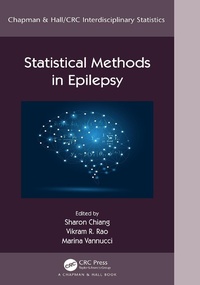
Statistical Methods in Epilepsy
1st Edition
Published on 25. March 2024
418 pages
978-1-003-82931-7 (ISBN)
Description

Epilepsy research promises new treatments and insights into brain function, but statistics and machine learning are paramount for extracting meaning from data and enabling discovery. Statistical Methods in Epilepsy provides a comprehensive introduction to statistical methods used in epilepsy research. Written in a clear, accessible style by leading authorities, this textbook demystifies introductory and advanced statistical methods, providing a practical roadmap that will be invaluable for learners and experts alike.
Topics include a primer on version control and coding, pre-processing of imaging and electrophysiological data, hypothesis testing, generalized linear models, survival analysis, network analysis, time-series analysis, spectral analysis, spatial statistics, unsupervised and supervised learning, natural language processing, prospective trial design, pharmacokinetic and pharmacodynamic modeling, and randomized clinical trials.
Features:
Provides a comprehensive introduction to statistical methods employed in epilepsy research
Divided into four parts: Basic Processing Methods for Data Analysis; Statistical Models for Epilepsy Data Types; Machine Learning Methods; and Clinical Studies
Covers methodological and practical aspects, as well as worked-out examples with R and Python code provided in the online supplement
Includes contributions by experts in the field
https://github.com/sharon-chiang/Statistics-Epilepsy-Book/
The handbook targets clinicians, graduate students, medical students, and researchers who seek to conduct quantitative epilepsy research. The topics covered extend broadly to quantitative research in other neurological specialties and provide a valuable reference for the field of neurology.
Topics include a primer on version control and coding, pre-processing of imaging and electrophysiological data, hypothesis testing, generalized linear models, survival analysis, network analysis, time-series analysis, spectral analysis, spatial statistics, unsupervised and supervised learning, natural language processing, prospective trial design, pharmacokinetic and pharmacodynamic modeling, and randomized clinical trials.
Features:
Provides a comprehensive introduction to statistical methods employed in epilepsy research
Divided into four parts: Basic Processing Methods for Data Analysis; Statistical Models for Epilepsy Data Types; Machine Learning Methods; and Clinical Studies
Covers methodological and practical aspects, as well as worked-out examples with R and Python code provided in the online supplement
Includes contributions by experts in the field
https://github.com/sharon-chiang/Statistics-Epilepsy-Book/
The handbook targets clinicians, graduate students, medical students, and researchers who seek to conduct quantitative epilepsy research. The topics covered extend broadly to quantitative research in other neurological specialties and provide a valuable reference for the field of neurology.
More details
Series
Edition
1. Auflage
Language
English
Place of publication
London
United Kingdom
Publishing group
Taylor & Francis Ebooks
Target group
Professional and scholarly
Product notice
Reflowable
Illustrations
27 Tables, black and white; 95 Line drawings, black and white; 95 Illustrations, black and white
ISBN-13
978-1-003-82931-7 (9781003829317)
Copyright in bibliographic data and cover images is held by Nielsen Book Services Limited or by the publishers or by their respective licensors: all rights reserved.
Schweitzer Classification
Other editions
Additional editions
Sharon Chiang | Vikram Rao | Marina Vannucci
Statistical Methods in Epilepsy
Book
03/2024
1st Edition
Chapman & Hall/CRC
€172.20
Shipment within 10-20 days
Persons
Sharon Chiang is a research fellow in the Department of Physiology and instructor in the Epilepsy Division in the Department of Neurology at the University of California, San Francisco, USA. Her research focuses on development of methods for state-space models in the estimation of seizure risk and neural mechanisms of memory consolidation in epilepsy.
Vikram R. Rao is Associate Professor of Clinical Neurology, Ernest Gallo Distinguished Professor, and Chief of the Epilepsy Division in the Department of Neurology at the University of California, San Francisco, USA. His clinical and research interests involve applications of neurostimulation devices for drug-resistant epilepsy, neuropsychiatric disorders, and seizure forecasting.
Marina Vannucci is Noah Harding Professor of Statistics at Rice University, Houston, TX, USA, and also holds an Adjunct Professor appointment at the MD Anderson Cancer Center, Houston, TX, USA. Her research is focused on the development of Bayesian statistical methodologies for application in genomics, neuroscience and neuroimaging.
Vikram R. Rao is Associate Professor of Clinical Neurology, Ernest Gallo Distinguished Professor, and Chief of the Epilepsy Division in the Department of Neurology at the University of California, San Francisco, USA. His clinical and research interests involve applications of neurostimulation devices for drug-resistant epilepsy, neuropsychiatric disorders, and seizure forecasting.
Marina Vannucci is Noah Harding Professor of Statistics at Rice University, Houston, TX, USA, and also holds an Adjunct Professor appointment at the MD Anderson Cancer Center, Houston, TX, USA. Her research is focused on the development of Bayesian statistical methodologies for application in genomics, neuroscience and neuroimaging.
Content
1. Coding Basics. 2. Preprocessing Electrophysiological Data: EEG, iEEG and MEG Data. 3. Acquisition and Preprocessing of Neuroimaging MRI Data. 4. Hypothesis Testing and Correction for Multiple Testing. 5. Introduction to Linear, Generalized Linear and Mixed-Effects Models. 6. Survival Analysis. 7. Graph and Network Control Theoretic Frameworks. 8. Time-Series Analysis. 9. Spectral Analysis of Electrophysiological Data. 10. Spatial Modeling of Imaging and Electrophysiological Data. 11. Unsupervised Learning. 12. Supervised Learning. 13. Natural Language Processing. 14. Prospective Observational Study Design and Analysis. 15.Pharmacokinetic and Pharmacodynamic Modeling. 16. Randomized Clinical Trial Analysis.
