

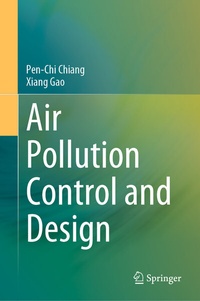
Air Pollution Control and Design
Description

This book focuses specifically on the environmental issues related to the air pollution control and design. It is divided into four parts: (1) Fundamentals of air pollution control, (2) fundamentals of energy utilization, (3) gaseous control and design, and (4) particulate control and design, each consisting of four to six chapters. The topics covered in this book not only introduce the basic concepts of air pollution control and design but also address the fundamentals of energy utilization in the context of good engineering practice and policy instruments. It also features several innovative technologies and integrated methodologies relating to gaseous and particulate matter control and design. To facilitate technology integration and meet the need for comprehensive information on sustainable development, the book discusses a wide range of areas concerning the principles, applications, and assessment of air pollution control and design and thermodynamics, heat transfer, advanced combustion and renewable energy for energy utilization. It also features regulations and policy instruments adopted around the globe as well as several case studies. Presenting the emerging challenges, new concepts, innovative methodologies, and resolving strategies, as well as illustrative and inspiring case studies, it appeals to a wide range of readers, such as researchers, graduate students, engineers, policy makers, and entrepreneurs.
More details
Other editions
Additional editions
Persons
Xiang Gao is currently the dean and a professor of the College of Energy Engineering, Zhejiang University, Hangzhou, China, and the director of Coal-Fired Air Pollution Control Engineering Center for Ministry of National Environmental Protection, China. He received his B.S. and Ph.D. degrees from Zhejiang University. His research focuses on simultaneous removal of multi-pollutants (NOx, SOx, particulate matter, and heavy metal, etc.) in flue gas, flue gas desulphurization, flue gas denitration, PM2.5 Control, and energy-saving technology. He has won First prize of the National Award for Technological Invention, Second prize of the National Award for Scientific and Technological Progress, Second prize of the National Award for Technological Invention, Second prize of the National Award for Teaching Achievements, the Chinese Outstanding Patents Award, etc. He has published more than 200 peer-reviewed papers, more than 60 invention patents (including 3 international patents) and involved in more than 30 authorized national/industrial standards as a leading or important role.
Content
Chapter 1. Air Pollution Control: SOx Control.- Chapter 2. NOx Control.- Chapter 3. VOCs Control.- Chapter 4. PM 2.5 Control.- Chapter 5. CO 2 Control.- Chapter 6. Fundamentals of Energy Utilization: Sustainable Energy.- Chapter 7. Thermal Dynamics and Heat Transfer.- Chapter 8. Advanced Combustion.- Chapter 9. Energy Materials.- Chapter 10. Integrated Energy Systems.- Chapter 11. Gaseous Control and Design: Adsorption.- Chapter 12. Absorption.- Chapter 13. Combustion.- Stack.- Chapter 14. Particulate Control and Design.- Chapter 15. Cyclone.- Chapter 16. Wet Scrubber.- Chapter 17. Baghouse Filter.- Chapter 18. Electrostatic Precipitator.- Chapter 19. Prospective and Perspective.
