

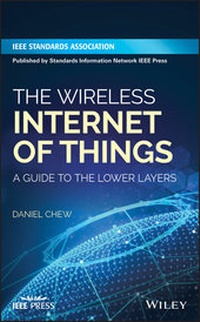
The Wireless Internet of Things
Description

The Wireless Internet of Things: A Guide to the Lower Layers presents a practitioner's perspective toward the Internet of Things (IoT) focusing on over-the-air interfaces used by applications such as home automation, sensor networks, smart grid, and healthcare. The author--a noted expert in the field--examines IoT as a protocol-stack detailing the physical layer of the wireless links, as both a radio and a modem, and the media access control (MAC) that enables communication in congested bands. Focusing on low-power wireless personal area networks (WPANs) the text outlines the physical and MAC layer standards used by ZigBee, Bluetooth LE, Z-Wave, and Thread. The text deconstructs these standards and provides background including relevant communication theory, modulation schemes, and access methods.
The author includes a discussion on Wi-Fi and gateways, and explores their role in IoT. He introduces radio topologies used in software-defined radio implementations for the WPANs. The book also discusses channel modelling and link budget analysis for WPANs in IoT. This important text:
* Introduces IEEE 802.15.4, ITU-T G.9959, and Bluetooth LE as physical layer technology standards enabling wireless IoT
* Takes a layered approach in order to cultivate an appreciation for the various standards that enable interoperability
* Provides clarity on wireless standards with particular focus on actual implementation
Written for IoT application and platform developers as well as digital signal processing, network, and wireless communication engineers; The Wireless Internet of Things: A Guide to the Lower Layersoffers an inclusive overview of the complex field of wireless IoT, exploring its beneficial applications that are proliferating in a variety of industries.
More details
Other editions
Additional editions
Content
Preface vii
Acknowledgments ix
About the Author xi
1 Introduction 1
1.1 What is the Internet of Things? 1
1.2 What is the Wireless Internet of Things? 4
1.3 Wireless Networks 5
1.4 What is the Role of Wireless Standards in the Internet of Things? 10
1.5 Protocol Stacks 10
1.6 Introduction to the Protocols for the Wireless Internet of Things 16
1.7 The Approach of this Book 17
References 18
2 Protocols of the Wireless Internet of Things 21
2.1 Bluetooth 22
2.2 ITU G.9959 29
2.3 Z-Wave 32
2.4 IEEE 802.15.4 33
2.5 The ZigBee Specification 38
2.6 Thread 40
2.7 Wi-Fi 41
References 44
3 Radio Layer 47
3.1 The Wireless System 47
3.2 Basic Transceiver Model 48
3.3 The Basics of Channels 67
3.4 Bit and Symbol Error Rate 74
3.5 Complex Channels 76
References 81
4 Modem Layer 83
4.1 The Signal Model 84
4.2 Pulse Shaping 90
4.3 Modulation Techniques 95
4.4 Synchronization 120
4.5 Spread Spectrum 132
References 137
5 MAC Layer 139
5.1 Bands and Spectrum Planning 140
5.2 Spectrum Access for the Wireless IoT 144
5.3 Multiple Access Techniques 145
5.4 Spread Spectrum as Multiple Access 153
5.5 Error Detection and Correction 154
5.6 Energy Efficiency 167
References 170
6 Conclusion 173
6.1 Selecting the Right Standard 173
6.2 Higher Layer Standardization and the Future of IoT 175
Index 177
