

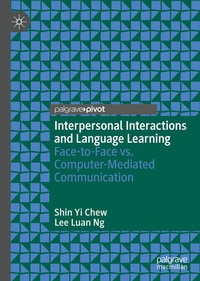
Interpersonal Interactions and Language Learning
Description

This book takes as its starting point the assumption that interpersonal communication is a crucial aspect of successful language learning. Following an examination of different communicative models, the authors focus on traditional face-to-face (F2F) interactions, before going on to compare these with the forms of computer-mediated communication (CMC) enabled by recent developments in educational technology. They also address the question of individual differences, particularly learners' preferred participation styles, and explore how F2F and CMC formats might impact learners differently. This book will be of interest to students and scholars of computer-mediated communication (CMC), computer-assisted language learning (CALL), technology-enhanced language learning (TELL), language acquisition and language education more broadly.
Reviews / Votes
"All the chapters are grounded on extensive referencing to theoretical and empirical research. Therefore, readers will find the book to be helpful as a starting point to build their knowledge on text-based vs. face-to-face discussion group dynamics in L2. . In the context of Malaysian education, where the teaching of English is at the centre of educational reform efforts, ESL professionals will find in this book many elements relevant to their teaching and research." (Concepción B. Godev, Revista de Lenguas para fines específicos, Vol. 29, 2023)More details
Other editions
Additional editions
Persons
Shin Yi Chew is a Senior Lecturer in the Faculty of Languages and Linguistics at the Universiti Malaya, Malaysia. Her interests include language acquisition and development, 21st century learning, computer-mediated communication and computer-assisted language learning.
Lee Luan Ng is a Senior Lecturer in the Faculty of Languages and Linguistics at the Universiti Malaya, Malaysia. Her current research interests include computer-assisted language learning, online learning, the use of computer assisted qualitative data analysis system in deciphering data in research projects as well as teaching and learning in higher education.
