

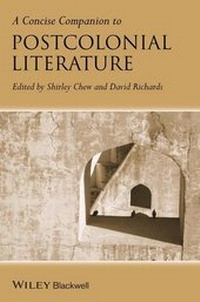
A Concise Companion to Postcolonial Literature
Description

More details
Other editions
Additional editions
Persons
Content
Introduction
Shirley Chew
This volume of essays provides an innovative multi-disciplinary approach to postcolonial literature. Unlike other current guides to postcolonialism, which are chiefly concerned with the theoretical formulations of postcolonial discourse, it seeks to investigate and explain ideas, issues, and practices from ten fields and disciplines that have made significant impact upon the literatures and cultures of countries which became independent nation-states in and after 1947. The essays explore in depth the ways in which their respective areas – for example, cartography, anthropology, translation studies, feminism – have shaped and problematized the period’s key concerns, such as ‘race’, culture, and identity; literary and cultural translations; and the politics of resistance. They draw attention to fresh developments in the areas; and discuss a wide range of postcolonial authors and their representations of the contemporary world. The Companion is an indispensable guide for literary students, specialists from other disciplines, and general readers seeking an authoritative and accessible overview of the intellectual contexts of postcolonialism.
*
‘Postcolonial’ is both a historical and an epistemological category, and the following brief reference to Heart of Darkness is indicative of a historicist reading as well as a reading according to postcolonialism’s central concerns. In the waiting-room of the Belgian company which was sending him to the Congo, Marlow noticed ‘a large shining map, marked with all the colours of a rainbow’. Despite the many colours, there was no mistaking the presence of a ‘vast amount of red’ and this, to the narrator, was ‘good to see at any time, because one knows that some real work is done in there’ (Conrad 2008 [1899]: 110). With that verbal interpretation of the visual image, storytelling and cartography are conjoined in Marlow’s narrative to produce a particular idea of the British empire – extensive, unified, and permanent. His pride was no doubt a sign of the times, given that between February and June 1899 when Heart of Darkness was being serialized, Britain’s possessions overseas amounted to a quarter of the globe and many of these were recent acquisitions made in the face of keen competition from other European nations.
To attempt a postcolonial reading of Marlow’s map is to note its function as ‘the graphic arm of colonial enterprise’ (Howard, Chapter 7: 148); in other words, as one of the myths of power which, like Pax Britannica, the civilizing mission, and the white man’s burden, served to justify colonization. With its ‘vast amount of red’, the map visualized the empire as a homogenous entity, not the loose collection it actually was of diverse peoples and cultures, spanning different geographies and centuries; and with being pin-pointed as the location where ‘real work’, hence order, could be expected, it masked the pernicious concomitants and effects of colonial rule, among them territorial and economic exploitation, psychological repression, and epistemic violence.
Resistance to colonial domination took the form of widespread physical conflicts during the decolonizing period from the end of the First World War onwards. While that was the case, it should also be borne in mind that the empire was never altogether free from outbreaks of violence in one form or another, examples being slave revolts, Maori wars, and, as variously described, the Indian Mutiny of 1857 or India’s First War of Independence. In cultural and symbolic terms, resistance was a struggle for agency in the representation process, that is, for the power among different colonized peoples to reinvent themselves as the subjects of their own stories and histories. With that in mind, the critical work in these essays on postcolonial writing, both the imaginative and the discursive, is underpinned by attentiveness to specific historical, social, and cultural contexts. As David Howard notes in his ranging discussion of new mapping techniques and technologies, and the ways they have helped to reshape ‘knowledge-power dynamics in society’ (Howard, Chapter 7: 11), the growth of community mapping projects in countries like Guyana means that maps are being produced by the people themselves to chart their local and first-hand experience of the areas in which social problems, such as poverty, are concentrated (15).
‘The fact of blackness’, David Richards points out in his compelling investigation of discourses of (post)colonial identity, was one of the main preoccupations of Frantz Fanon – Martinican psychiatrist, political philosopher, literary critic and revolutionary – in his resistance to colonialism and its psychologically maiming effects. While Fanon advocated insurrection and civil war in Algeria as political strategies in the push for independence (Richards, Chapter 1: 13), he also channelled his intellectual passion and power into the task of forging ‘an anticolonial political rhetoric’ out of his dissections of racism. In his writing, he drew on a range of disciplines – existentialism, psychoanalysis, colonial anthropology, and Negritude with special reference to the poetry of Leopold Senghor and Aimé Césaire. The force of Fanon’s ideas, the intermingling of the different influences in his work, and the distinctiveness of his style meant that Black Skin, White Masks and The Wretched of the Earth were ‘as much of an intervention in literary concerns as … in either psychology or liberation politics’, and helped to reshape ‘emerging forms of literary expression’ as well as cultural criticism (14).
Of the theorists and critics indebted to Fanon’s theories of colonial identity, Edward Said, Homi K. Bhabha, and Gayatri C. Spivak occupy a central place in postcolonial discourse. This is due in part to their radical approaches as readers of texts, examples being Said on Jane Austen’s Mansfield Park (Richards, Chapter 1: 18), Spivak on Mahasweta Devi’s Bengali short story ‘Breast-Giver’ (24), and Bhabha on post-Enlightenment colonialist documents, such as Thomas Macaulay’s ‘Minute on Education’ (1835) which, with its incisive analysis of colonial mimicry, makes realizable an ‘in-between’ space for subversion and reinvention on the part of the colonial subject.
Among creative writers, postcolonial reading of canonical literary texts is liable to go hand in hand with rewriting, the issues in question being those of ‘authority and authenticity’ and ‘representation and self-representation’ (Innes, Chapter 3: 57). Speaking to a broad and exciting selection of rewritings from Southern Africa, the Caribbean, and Australia, C.L. Innes draws attention to the dialogues that are opened up between the postcolonial writer and his or her antecedents, and the experiments with form and language which this has resulted in. Engaging with the critical problem of rewriting as reinscription, she argues for rewriting as the enactment of the writers’ identity ‘as cosmopolitan participants in a variety of cultures, capable of choosing the terms in which their worlds and the relationships between them are defined’ (76).
Not infrequently, strikingly original work has been known to come out of rewriting. An example being Salman Rushdie’s Midnight’s Children which, indebted as it has been said to Kipling and Forster among others, is nevertheless a novel altogether distinct and new. To what extent then can translation – involving as it does the carrying across of a source text into something other – be accounted a kind of rewriting? Is the translated work bound to stay faithful to the original? As is evident from Susan Bassnett’s lucid exposition, a postcolonial poetics of translation cannot be separated from the politics of translation. In her delineation of changing critical perspectives, emphasis is placed upon translation not as loss but as re-creation, (Bassnett, Chapter 4: 79); and the translator not as ‘slave’ but as ‘playing a crucial role in the reclaiming and re-evaluating of a people’s language and literature’ (88). Part of the pleasure in translating a play by Shakespeare into, say, Indian languages or Yoruba or Mauritian Creole is said to lie in ‘the subversive power of neutralizing the dominance of the English original’ (83); and part of it, in its remaking – the same and also different – in another cultural space, another time.
The idea of nation, of subject peoples thinking of themselves ‘as coherent imagined communities’, impelled the anti-colonial movements of the late nineteenth and the twentieth centuries. Today not a few of the countries which subsequently became independent nations exist under oppressive nationalist regimes.1 Inevitably, the idea of nation has undergone in the last sixty odd years constant re-examination in postcolonial literature and criticism. Drawing upon a significant range of postcolonial theorists and writers, postcolonial narratives and counter-narratives, John McLeod explores ‘the vital cultural space’ they open up (McLeod, Chapter 5: 98), tracing in assured fashion the evolving views in the debate, the ambivalent responses, the disillusionment, and, in some instances, the ‘unshakeable faith’, despite the failures, ‘in the nation as an egalitarian...
