

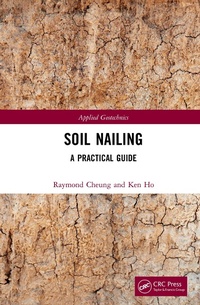
Soil Nailing
A Practical Guide
1st Edition
Published on 11. March 2021
354 pages
978-1-000-35177-4 (ISBN)
Description

Soil nailing is an in situ soil reinforcement technique that can be used to enhance the stability of slopes, retaining walls, embankments, and excavations. It involves installation of closely spaced, relatively slender unstressed tension-carrying structural elements into the ground to stabilize the soil mass. These elements, which are called soil nails, comprise steel or other engineering materials such as fiber reinforced polymer.
Soil nailing did not gain popularity until the 1970s when engineers started to realize that the technique could offer an effective, robust, and economical reinforcing system for a variety of ground conditions. More importantly, the track record has been excellent in that no major collapses have been reported in properly designed and well-constructed soil nailed structures so far. Considerable experience and knowledge of the technique have been gained in the past few decades through systematic technical development work comprising laboratory tests, numerical modeling, physical modeling, site trials and field monitoring covering design, and construction practices.
Soil Nailing: A Practical Guide consolidates the experience and advances made in the development and use of the soil nailing technique and encourages a wider adoption of the technique by practitioners. The book is intended for use by postgraduate students, researchers, and practicing civil and geotechnical engineers, who wish to have a more in-depth and fundamental understanding of the theory and practice behind the technique. It presents the basic principles of the technique as well as state-of-the-art knowledge and recommended standard of good practice in respect of design, construction, monitoring, and maintenance of soil nailed structures.
Soil nailing did not gain popularity until the 1970s when engineers started to realize that the technique could offer an effective, robust, and economical reinforcing system for a variety of ground conditions. More importantly, the track record has been excellent in that no major collapses have been reported in properly designed and well-constructed soil nailed structures so far. Considerable experience and knowledge of the technique have been gained in the past few decades through systematic technical development work comprising laboratory tests, numerical modeling, physical modeling, site trials and field monitoring covering design, and construction practices.
Soil Nailing: A Practical Guide consolidates the experience and advances made in the development and use of the soil nailing technique and encourages a wider adoption of the technique by practitioners. The book is intended for use by postgraduate students, researchers, and practicing civil and geotechnical engineers, who wish to have a more in-depth and fundamental understanding of the theory and practice behind the technique. It presents the basic principles of the technique as well as state-of-the-art knowledge and recommended standard of good practice in respect of design, construction, monitoring, and maintenance of soil nailed structures.
More details
Series
Edition
1. Auflage
Language
English
Place of publication
London
United Kingdom
Publishing group
Taylor & Francis Ltd
Target group
College/higher education
Professional and scholarly
Illustrations
50 Tables, black and white; 80 Line drawings, black and white; 40 Halftones, black and white; 120 Illustrations, black and white
ISBN-13
978-1-000-35177-4 (9781000351774)
Copyright in bibliographic data and cover images is held by Nielsen Book Services Limited or by the publishers or by their respective licensors: all rights reserved.
Schweitzer Classification
Other editions
Additional editions
Book
09/2022
1st Edition
CRC Press
€74.00
Shipment within 15-20 days
Book
03/2021
1st Edition
CRC Press
€208.33
Shipment within 10-20 days
Persons
Raymond Cheung is Deputy Head of the Geotechnical Engineering Office of the Civil Engineering and Development Department, Government of the Hong Kong Special Administrative Region, China.
Ken Ho is Deputy Head of the Geotechnical Engineering Office of the Civil Engineering and Development Department, Government of the Hong Kong Special Administrative Region, China and an Adjunct Professor of The University of Hong Kong.
Ken Ho is Deputy Head of the Geotechnical Engineering Office of the Civil Engineering and Development Department, Government of the Hong Kong Special Administrative Region, China and an Adjunct Professor of The University of Hong Kong.
Content
1. Introduction. 2. Fundamentals and concepts. 3. Site investigation. 4. Design and analysis. 5. Durability. 6. Pullout resistance. 7. Construction. 8. Monitoring and maintenance. 9. International standards of good practice. Appendix A. Appendix B. Index.
