

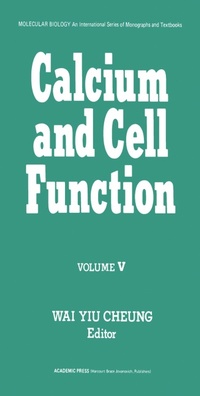
Calcium and Cell Function
Published on 22. October 2013
330 pages
978-1-4832-8198-8 (ISBN)
Description

Calcium and Cell Function, Volume V emphasizes the roles of calcium in cellular functions. This book consists of eight chapters. Chapter 1 presents evidence for the role of calmodulin in cell proliferation. The role of calcium in the control of cyclic AMP metabolism in glial and pituitary tumor cells is analyzed in Chapter 2. Chapter 3 explains the evidence that calmodulin regulates neurotransmitter synthesis, while Chapter 4 deliberates the role of calcium in adipocytes. Chapter 5 is devoted to the modulatory function of lipomodulin in cellular phospholipid metabolism. The pharmacological properties of naphthalenesulfonamides as calmodulin antagonists, phophorylase kinase, and phospholipidsensitive calcium-dependent protein kinase are reviewed in the last chapters. This volume is valuable to biologists and medical practitioners interested in calcium and cell function.
More details
Other editions
Additional editions

Wai Yiu Cheung
Calcium and Cell Function: v. 5
Book
12/1984
Academic Press
€66.85
Article exhausted; check different version
Content
ContributorsPrefaceContents of Previous VolumesChapter 1 Molecular Properties of Phosphorylase Kinase I. Introduction II. Molecular Characteristics III. Regulation of Enzyme Activity IV. Enzymic Reaction Mechanism V. Substrate Specificity ReferencesChapter 2 Phospholipid-Sensitive Ca2 + -Dependent Protein Phosphorylation I. Introduction II. Occurrence and Distribution III. Purification and General Properties IV. Mechanism of Activation V. Substrate Specificity VI. Regulation by Various Agents VII. Perspectives ReferencesChapter 3 Role of Calmodulin in Neurotransmitter Synthesis I. Introduction II. Discovery of Calmodulin-Dependent Protein Kinase II III. Assay of Calmodulin-Dependent Protein Kinase II IV. Purification of Calmodulin-Dependent Protein Kinase II V. Properties of Calmodulin-Dependent Protein Kinase II VI. Distribution of Calmodulin-Dependent Protein Kinase II VII. Substrates of Calmodulin-Dependent Protein Kinase II VIII. Activator Protein IX. Concluding Remarks ReferencesChapter 4 Evidence for a Role for Calmodulin in Cell Proliferation Involving the DNA Repair Pathway I. Introduction II. Anticalmodulin Drugs III. Cell Survival in Response to W-13 IV. Effect of W-13 on Reentry of Quiescent Cells into the Cell Cycle V. Changes in Calmodulin during Plateau Reentry VI. Comparisons of Calmodulin Changes in Exponentially Growing and Plateau-Related Cells VII. Bleomycins VIII. Potentiation of Bleomycin-Induced Cell Death by W-13 IX. Effect of W-13 on Recovery from Bleomycin-Induced Potentially Lethal Damage X. Conclusions and Reflections ReferencesChapter 5 Biopharmacological Properties of Naphthalenesulfonamides as Potent Calmodulin Antagonists I. Introduction II. Antagonism of Calmodulin by Various Compounds III. Antagonism of Calmodulin Activity by W-7 IV. Structure-Activity Relationship of Naphthalenesulfonamides V. Other Effects of Naphthalenesulfonamides VI. Pharmacological Properties of Naphthalenesulfonamides as Calmodulin Antagonists VII. Summary and Conclusions ReferencesChapter 6 Calcium Control of Cyclic AMP Metabolism in Glial and Pituitary Tumor Cells I. Introduction II. The C6 Glial Tumor Cell III. The Human Astrocytoma Cell Line 1321N1 IV. Neuroblastoma-Glioma Hybrids V. The GH3 Pituitary Tumor Cell VI. Summary ReferencesChapter 7 Calcium and the Adipocyte I. Introduction II. Calcium Content and Fluxes III. Calcium Homeostasis by Subcellular Organelles IV. The Role of Calcium in the Regulation of Adipocyte Metabolism V. The Role of Calcium in the Mechanism of Insulin Action ReferencesChapter 8 Lipomodulin: A Modulator of Cellular Phospholipid Metabolism I. The Modulation of Receptor Functions by Glucocorticoids II. Lipomodulin III. Regulation of Arachidonic Acid Release in Intact Cells by Lipomodulin IV. Biological Roles of Lipomodulin V. Summary ReferencesIndex
