

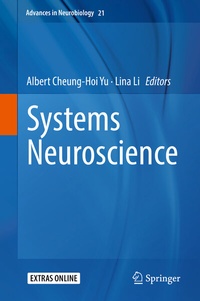
Systems Neuroscience
Description

This edition of Advances in Neurobiology brings together experts in the emerging field of Systems Neuroscience to present an overview of this area of research. Topics covered include: how different neural circuits analyze sensory information, form perceptions of the external world, make decisions, and execute movements; how nerve cells behave when connected together to form neural networks; the relationship between molecular and cellular approaches to understanding brain structure and function; the study of high-level mental functions; and studying brain pathologies and diseases with Systems Neuroscience. A hierarchy of biological complexity arises from the genome, transcriptome, proteome, organelles, cells, synapses, circuits, brain regions, the whole brain, and behaviour. The best way to study the brain, the most complex organ in the body composed of 100 billion cells with trillions of interconnections, is with a Systems Biology approach. Systems biology is an inter-disciplinary field that focuses on complex interactions within biological systems to reveal 'emergent properties' - properties of cells and groups of cells functioning as a system whose actual and theoretical description is only possible using Systems Biology techniques.
More details
Other editions
Additional editions
Content
Neuronal bases of systemic organization of behavior.- Neural circuits mediating fear learning and extinction.- The hippocampal ensemble code for spatial navigation and episodic memory.- Context-dependent adjustments in executive control of goal-directed behaviour: Contribution of frontal brain areas to conflict-induced behavioural adjustments in primates.- Synaptic excitatory-inhibitory balance underlying efficient neural coding.- Mapping molecular datasets back to the brain regions they are extracted from: Remembering the native countries of hypothalamic expatriates and refugees.- Genome-Scale Brain Metabolic Networks as Scaffolds for the Systems Biology of Neurodegenerative Diseases: Mapping Metabolic Alterations.- Synaptic Plasticity and Synchrony in the Anterior Cingulate Cortex Circuitry: A Neural Network Approach to Causality of Chronic Visceral Pain and Associated Cognitive Deficits.- Large de novo microdeletion in epilepsy with intellectual and developmental disabilities, with a systems biology analysis.- Using Systems Biology and Mathematical Modeling Approaches in the Discovery of Therapeutic Targets for Spinal Muscular Atrophy.- Not Cure but Heal: Music and Medicine.
