


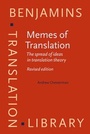
Memes of Translation
The spread of ideas in translation theory. <strong>Revised edition</strong>
1st Edition
Published on 15. February 2016
XII, 217 pages
978-90-272-6738-2 (ISBN)
Description

This revised edition of Memes of Translation includes updates that relate the book's themes to more recent research in Translation Studies. The book contributes to the debate about whether it is worth seeking a coherent theory of translation, by proposing an approach based on norms, strategies and values, which are all seen as kinds of memes, i.e. ideas that spread. The meme metaphor allows us to see translation in the context of cultural evolution, and also highlights similarities with the philosopher Karl Popper's analysis of another kind of evolution: that of scientific knowledge. A translation is, after all, itself a theory - a theory about the source text. And as Popper stressed, theories of all kinds are like nets we make in order to catch something of reality: never perfectly, but always in the hope of better understanding.
More details
Other editions
Additional editions
Book
02/2016
John Benjamins Publishing Co
€100.70
Shipment within 10-15 days
Person
Content
- Preface
- Chapter 1
- Survival machines for memes
- 1.1 Introducing memes
- 1.2 Five translation supermemes
- 1.2.1 Source-target
- 1.2.2 Equivalence
- 1.2.3 Untranslatability
- 1.2.4 Free-vs-literal
- 1.2.5 All-writing-is-translating
- 1.3 The locus of memes
- 1.4 A Popperian meme
- 1.5 Update
- Chapter 2
- The evolution of translation memes
- 2.1 Words
- 2.2 The Word of God
- 2.3 Rhetoric
- 2.4 Logos
- 2.5 Linguistic science
- 2.6 Communication
- 2.7 Target
- 2.8 Cognition
- 2.9 Theory in the current meme pool
- 2.10 Update
- Chapter 3
- From memes to norms
- 3.1 Normative vs. prescriptive
- 3.2 Norm theory
- 3.3 Norms of language
- 3.4 What counts as a translation?
- 3.5 Translation norms
- 3.5.1 Toury's norms
- 3.5.2 Expectancy norms
- 3.5.3 Professional norms
- 3.6 General translation laws and normative laws
- 3.6.1 Translation laws
- 3.6.2 Normative laws
- 3.6.3 Explanations
- 3.7 Norms as constraints
- 3.8 On expectancy norms for English
- 3.9 Update
- Chapter 4
- Translation strategies
- 4.1 General characteristics of strategies
- 4.2 A classification
- 4.2.1 Syntactic strategies
- 4.2.2 Semantic strategies
- 4.2.3 Pragmatic strategies
- 4.3 Motivation
- 4.3.1 The significance threshold
- 4.3.2 Compensation
- 4.4 Update
- Chapter 5
- Translation as theory
- 5.1 Tentative Theory, Error Elimination and translational competence
- 5.2 Retrospective assessment
- 5.3 Prospective assessment
- 5.4 Lateral assessment
- 5.5 Introspective assessment
- 5.6 Pedagogical assessment
- 5.7 Mind the gap!
- 5.8 Update
- Chapter 6
- The development of translational competence
- 6.1 Stages of expertise
- 6.2 The significance of memes
- 6.3 Suggestions for teaching
- 6.4 Ontogenetic = phylogenetic?
- 6.5 Bootstraps
- 6.6 Update
- Chapter 7
- On translation ethics
- 7.1 Background issues
- 7.2 Norms, actions and values
- 7.3 Clarity
- 7.4 Truth
- 7.5 Trust
- 7.6 Understanding
- 7.7 The Translator's Charter
- 7.8 Emancipatory translation
- 7.9 Update
- Epilogue
- Appendix
- References
- Preface
- Update
- Acknowledgements
- 1. Survival machines for memes
- 1.1 Introducing memes
- 1.2 Five translation supermemes
- 1.2.1 Source-target
- 1.2.2 Equivalence
- 1.2.3 Untranslatability
- 1.2.4 Free-vs-literal
- 1.2.5 All-writing-is-translating
- 1.3 The locus of memes
- 1.4 A Popperian meme
- 1.5 Update
- 2. The evolution of translation memes
- 2.1 Words
- 2.2 The Word of God
- 2.3 Rhetoric
- 2.4 Logos
- 2.5 Linguistic science
- 2.6 Communication
- 2.7 Target
- 2.8 Cognition
- 2.9 Theory in the current meme pool
- 2.10 Update
- 3. From memes to norms
- 3.1 Normative vs. prescriptive
- 3.2 Norm theory
- 3.3 Norms of language
- 3.4 What counts as a translation?
- 3.5 Translation norms
- 3.5.1 Toury's norms
- 3.5.2 Expectancy norms
- 3.5.3 Professional norms
- 3.6 General translation laws and normative laws
- 3.6.1 Translation laws
- 3.6.2 Normative laws
- 3.6.3 Explanations
- 3.7 Norms as constraints
- 3.8 On expectancy norms for English
- 3.9 Update
- 4. Translation strategies
- 4.1 General characteristics of strategies
- 4.2 A classification
- 4.2.1 Syntactic strategies
- 4.2.2 Semantic strategies
- 4.2.3 Pragmatic strategies
- 4.3 Motivation
- 4.3.1 The significance threshold
- 4.3.2 Compensation
- 4.4 Update
- 5. Translation as theory
- 5.1 Tentative Theory, Error Elimination and translational competence
- 5.2 Retrospective assessment
- 5.3 Prospective assessment
- 5.4 Lateral assessment
- 5.5 Introspective assessment
- 5.6 Pedagogical assessment
- 5.7 Mind the gap!
- 5.8 Update
- 6. The development of translational competence
- 6.1 Stages of expertise
- 6.2 The significance of memes
- 6.3 Suggestions for teaching
- 6.4 Ontogenetic = phylogenetic?
- 6.5 Bootstraps
- 6.6 Update
- 7. On translation ethics
- 7.1 Background issues
- 7.2 Norms, actions and values
- 7.3 Clarity
- 7.4 Truth
- 7.5 Trust
- 7.6 Understanding
- 7.7 The Translator's Charter
- 7.8 Emancipatory translation
- 7.9 Update
- Epilogue
- Appendix
- References
- Author index
- Subject index
