

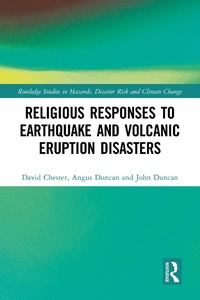
Religious Responses to Earthquake and Volcanic Eruption Disasters
1st Edition
Published on 26. July 2024
262 pages
978-1-040-11068-3 (ISBN)
Description

This book argues that, although secular and religious perspectives on disasters have often conflicted, today there are grounds for believing that the world's major faiths have much to contribute to the processes of post-disaster recovery and future disaster risk reduction (DRR).
It seeks to demonstrate how contemporary dialogues between theologians, disaster scholars and policymakers are defining new ways of working together. These explore how the resources of religious communities, e.g. buildings, human resources and finance, may be used to foster successful policies of DRR, particularly in the aftermath of earthquakes and volcanic eruptions. Musing on the relationships between religion and disasters has occurred for millennia and has affected many societies worldwide. In societies where the world's major religions - Buddhism, Christianity, Hinduism, Islam, Judaism and Shinto - have been and remain dominant, attempting to find supernatural explanations for disasters has occurred throughout history and there have been many theologies seeking to explain why people suffer losses. It is argued that developments both within these traditions of faith and in how disasters are understood by the hazard research community of researchers and planners have allowed a new modus vivendi to emerge which emphasises both a recognition of religious worldviews by academic writers and disaster planners on the one hand, and a desire by people of faith and their leaders to be more fully committed to the goals of DRR.
The book will appeal to those who are interested in the interface between disasters and theology across the principal religions of the world. This includes researchers and students in geology, geography, theology and religious studies. It will also be useful for specialist academic audience and the educated general reader.
It seeks to demonstrate how contemporary dialogues between theologians, disaster scholars and policymakers are defining new ways of working together. These explore how the resources of religious communities, e.g. buildings, human resources and finance, may be used to foster successful policies of DRR, particularly in the aftermath of earthquakes and volcanic eruptions. Musing on the relationships between religion and disasters has occurred for millennia and has affected many societies worldwide. In societies where the world's major religions - Buddhism, Christianity, Hinduism, Islam, Judaism and Shinto - have been and remain dominant, attempting to find supernatural explanations for disasters has occurred throughout history and there have been many theologies seeking to explain why people suffer losses. It is argued that developments both within these traditions of faith and in how disasters are understood by the hazard research community of researchers and planners have allowed a new modus vivendi to emerge which emphasises both a recognition of religious worldviews by academic writers and disaster planners on the one hand, and a desire by people of faith and their leaders to be more fully committed to the goals of DRR.
The book will appeal to those who are interested in the interface between disasters and theology across the principal religions of the world. This includes researchers and students in geology, geography, theology and religious studies. It will also be useful for specialist academic audience and the educated general reader.
More details
Series
Edition
1. Auflage
Language
English
Place of publication
London
United Kingdom
Publishing group
Taylor & Francis Ltd
Target group
College/higher education
Illustrations
25 Tables, black and white; 11 Line drawings, black and white; 11 Halftones, black and white; 22 Illustrations, black and white
ISBN-13
978-1-040-11068-3 (9781040110683)
Copyright in bibliographic data and cover images is held by Nielsen Book Services Limited or by the publishers or by their respective licensors: all rights reserved.
Schweitzer Classification
Other editions
Additional editions
David Chester | Angus Duncan | John Duncan
Religious Responses to Earthquake and Volcanic Eruption Disasters
Book
approx. 11/2025
1st Edition
Routledge
€63.80
Not yet published
David Chester | Angus Duncan | John Duncan
Religious Responses to Earthquake and Volcanic Eruption Disasters
Book
07/2024
1st Edition
Routledge
€178.20
Shipment within 10-20 days
Persons
David Chester is a graduate of the Universities of Durham and Aberdeen and for more than four decades has carried out research on disasters, especially those produced by earthquakes and volcanic eruptions. He retired as a Professor of Environmental Sciences at Liverpool Hope University in 2020, having previously worked at the University of Liverpool where he is currently a Senior Fellow. David Chester is also an ordained priest in the Anglican (i.e. Episcopalian) Church.
Angus Duncan has a degree in Geology from the University of Durham and a PhD from University College London. He has worked on the volcanoes of Italy and the Azores for nearly 50 years and retired as a Professor of Volcanology from the University of Bedfordshire in 2013. Angus Duncan subsequently became an Honorary Research Fellow at the University of Liverpool.
John Duncan has a degree in Geography from the University of Southampton and PhD in Geography, also from the University of Southampton. John's PhD research focused on using remote sensing data to monitor agricultural systems in Northern India. Subsequently, John has worked as a researcher at The University of Southampton and Tufts University on projects using geospatial data to explore climate impacts on agricultural systems and rural communities in South Asia, Sub-Saharan Africa and Brazil. John is currently a Research Fellow at the University of Western Australia where he has worked across a range of projects spanning monitoring urban vegetation and built environments to developing farm data collection tools for use in Pacific Island mixed-farming and agroforestry systems.
Angus Duncan has a degree in Geology from the University of Durham and a PhD from University College London. He has worked on the volcanoes of Italy and the Azores for nearly 50 years and retired as a Professor of Volcanology from the University of Bedfordshire in 2013. Angus Duncan subsequently became an Honorary Research Fellow at the University of Liverpool.
John Duncan has a degree in Geography from the University of Southampton and PhD in Geography, also from the University of Southampton. John's PhD research focused on using remote sensing data to monitor agricultural systems in Northern India. Subsequently, John has worked as a researcher at The University of Southampton and Tufts University on projects using geospatial data to explore climate impacts on agricultural systems and rural communities in South Asia, Sub-Saharan Africa and Brazil. John is currently a Research Fellow at the University of Western Australia where he has worked across a range of projects spanning monitoring urban vegetation and built environments to developing farm data collection tools for use in Pacific Island mixed-farming and agroforestry systems.
Content
Chapter 1 Where is God in this? Pre-Historic and Historic Relationships between Religion and Disasters
Chapter 2 A Paradigm Shift in Disaster Studies
Chapter 3 Judaism, Christianity and Disasters
Chapter 4 Islamic Understandings
Chester 5 Disaster Losses and Suffering: Buddhist, Hindu and Shinto Perspectives
Chapter 6 Religion and the Policies of Disaster Risk Reduction
Chapter 2 A Paradigm Shift in Disaster Studies
Chapter 3 Judaism, Christianity and Disasters
Chapter 4 Islamic Understandings
Chester 5 Disaster Losses and Suffering: Buddhist, Hindu and Shinto Perspectives
Chapter 6 Religion and the Policies of Disaster Risk Reduction
