

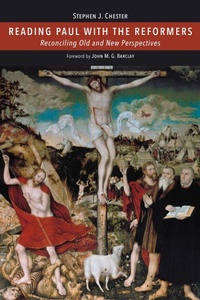
Reading Paul with the Reformers
Reconciling Old and New Perspectives
Published on 11. July 2017
377 pages
978-1-4674-4788-1 (ISBN)
Description

In debates surrounding the New Perspective on Paul, the sixteenth-century Protestant Reformers are often characterized as the apostle's misinterpreters-in-chief. In this book Stephen Chester challenges that conception with a careful and nuanced reading of the Reformers' Pauline exegesis. Examining the overall contours of Reformation exegesis of Paul, Chester contrasts the Reformers with their opponents and explores particular contributions made by such key figures as Luther, Melanchthon, and Calvin. He relates their insights to contemporary debates in Pauline theology about justification, union with Christ, and other central themes, arguing that their work remains a significant resource today. Published in the 500th anniversary year of the Protestant Reformation, Chester's Reading Paul with the Reformers reclaims a robust understanding of how the Reformers actually read the apostle Paul.
More details
Other editions
Additional editions
Book
07/2017
William B Eerdmans Publishing Co
€66.00
Shipment within 15-20 days
Content
- Intro
- Title Page
- Copyright
- Contents
- Foreword
- Preface
- Abbreviations
- Prologue
- I. Hermeneutics: The SixteenthCentury and the Twenty-First Century
- 1. The Hermeneutics of Reform: Erasmus, Luther, and Contemporary Theological Interpretation of Scripture
- 1.1. An Apparent or Real Quarrel? Erasmus and Luther on Paul and Peter at Antioch
- 1.2. Erasmus and Luther on Scripture and Interpretation
- 1.3. Erasmus, Luther, and the Goals of Contemporary Theological Interpretation
- 1.4. Erasmus, Luther, and the Conflict of Interpretations
- 1.5. Erasmus, Luther, and Reception History
- II. Shared Convictions: The Reformers' New Pauline Exegetical Grammar
- 2. The Medieval Context of the Reformers: Pauline Exegesis and Soteriology
- 2.1. Continuity or Discontinuity? The Reformers and Medieval Pauline Interpretation
- 2.2. Augustine
- 2.3. Medieval Appropriations of Augustine's Pauline Exegetical Grammar
- 2.4. The Impact on Luther and the Reaction of the Council of Trent
- 3. The Human Plight apart from Christ: Sin, the Law, and the Conscience
- 3.1. Sin
- 3.2. The Law
- 3.3. Conscience
- 3.4. Summary
- 4. Salvation in Christ: The Works of the Law, Grace, and Faith
- 4.1. Not by the Works of the Law
- 4.2. Grace
- 4.3. Faith
- 4.4. Summary
- III. Individual Perspectives: Luther, Melanchthon, and Calvin on Righteousness in Christ
- 5. Alien Righteousness in Christ: The Integration of Justification by Faith and Union with Christ in Martin Luther's Pauline Exegesis
- 5.1. Luther's account of Justification in its early Protestant Context
- 5.2. Interpreting Luther Interpreting Paul
- 5.3. The Human Plight: Luther's Apocalyptic Anthropology
- 5.4. Christ Present in Faith: Justification and Union with Christ
- 5.5. Receiving Christ's Righteousness
- 5.6. Living an Alien Life
- 5.7. Faith and Good Works
- 5.8. Faith and Love
- 5.9. The Finnish School and their Opponents 201
- 5.10. The Finnish School and Alien Righteousness The Finnish School and Alien Righteousness
- 5.11. Conclusions and Implications: United with the Victor
- 6. Relational Righteousness: Justification on account of Christ in Philip Melanchthon's Pauline Exegesis
- 6.1. Melanchthon in the Shadow of Luther
- 6.2. Melanchthon's Rhetorical Approach to Interpreting Romans
- 6.3. The Drama of Law and Gospel in Melanchthon's Interpretation of Romans
- 6.4. Forensic Imagery in Melanchthon's Interpretation of Romans
- 6.5. Chronological Development in Melanchthon's Interpretation of Justification in Romans
- 6.6. Melanchthon and Luther on Justification: Contrast or Continuity?
- 6.7. Exegetical Comparison: Melanchthon and Luther on Justification in Key Pauline Texts
- 6.8. Justification and Good Works: The Dialog at Pastor Bugenhagen's House
- 6.9. Conclusions
- 7. Righteousness and Reciprocity: Justification and the Works of the Believer in John Calvin's Pauline Exegesis
- 7.1. Calvin as Pauline Interpreter in the Context of Luther and Melanchthon
- 7.2. Union with Christ (1): Justification
- 7.3. Union with Christ (2): Sanctification
- 7.4. Union with Christ (3): 1 Corinthians 1:30 as an Exegetical Center
- 7.5. Union with Christ (4): The Spirit and Christ's Humanity
- 7.6. A Conflict of Errors: Recent Criticism of Calvin's Characterization of Human Response
- 7.7. Doing but not Meriting
- 7.8. Unmerited Rewards
- 7.9. Ecclesial and Social Reciprocity
- 7.10. Conclusions and Implications: Union at the Center
- IV. Contemporary Implications: The Reformers and the New Perspective on Paul
- 8. Mapping Complexity: A Revised Account of the Relationship between Reformation Exegesis and the "New Perspective on Paul"
- 8.1. The Reformers and the Rhetoric of "The New Perspective"
- 8.2. Continued Dependence: Pauline Anthropology
- 8.3. Intensification: "Apocalyptic" Interpretations of Paul
- 8.4. Intensification: "Covenantal" Interpretations of Paul
- 8.5. Erroneous Contrast: The Introspective Conscience
- 8.6. The Heart of the Matter: Judaism and Works of the Law
- 8.7. Conclusions
- 9. Righteousness in Christ: Towards the Reconciliation of the Perspectives
- 9.1. Staging the Dialog between the Sixteenth and Twenty-First Centuries
- 9.2. The Gifts of Reformation Exegesis for Contemporary Pauline Theology
- 9.3. Reformation Exegesis and NPP Scholarship: Richard Hays and the Faith of Jesus Christ
- 9.4. Reformation Exegesis and NPP Scholarship: Douglas Campbell and the Deliverance of God
- 9.5. Reformation Exegesis and NPP Scholarship: N. T. Wright and the Faithfulness of God
- 9.6. Romans 4: An Exegetical Test Case for Reconciling the Perspectives
- 9.7. Conclusions
- Medieval and Reformation Figures
- Bibliography
- Index of Authors
- Index of Subjects
- Index of Scripture and Other Ancient Texts
- Index of Medieval and Reformation Texts
