

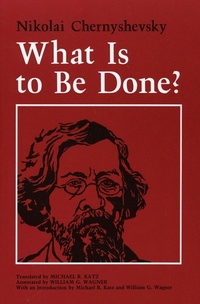
What Is to Be Done?
Published on 30. May 2014
464 pages
978-0-8014-7158-2 (ISBN)
Description

No work in modern literature, with the possible exception of Uncle Tom's Cabin, can compete with What Is to Be Done? in its effect on human lives and its power to make history. For Chernyshevsky's novel, far more than Marx's Capital, supplied the emotional dynamic that eventually went to make the Russian Revolution.-The Southern Review
Almost from the moment of its publication in 1863, Nikolai Chernyshevsky's novel, What Is to Be Done?, had a profound impact on the course of Russian literature and politics. The idealized image it offered of dedicated and self-sacrificing intellectuals transforming society by means of scientific knowledge served as a model of inspiration for Russia's revolutionary intelligentsia. On the one hand, the novel's condemnation of moderate reform helped to bring about the irrevocable break between radical intellectuals and liberal reformers; on the other, Chernyshevsky's socialist vision polarized conservatives' opposition to institutional reform. Lenin himself called Chernyshevsky "the greatest and most talented representative of socialism before Marx"; and the controversy surrounding What Is to Be Done? exacerbated the conflicts that eventually led to the Russian Revolution.
Michael R. Katz's readable and compelling translation is now the definitive unabridged English-language version, brilliantly capturing the extraordinary qualities of the original. William G. Wagner has provided full annotations to Chernyshevsky's allusions and references and to the sources of his ideas, and has appended a critical bibliography.
An introduction by Katz and Wagner places the novel in the context of nineteenth-century Russian social, political, and intellectual history and literature, and explores its importance for several generations of Russian radicals.
Almost from the moment of its publication in 1863, Nikolai Chernyshevsky's novel, What Is to Be Done?, had a profound impact on the course of Russian literature and politics. The idealized image it offered of dedicated and self-sacrificing intellectuals transforming society by means of scientific knowledge served as a model of inspiration for Russia's revolutionary intelligentsia. On the one hand, the novel's condemnation of moderate reform helped to bring about the irrevocable break between radical intellectuals and liberal reformers; on the other, Chernyshevsky's socialist vision polarized conservatives' opposition to institutional reform. Lenin himself called Chernyshevsky "the greatest and most talented representative of socialism before Marx"; and the controversy surrounding What Is to Be Done? exacerbated the conflicts that eventually led to the Russian Revolution.
Michael R. Katz's readable and compelling translation is now the definitive unabridged English-language version, brilliantly capturing the extraordinary qualities of the original. William G. Wagner has provided full annotations to Chernyshevsky's allusions and references and to the sources of his ideas, and has appended a critical bibliography.
An introduction by Katz and Wagner places the novel in the context of nineteenth-century Russian social, political, and intellectual history and literature, and explores its importance for several generations of Russian radicals.
Reviews / Votes
No work in modern literature, with the possible exception of Uncle Tom's Cabin, can compete with What Is to Be Done? in its effect on human lives and its power to make history. For Chernyshevsky's novel, far more than Marx's Capital, supplied the emotional dynamic that eventually went to make the Russian Revolution.(The Southern Review) In the Russian revolutionary movement, no literary work can compare in importance with Chernyshevsky's What Is to Be Done?.... Katz and Wagner have provided us with a version that is worthy of the novel's importance. Katz's translation is faithful to the original, yet cast in words that bring Chernyshevsky's meaning alive to modern readers.... Wagner, in turn, provides abundant notes, explaining obscure references, making connections between parts of the novel that could easily be missed on first reading, and alerting the reader to those many passages where Chernyshevksy hinted at what he could not say outright.
(Russian History)
More details
Language
English
Place of publication
Ithaca
United States
Product notice
Reflowable
ISBN-13
978-0-8014-7158-2 (9780801471582)
Copyright in bibliographic data and cover images is held by Nielsen Book Services Limited or by the publishers or by their respective licensors: all rights reserved.
Schweitzer Classification
Other editions
Additional editions
Nikolai Chernyshevsky
What Is to Be Done?
Book
01/1989
Cornell University Press
€148.56
Shipment within 10-20 days
Nikolai Chernyshevsky
What Is to Be Done?
Book
01/1989
Cornell University Press
€31.50
Shipment within 10-20 days
Persons
Michael R. Katz is C. V. Starr Professor of Russian Studies at Middlebury College. He is the author of The Literary Ballad in Early Nineteenth-Century Russian Literature and Dreams and the Unconscious in Nineteenth-Century Russian Fiction. Katz is also translator of many books, including The Five, Sanin, and What Is to Be Done? also from Cornell. William Wagner is Associate Professor of History and Chair of the Russian, Soviet, and East European Studies Program at Williams College.
