

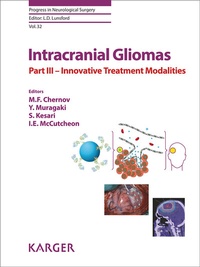
Intracranial Gliomas Part III - Innovative Treatment Modalities
1st Edition
Published on 10. July 2018
222 pages
978-3-318-06063-8 (ISBN)
Available for download
Description

At present most intracranial gliomas are considered incurable with current treatment strategies, and the search for new modalities that may effectively control tumor growth continues. The chapters in this volume describe basic principles and therapeutic possibilities of several innovative techniques, including photodynamic therapy, laser-induced interstitial thermotherapy, stereotactic cryodestruction, high-intensity focused ultrasound ablation, boron neutron capture therapy, proton and carbon ion irradiation, targeted therapy, immunotherapy, gene therapy, local chemotherapy, and alternating electric fields therapy. Potential applications of extracellular vesicles and nanotechnology for management of gliomas are highlighted as well. Many of these methods have already demonstrated antitumor efficacy in clinical testing, whereas others are still under development. The materials presented in this book are mainly directed at clinicians treating patients with brain tumors, as well as clinical and basic researchers working in the field of neuro-oncology.
More details
Other editions
Additional editions
Mikhail F. Chernov | Yoshihiro Muragaki | Santosh Kesari
Intracranial Gliomas Part III - Innovative Treatment Modalities
Book
07/2018
1st Edition
S. Karger
€216.15
Article exhausted; check different version
Persons
Content
- Cover
- Front Matter
- Contents
- Series Editor's Note
- Preface
- Photodynamic Therapy of Malignant Gliomas
- Abstract
- Introduction
- Basic Principles of Photodynamic Therapy
- Current Status of Photodynamic Therapy for Malignant Gliomas
- Personal Experience with Photodynamic Therapy of Gliomas
- Safety of Photodynamic Therapy
- Conclusion
- Acknowledgments
- Disclosure Statement
- References
- Laser-Induced Interstitial Thermotherapy of Gliomas
- Abstract
- Introduction
- Basic Principles
- Neurobiological Effects
- Role of Intraoperative MRI during LITT
- Main Technological Systems for LITT
- Systematic Review of Clinical Results of LITT for Intracranial Gliomas
- Conclusions
- Disclosure Statement
- References
- Stereotactic Cryodestruction of Gliomas
- Abstract
- Introduction
- Rationale for Stereotactic Cryodestruction of Intracranial Gliomas
- Personal Experience with Stereotactic Cryodestruction of Intracranial Gliomas
- Advantages and Limitations of Stereotactic Cryodestruction of Gliomas
- Conclusion
- Disclosure Statement
- References
- High-Intensity Focused Ultrasound Ablation Therapy of Gliomas
- Abstract
- Introduction
- Ultrasound
- Ultrasound Systems for Clinical Treatments
- Clinical Experience with HIFU Ablative Therapy
- Conclusion
- Disclosure Statement
- References
- Boron Neutron Capture Therapy of Malignant Gliomas
- Abstract
- Introduction
- Basic Principles of BNCT
- Clinical Results of BNCT of Malignant Gliomas
- Recent Developments: From Nuclear Reactors to Accelerators
- Conclusion
- Disclosure Statement
- References
- Proton and Carbon Ion Therapy of Intracranial Gliomas
- Abstract
- Introduction
- Standard Fractionated Radiotherapy of Intracranial Gliomas
- Rationale for Particle Therapy of Gliomas
- Comparison of Proton and Carbon Ion Radiotherapy
- Clinical Results of Particle Therapy for Intracranial Gliomas
- Conclusion
- Disclosure Statement
- References
- Novel and Prospective Molecular Targets for Therapy of Intracranial Gliomas
- Abstract
- Introduction
- Inhibitors of Growth Factor Receptors
- Inhibitors of Intracellular Signaling Pathways
- Alterations in Tumor Metabolism
- Anti-Invasion Strategies
- Other Molecular Targets and Agents
- Summary and Conclusion
- Disclosure Statement
- References
- Cytokine Therapy of Gliomas
- Abstract
- Introduction
- Cytokines and Cytokine Therapies
- Interferon-Based Therapies
- Conclusion
- Disclosure Statement
- References
- Cell-Based Immunotherapy of Gliomas
- Abstract
- Introduction
- Passive Cellular Immunotherapy with Adoptive Cell Transfer
- Active Cellular Immunotherapy with Dendritic Cell-Based Vaccines
- Conclusions
- Disclosure Statement
- References
- Vaccine Therapy of High-Grade Gliomas
- Abstract
- Introduction
- Vaccine Therapies for High-Grade Gliomas
- Role of Vaccines in Combination Therapy of High-Grade Gliomas
- Conclusion
- Disclosure Statement
- References
- Gene Therapy and Virotherapy of Gliomas
- Abstract
- Introduction
- Common Delivery Vehicles for Gene Therapy
- Common Viruses for Oncolytic Virotherapy of Gliomas
- Therapeutic Genes for Treatment of Gliomas
- Combinatorial Therapy: Oncolytic Viruses Carrying Therapeutic Gene(s)
- Potential Advantages of Gene Therapy and Virotherapy
- Conclusion
- Acknowledgment
- Disclosure Statement
- References
- Stem Cell Therapy of Gliomas
- Abstract
- Introduction
- Definition of Stem Cells
- Classification of Stem Cells
- Clinical Applications of Stem Cells: Overview
- Stem Cells in Brain Tumor Therapy: Types, History, and Rationale
- Types of Therapeutic Cargo
- Administration Routes of Stem Cell Therapy in Clinical Applications
- Clinical Trials
- Conclusions
- Acknowledgments
- Disclosure Statement
- References
- Convection-Enhanced Delivery for Management of Malignant Gliomas
- Abstract
- Introduction
- Convection-Enhanced Delivery
- Conclusion
- Disclosure Statement
- References
- Targeted Local Therapy for Management ofIntracranial High-Grade Gliomas
- Abstract
- Introduction
- Intratumoral Injections and Infusions
- Convection-Enhanced Delivery
- Nanocarriers
- Gels
- Microchips
- Polymers
- Conclusion
- Disclosure Statement
- References
- Extracellular Vesicles as a Platform for Glioma Therapeutic Development
- Abstract
- Introduction
- Definitions
- Methods of EV Purification and Characterization
- EV as a Basis for Glioma Therapy
- Conclusion
- Disclosure Statement
- References
- Alternating Electric Fields Therapy for Malignant Gliomas: From Bench Observation to Clinical Reality
- Abstract
- Introduction
- Basic Mechanisms of TTFields Therapy
- Distribution of TTFields within the Brain
- Clinical Results of TTFields Therapy of Intracranial Gliomas
- Conclusion
- Disclosure Statement
- References
- Perspectives of Nanotechnology in the Management of Gliomas
- Abstract
- Introduction
- Molecular Imaging
- Instrumentation for Fluorescence Nanoscopy
- Toward Clinical Applications
- Current Limitations and Future Perspectives
- Conclusion
- Disclosure Statement
- Acknowledgments
- References
- Author Index
- Subject Index
- Cover

