

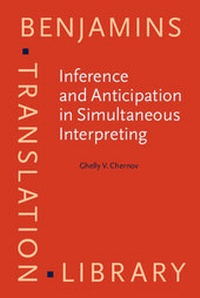
Inference and Anticipation in Simultaneous Interpreting
A probability-prediction model
1st Edition
Published on 23. December 2004
XXX, 268 pages
978-90-272-9498-2 (ISBN)
Description

Until now, Ghelly Chernov's work on the theory of simultaneous interpretation (SI) was mostly accessible only to a Russian-speaking readership. Finally, Chernov's major work, originally published in Russia in 1987 under the title ?????? ??????????? ???????? (Introduction to Simultaneous Interpretation) and widely considered a classic in interpretation theory, is now available in English as well. Adopting a psycholinguistic approach to professional SI, Chernov defines it as a task performed in a single pass concurrently with the source language speech, under extreme perception and production conditions in which only a limited amount of information can be processed at any given time.
Being both a researcher and a practitioner, Chernov drew from a rich interpreting corpus to create the first comprehensive model of simultaneous interpretation. His model draws on semantics, pragmatics, Russian Activity Theory and the SI communicative situation to formulate the principles of objective and subjective redundancy and identify probability prediction as the enabling mechanism of SI. Edited with notes and a critical foreword by two active SI researchers, Robin Setton and Adelina Hild, this book will be useful to practicing interpreters in providing a theoretical basis for appreciating the syntactic and other devices that can be used by both students and experienced interpreters in fine-tuning their performance in the booth.
Being both a researcher and a practitioner, Chernov drew from a rich interpreting corpus to create the first comprehensive model of simultaneous interpretation. His model draws on semantics, pragmatics, Russian Activity Theory and the SI communicative situation to formulate the principles of objective and subjective redundancy and identify probability prediction as the enabling mechanism of SI. Edited with notes and a critical foreword by two active SI researchers, Robin Setton and Adelina Hild, this book will be useful to practicing interpreters in providing a theoretical basis for appreciating the syntactic and other devices that can be used by both students and experienced interpreters in fine-tuning their performance in the booth.
More details
Other editions
Additional editions
Ghelly V. Chernov | Robin Setton | Adelina Hild
Inference and Anticipation in Simultaneous Interpreting
A probability-prediction model
Book
12/2004
John Benjamins Publishing Co
€121.90
Shipment within 10-15 days
Content
- Inference and Anticipation in Simultaneous Interpreting
- Editorial page
- Title page
- LCC page
- Table of contents
- Editors' critical foreword
- The probability prediction model and Chernov's contribution to interpreting studies: A critical evaluation
- The theoretical framework: Eclecticism and interdisciplinarity
- Methodology
- Convergences with other models
- Conclusion
- Editing policy
- Editors' acknowledgements
- Notes
- References
- Foreword
- Abbreviations and symbols
- 1. The psycholinguistic approach to SI research
- 1. SI and the linguistic theory of translation
- 2. The methodological basis of a psycholinguistic approach to SI
- Research assumptions on SI processes
- 3. The object of SI psycholinguistic research
- 2. Speed, memory and simultaneity
- 4. Simultaneity in SI
- 5. Time constraints
- 6. Externally controlled pace of activity
- 7. Recited texts vs. improvised discourse
- 3. The semantic and pragmatic structure of discourse
- 8. Word meaning
- 9. Polysemy and synonymy in discourse
- 10. Componential analysis of meaning
- 11. Semantic agreement: A combinatory law of discourse
- 12. Semantic redundancy in discourse
- 13. Semantic redundancy in discourse: An example
- 4. Semantic structure and objective semantic redundancy
- 14. The concept of sense
- 15. Theme of communication, object of an utterance, and foregrounding
- 16. The semantic structure of discourse and its basic components
- 17. Semantic structure as the object and product of SI
- 5. Communicative context and subjective redundancy
- 18. Implicit sense and inference
- 19. Linguistic inference
- 20. Cognitive inference
- 21. Situational inference
- 22. Pragmatic inference
- 23. The communicative situation of simultaneous interpretation
- 23.1. Sources of cognitive inference
- 23.2. Sources of situational inference
- 23.3. Sources of pragmatic inference
- 23.4. Factor F (`Forum') as a variable
- 24. Discourse equivalent9
- 25. Interdependence of situation and semantic structure in inferencing
- 26. Situational factors in comprehension: An illustration
- 6. A probability anticipation model for SI
- 27. The principle of anticipatory reflection of reality
- 28. Message development probability anticipation
- 29. Multilevel redundancy and probability anticipation
- 30. Cumulative dynamic analysis (CDA) and the range of probability anticipation
- 31. Towards the internal programme for the TL utterance
- 7. Theme and compression
- 32. The thematic (referential) component of discourse in SI
- 33. Redundancy in Spanish public speaking
- 34. Types of speech compression in SI
- 8. Rheme and information density
- 35. Perception by information density peaks
- 36. Loss of information due to a missed rheme
- 37. Strong rheme, weak rheme, chain of referents
- 38. The dominant evaluative rheme in a political discourse
- 39. Rendering the evaluative component in SI
- 9. Syntax and communicative word order
- 40. The internal programme for the TL utterance: Whole or broken?
- 41. Word order and communicative syntax
- 42. Syntactic complexity, logical sequence and working memory
- 43. Short and extended predicates
- 10. SI and Anokhin's theory of activity
- 44. SI as a functional system
- 45. Probability anticipation as a multilevel mechanism
- 46. Self-monitoring or feedback
- 47. The efficiency of the SI communicative act and the SI invariant
- 11. Anticipation and SI
- 12. Conclusion
- Notes
- -24pt
- Chapter 2
- -24pt
- Chapter 3
- -24pt
- Chapter 4
- -24pt
- Chapter 5
- -24pt
- Chapter 6
- -24pt
- Chapter 7
- -24pt
- Chapter 8
- -24pt
- Chapter 9
- -24pt
- Chapter 10
- -24pt
- Chapter 11
- -24pt
- References
- Appendix B
- Note
- Appendix C
- Name index
- Subject index
- The series Benjamins Translation Library
